CAT 2024 Slot 2 — DILR
All 22 DILR questions from CAT 2024 Slot 2, with the answer key and detailed solutions. Practise free — check answers as you go, or tap Show solution.
CAT 2024 Slot 2 · DILR
Passage / Data
Answer the following questions based on the information given below.
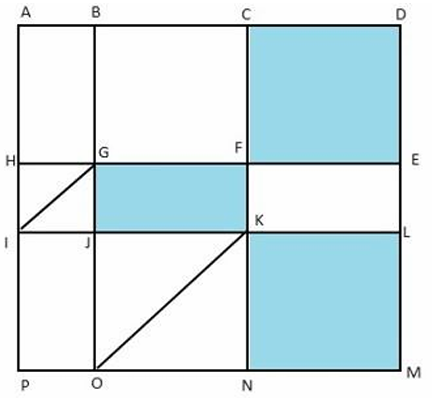
The above is a schematic diagram of walkways (indicated by all the straight-lines) and lakes (3 of them, each in the shape of rectangles – shaded in the diagram) of a gated area. Different points on the walkway are indicated by letters (A through P) with distances being OP = 150 m, ON = MN = 300 m, ML = 400 m, EL = 200 m, DE = 400 m.
The following additional information about the facilities in the area is known.
1. The only entry/exit point is at C.
2. There are many residences within the gated area; all of them are located on the path AH and ML with four of them being at A, H, M, and L.
3. The post office is located at P and the bank is located at B.
| Segment | Length (m) | Segment | Length (m) |
|---|---|---|---|
| AB, HG, IJ, PO | 150 | HI, GJ, FK, EL | 200 |
| BC, CD | 300 | GF, FE | 300 |
| JK, KL | 300 | ON, NM | 300 |
| AH, IP, BG, JO | 400 | CF, KN, DE, LM | 400 |
| GI (diagonal) | 250 | OK (diagonal) | 500 |
Coordinates (m), origin at P, taking the grid columns at x = 0, 150, 450, 750 and rows at y = 0, 400, 600, 1000: A(0,1000) B(150,1000) C(450,1000) D(750,1000); H(0,600) G(150,600) F(450,600) E(750,600); I(0,400) J(150,400) K(450,400) L(750,400); P(0,0) O(150,0) N(450,0) M(750,0). Lakes: C-D-E-F, G-F-K-J, K-L-M-N.
One resident whose house is located at L, needs to visit the post office as well as the bank. What is the minimum distance (in m) he has to walk starting from his residence and returning to his residence after visiting both the post office and the bank?
Passage / Data
Answer the following questions based on the information given below.
The above is a schematic diagram of walkways (indicated by all the straight-lines) and lakes (3 of them, each in the shape of rectangles – shaded in the diagram) of a gated area. Different points on the walkway are indicated by letters (A through P) with distances being OP = 150 m, ON = MN = 300 m, ML = 400 m, EL = 200 m, DE = 400 m.
The following additional information about the facilities in the area is known.
1. The only entry/exit point is at C.
2. There are many residences within the gated area; all of them are located on the path AH and ML with four of them being at A, H, M, and L.
3. The post office is located at P and the bank is located at B.
| Segment | Length (m) | Segment | Length (m) |
|---|---|---|---|
| AB, HG, IJ, PO | 150 | HI, GJ, FK, EL | 200 |
| BC, CD | 300 | GF, FE | 300 |
| JK, KL | 300 | ON, NM | 300 |
| AH, IP, BG, JO | 400 | CF, KN, DE, LM | 400 |
| GI (diagonal) | 250 | OK (diagonal) | 500 |
Coordinates (m), origin at P, taking the grid columns at x = 0, 150, 450, 750 and rows at y = 0, 400, 600, 1000: A(0,1000) B(150,1000) C(450,1000) D(750,1000); H(0,600) G(150,600) F(450,600) E(750,600); I(0,400) J(150,400) K(450,400) L(750,400); P(0,0) O(150,0) N(450,0) M(750,0). Lakes: C-D-E-F, G-F-K-J, K-L-M-N.
One person enters the gated area and decides to walk as much as possible before leaving the area without walking along any path more than once and always walking next to one of the lakes. Note that he may cross a point multiple times. How much distance (in m) will he walk within the gated area?
Passage / Data
Answer the following questions based on the information given below.
The above is a schematic diagram of walkways (indicated by all the straight-lines) and lakes (3 of them, each in the shape of rectangles – shaded in the diagram) of a gated area. Different points on the walkway are indicated by letters (A through P) with distances being OP = 150 m, ON = MN = 300 m, ML = 400 m, EL = 200 m, DE = 400 m.
The following additional information about the facilities in the area is known.
1. The only entry/exit point is at C.
2. There are many residences within the gated area; all of them are located on the path AH and ML with four of them being at A, H, M, and L.
3. The post office is located at P and the bank is located at B.
| Segment | Length (m) | Segment | Length (m) |
|---|---|---|---|
| AB, HG, IJ, PO | 150 | HI, GJ, FK, EL | 200 |
| BC, CD | 300 | GF, FE | 300 |
| JK, KL | 300 | ON, NM | 300 |
| AH, IP, BG, JO | 400 | CF, KN, DE, LM | 400 |
| GI (diagonal) | 250 | OK (diagonal) | 500 |
Coordinates (m), origin at P, taking the grid columns at x = 0, 150, 450, 750 and rows at y = 0, 400, 600, 1000: A(0,1000) B(150,1000) C(450,1000) D(750,1000); H(0,600) G(150,600) F(450,600) E(750,600); I(0,400) J(150,400) K(450,400) L(750,400); P(0,0) O(150,0) N(450,0) M(750,0). Lakes: C-D-E-F, G-F-K-J, K-L-M-N.
One resident takes a walk within the gated area starting from A and returning to A without going through any point (other than A) more than once. What is the maximum distance (in m) she can walk in this way?
Passage / Data
Answer the following questions based on the information given below.
The above is a schematic diagram of walkways (indicated by all the straight-lines) and lakes (3 of them, each in the shape of rectangles – shaded in the diagram) of a gated area. Different points on the walkway are indicated by letters (A through P) with distances being OP = 150 m, ON = MN = 300 m, ML = 400 m, EL = 200 m, DE = 400 m.
The following additional information about the facilities in the area is known.
1. The only entry/exit point is at C.
2. There are many residences within the gated area; all of them are located on the path AH and ML with four of them being at A, H, M, and L.
3. The post office is located at P and the bank is located at B.
| Segment | Length (m) | Segment | Length (m) |
|---|---|---|---|
| AB, HG, IJ, PO | 150 | HI, GJ, FK, EL | 200 |
| BC, CD | 300 | GF, FE | 300 |
| JK, KL | 300 | ON, NM | 300 |
| AH, IP, BG, JO | 400 | CF, KN, DE, LM | 400 |
| GI (diagonal) | 250 | OK (diagonal) | 500 |
Coordinates (m), origin at P, taking the grid columns at x = 0, 150, 450, 750 and rows at y = 0, 400, 600, 1000: A(0,1000) B(150,1000) C(450,1000) D(750,1000); H(0,600) G(150,600) F(450,600) E(750,600); I(0,400) J(150,400) K(450,400) L(750,400); P(0,0) O(150,0) N(450,0) M(750,0). Lakes: C-D-E-F, G-F-K-J, K-L-M-N.
Visitors coming for morning walks are allowed to enter as long as they do not pass by any of the residences and do not cross any point (except C) more than once. What is the maximum distance (in m) that such a visitor can walk within the gated area?
Passage / Data
Answer the following questions based on the information given below.
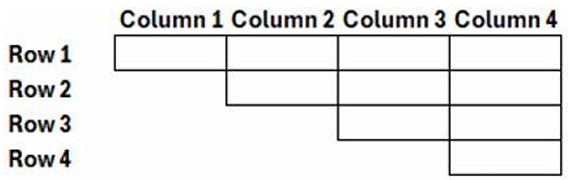
The numbers 1, 2, 3, 4, 5, 6, 7, 8, 9, and 10 are placed in ten slots of the following grid based on the conditions below.
| Column 1 | Column 2 | Column 3 | Column 4 | |
|---|---|---|---|---|
| Row 1 | □ | □ | □ | □ |
| Row 2 | □ | □ | □ | |
| Row 3 | □ | □ | ||
| Row 4 | □ |
(Row 1 has 4 slots in Columns 1–4; Row 2 has 3 slots in Columns 2–4; Row 3 has 2 slots in Columns 3–4; Row 4 has 1 slot in Column 4 — ten slots in all.)
1. Numbers in any row appear in an increasing order from left to right.
2. Numbers in any column appear in a decreasing order from top to bottom.
3. 1 is placed either in the same row or in the same column as 10.
4. Neither 2 nor 3 is placed in the same row or in the same column as 10.
5. Neither 7 nor 8 is placed in the same row or in the same column as 9.
6. 4 and 6 are placed in the same row.
What is the row number which has the least sum of numbers placed in that row?
Passage / Data
Answer the following questions based on the information given below.
The numbers 1, 2, 3, 4, 5, 6, 7, 8, 9, and 10 are placed in ten slots of the following grid based on the conditions below.
| Column 1 | Column 2 | Column 3 | Column 4 | |
|---|---|---|---|---|
| Row 1 | □ | □ | □ | □ |
| Row 2 | □ | □ | □ | |
| Row 3 | □ | □ | ||
| Row 4 | □ |
(Row 1 has 4 slots in Columns 1–4; Row 2 has 3 slots in Columns 2–4; Row 3 has 2 slots in Columns 3–4; Row 4 has 1 slot in Column 4 — ten slots in all.)
1. Numbers in any row appear in an increasing order from left to right.
2. Numbers in any column appear in a decreasing order from top to bottom.
3. 1 is placed either in the same row or in the same column as 10.
4. Neither 2 nor 3 is placed in the same row or in the same column as 10.
5. Neither 7 nor 8 is placed in the same row or in the same column as 9.
6. 4 and 6 are placed in the same row.
Which of the following statements MUST be true?
I. 10 is placed in a slot in Row 1.
II. 1 is placed in a slot in Row 4.
Passage / Data
Answer the following questions based on the information given below.
The numbers 1, 2, 3, 4, 5, 6, 7, 8, 9, and 10 are placed in ten slots of the following grid based on the conditions below.
| Column 1 | Column 2 | Column 3 | Column 4 | |
|---|---|---|---|---|
| Row 1 | □ | □ | □ | □ |
| Row 2 | □ | □ | □ | |
| Row 3 | □ | □ | ||
| Row 4 | □ |
(Row 1 has 4 slots in Columns 1–4; Row 2 has 3 slots in Columns 2–4; Row 3 has 2 slots in Columns 3–4; Row 4 has 1 slot in Column 4 — ten slots in all.)
1. Numbers in any row appear in an increasing order from left to right.
2. Numbers in any column appear in a decreasing order from top to bottom.
3. 1 is placed either in the same row or in the same column as 10.
4. Neither 2 nor 3 is placed in the same row or in the same column as 10.
5. Neither 7 nor 8 is placed in the same row or in the same column as 9.
6. 4 and 6 are placed in the same row.
Which of the following statements MUST be true?
I. 2 is placed in a slot in Column 2.
II. 3 is placed in a slot in Column 3.
Passage / Data
Answer the following questions based on the information given below.
The numbers 1, 2, 3, 4, 5, 6, 7, 8, 9, and 10 are placed in ten slots of the following grid based on the conditions below.
| Column 1 | Column 2 | Column 3 | Column 4 | |
|---|---|---|---|---|
| Row 1 | □ | □ | □ | □ |
| Row 2 | □ | □ | □ | |
| Row 3 | □ | □ | ||
| Row 4 | □ |
(Row 1 has 4 slots in Columns 1–4; Row 2 has 3 slots in Columns 2–4; Row 3 has 2 slots in Columns 3–4; Row 4 has 1 slot in Column 4 — ten slots in all.)
1. Numbers in any row appear in an increasing order from left to right.
2. Numbers in any column appear in a decreasing order from top to bottom.
3. 1 is placed either in the same row or in the same column as 10.
4. Neither 2 nor 3 is placed in the same row or in the same column as 10.
5. Neither 7 nor 8 is placed in the same row or in the same column as 9.
6. 4 and 6 are placed in the same row.
For how many slots in the grid, placement of numbers CANNOT be determined with certainty?
Passage / Data
Answer the following questions based on the information given below.
The numbers 1, 2, 3, 4, 5, 6, 7, 8, 9, and 10 are placed in ten slots of the following grid based on the conditions below.
| Column 1 | Column 2 | Column 3 | Column 4 | |
|---|---|---|---|---|
| Row 1 | □ | □ | □ | □ |
| Row 2 | □ | □ | □ | |
| Row 3 | □ | □ | ||
| Row 4 | □ |
(Row 1 has 4 slots in Columns 1–4; Row 2 has 3 slots in Columns 2–4; Row 3 has 2 slots in Columns 3–4; Row 4 has 1 slot in Column 4 — ten slots in all.)
1. Numbers in any row appear in an increasing order from left to right.
2. Numbers in any column appear in a decreasing order from top to bottom.
3. 1 is placed either in the same row or in the same column as 10.
4. Neither 2 nor 3 is placed in the same row or in the same column as 10.
5. Neither 7 nor 8 is placed in the same row or in the same column as 9.
6. 4 and 6 are placed in the same row.
What is the sum of the numbers placed in Column 4?
Passage / Data
Answer the following questions based on the information given below.
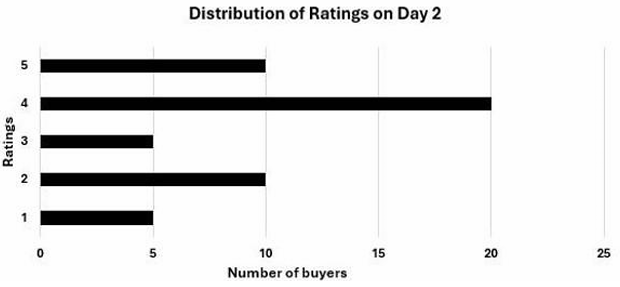
An online e-commerce firm receives daily integer product ratings from 1 through 5 given by buyers. The daily average is the average of the ratings given on that day. The cumulative average is the average of all ratings given on or before that day. The rating system began on Day 1, and the cumulative averages were 3 and 3.1 at the end of Day 1 and Day 2, respectively. The distribution of ratings on Day 2 is given in the figure below.
| Rating (Day 2) | 1 | 2 | 3 | 4 | 5 |
|---|---|---|---|---|---|
| Number of buyers | 5 | 10 | 5 | 20 | 10 |
The following information is known about ratings on Day 3.
1. 100 buyers gave product ratings on Day 3.
2. The modes of the product ratings were 4 and 5.
3. The numbers of buyers giving each product rating are non-zero multiples of 10.
4. The same number of buyers gave product ratings of 1 and 2, and that number is half the number of buyers who gave a rating of 3.
How many buyers gave ratings on Day 1?
Passage / Data
Answer the following questions based on the information given below.
An online e-commerce firm receives daily integer product ratings from 1 through 5 given by buyers. The daily average is the average of the ratings given on that day. The cumulative average is the average of all ratings given on or before that day. The rating system began on Day 1, and the cumulative averages were 3 and 3.1 at the end of Day 1 and Day 2, respectively. The distribution of ratings on Day 2 is given in the figure below.
| Rating (Day 2) | 1 | 2 | 3 | 4 | 5 |
|---|---|---|---|---|---|
| Number of buyers | 5 | 10 | 5 | 20 | 10 |
The following information is known about ratings on Day 3.
1. 100 buyers gave product ratings on Day 3.
2. The modes of the product ratings were 4 and 5.
3. The numbers of buyers giving each product rating are non-zero multiples of 10.
4. The same number of buyers gave product ratings of 1 and 2, and that number is half the number of buyers who gave a rating of 3.
What is the daily average rating of Day 3?
Passage / Data
Answer the following questions based on the information given below.
An online e-commerce firm receives daily integer product ratings from 1 through 5 given by buyers. The daily average is the average of the ratings given on that day. The cumulative average is the average of all ratings given on or before that day. The rating system began on Day 1, and the cumulative averages were 3 and 3.1 at the end of Day 1 and Day 2, respectively. The distribution of ratings on Day 2 is given in the figure below.
| Rating (Day 2) | 1 | 2 | 3 | 4 | 5 |
|---|---|---|---|---|---|
| Number of buyers | 5 | 10 | 5 | 20 | 10 |
The following information is known about ratings on Day 3.
1. 100 buyers gave product ratings on Day 3.
2. The modes of the product ratings were 4 and 5.
3. The numbers of buyers giving each product rating are non-zero multiples of 10.
4. The same number of buyers gave product ratings of 1 and 2, and that number is half the number of buyers who gave a rating of 3.
What is the median of all ratings given on Day 3?
Passage / Data
Answer the following questions based on the information given below.
An online e-commerce firm receives daily integer product ratings from 1 through 5 given by buyers. The daily average is the average of the ratings given on that day. The cumulative average is the average of all ratings given on or before that day. The rating system began on Day 1, and the cumulative averages were 3 and 3.1 at the end of Day 1 and Day 2, respectively. The distribution of ratings on Day 2 is given in the figure below.
| Rating (Day 2) | 1 | 2 | 3 | 4 | 5 |
|---|---|---|---|---|---|
| Number of buyers | 5 | 10 | 5 | 20 | 10 |
The following information is known about ratings on Day 3.
1. 100 buyers gave product ratings on Day 3.
2. The modes of the product ratings were 4 and 5.
3. The numbers of buyers giving each product rating are non-zero multiples of 10.
4. The same number of buyers gave product ratings of 1 and 2, and that number is half the number of buyers who gave a rating of 3.
Which of the following is true about the cumulative average ratings of Day 2 and Day 3?
Passage / Data
Answer the following questions based on the information given below.
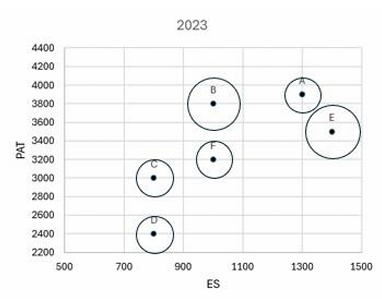
The two plots below give the following information about six firms A, B, C, D, E, and F for 2019 and 2023.
PAT: The firm’s profits after taxes in Rs. crores,
ES: The firm’s employee strength, that is the number of employees in the firm, and
PRD: The percentage of the firm’s PAT that they spend on Research and Development (R&D).
In the plots, the horizontal and vertical coordinates of the point representing each firm give their ES and PAT values respectively. The PRD values of each firm are proportional to the areas around the points representing each firm. The areas are comparable between the two plots, i.e., equal areas in the two plots represent the same PRD values for the two years.
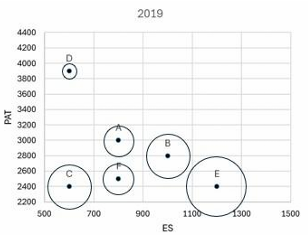
Approximate 2019 readings (ES on the horizontal axis, PAT on the vertical axis; bubble size ∝ PRD):
| Firm (2019) | ES (approx.) | PAT (approx.) | Bubble size (PRD) |
|---|---|---|---|
| A | 800 | 3000 | medium |
| B | 1000 | 2800 | medium-large |
| C | 600 | 2400 | medium |
| D | 600 | 3900 | small |
| E | 1200 | 2500 | large |
| F | 800 | 2500 | small |
Assume that the annual rate of growth in PAT over the previous year (ARG) remained constant over the years for each of the six firms. Which among the firms A, B, C, and E had the highest ARG?
Passage / Data
Answer the following questions based on the information given below.
The two plots below give the following information about six firms A, B, C, D, E, and F for 2019 and 2023.
PAT: The firm’s profits after taxes in Rs. crores,
ES: The firm’s employee strength, that is the number of employees in the firm, and
PRD: The percentage of the firm’s PAT that they spend on Research and Development (R&D).
In the plots, the horizontal and vertical coordinates of the point representing each firm give their ES and PAT values respectively. The PRD values of each firm are proportional to the areas around the points representing each firm. The areas are comparable between the two plots, i.e., equal areas in the two plots represent the same PRD values for the two years.
Approximate 2019 readings (ES on the horizontal axis, PAT on the vertical axis; bubble size ∝ PRD):
| Firm (2019) | ES (approx.) | PAT (approx.) | Bubble size (PRD) |
|---|---|---|---|
| A | 800 | 3000 | medium |
| B | 1000 | 2800 | medium-large |
| C | 600 | 2400 | medium |
| D | 600 | 3900 | small |
| E | 1200 | 2500 | large |
| F | 800 | 2500 | small |
The ratio of the amount of money spent by Firm C on R&D in 2019 to that in 2023 is closest to
Passage / Data
Answer the following questions based on the information given below.
The two plots below give the following information about six firms A, B, C, D, E, and F for 2019 and 2023.
PAT: The firm’s profits after taxes in Rs. crores,
ES: The firm’s employee strength, that is the number of employees in the firm, and
PRD: The percentage of the firm’s PAT that they spend on Research and Development (R&D).
In the plots, the horizontal and vertical coordinates of the point representing each firm give their ES and PAT values respectively. The PRD values of each firm are proportional to the areas around the points representing each firm. The areas are comparable between the two plots, i.e., equal areas in the two plots represent the same PRD values for the two years.
Approximate 2019 readings (ES on the horizontal axis, PAT on the vertical axis; bubble size ∝ PRD):
| Firm (2019) | ES (approx.) | PAT (approx.) | Bubble size (PRD) |
|---|---|---|---|
| A | 800 | 3000 | medium |
| B | 1000 | 2800 | medium-large |
| C | 600 | 2400 | medium |
| D | 600 | 3900 | small |
| E | 1200 | 2500 | large |
| F | 800 | 2500 | small |
Which among the firms A, C, E, and F had the maximum PAT per employee in 2023?
Passage / Data
Answer the following questions based on the information given below.
The two plots below give the following information about six firms A, B, C, D, E, and F for 2019 and 2023.
PAT: The firm’s profits after taxes in Rs. crores,
ES: The firm’s employee strength, that is the number of employees in the firm, and
PRD: The percentage of the firm’s PAT that they spend on Research and Development (R&D).
In the plots, the horizontal and vertical coordinates of the point representing each firm give their ES and PAT values respectively. The PRD values of each firm are proportional to the areas around the points representing each firm. The areas are comparable between the two plots, i.e., equal areas in the two plots represent the same PRD values for the two years.
Approximate 2019 readings (ES on the horizontal axis, PAT on the vertical axis; bubble size ∝ PRD):
| Firm (2019) | ES (approx.) | PAT (approx.) | Bubble size (PRD) |
|---|---|---|---|
| A | 800 | 3000 | medium |
| B | 1000 | 2800 | medium-large |
| C | 600 | 2400 | medium |
| D | 600 | 3900 | small |
| E | 1200 | 2500 | large |
| F | 800 | 2500 | small |
Which among the firms C, D, E, and F had the least amount of R&D spending per employee in 2023?
Passage / Data
Answer the following questions based on the information given below.
Eight gymnastics players numbered 1 through 8 underwent a training camp where they were coached by three coaches - Xena, Yuki, and Zara. Each coach trained at least two players. Yuki trained only even numbered players, while Zara trained only odd numbered players. After the camp, the coaches evaluated the players and gave integer ratings to the respective players trained by them on a scale of 1 to 7, with 1 being the lowest rating and 7 the highest.
The following additional information is known.
1. Xena trained more players than Yuki.
2. Player-1 and Player-4 were trained by the same coach, while the coaches who trained Player-2, Player-3 and Player-5 were all different.
3. Player-5 and Player-7 were trained by the same coach and got the same rating. All other players got a unique rating.
4. The average of the ratings of all the players was 4.
5. Player-2 got the highest rating.
6. The average of the ratings of the players trained by Yuki was twice that of the players trained by Xena and two more than that of the players trained by Zara.
7. Player-4's rating was double of Player-8's and less than Player-5's.
What best can be concluded about the number of players coached by Zara?
Passage / Data
Answer the following questions based on the information given below.
Eight gymnastics players numbered 1 through 8 underwent a training camp where they were coached by three coaches - Xena, Yuki, and Zara. Each coach trained at least two players. Yuki trained only even numbered players, while Zara trained only odd numbered players. After the camp, the coaches evaluated the players and gave integer ratings to the respective players trained by them on a scale of 1 to 7, with 1 being the lowest rating and 7 the highest.
The following additional information is known.
1. Xena trained more players than Yuki.
2. Player-1 and Player-4 were trained by the same coach, while the coaches who trained Player-2, Player-3 and Player-5 were all different.
3. Player-5 and Player-7 were trained by the same coach and got the same rating. All other players got a unique rating.
4. The average of the ratings of all the players was 4.
5. Player-2 got the highest rating.
6. The average of the ratings of the players trained by Yuki was twice that of the players trained by Xena and two more than that of the players trained by Zara.
7. Player-4's rating was double of Player-8's and less than Player-5's.
What was the rating of Player-7?
Passage / Data
Answer the following questions based on the information given below.
Eight gymnastics players numbered 1 through 8 underwent a training camp where they were coached by three coaches - Xena, Yuki, and Zara. Each coach trained at least two players. Yuki trained only even numbered players, while Zara trained only odd numbered players. After the camp, the coaches evaluated the players and gave integer ratings to the respective players trained by them on a scale of 1 to 7, with 1 being the lowest rating and 7 the highest.
The following additional information is known.
1. Xena trained more players than Yuki.
2. Player-1 and Player-4 were trained by the same coach, while the coaches who trained Player-2, Player-3 and Player-5 were all different.
3. Player-5 and Player-7 were trained by the same coach and got the same rating. All other players got a unique rating.
4. The average of the ratings of all the players was 4.
5. Player-2 got the highest rating.
6. The average of the ratings of the players trained by Yuki was twice that of the players trained by Xena and two more than that of the players trained by Zara.
7. Player-4's rating was double of Player-8's and less than Player-5's.
What was the rating of Player-6?
Passage / Data
Answer the following questions based on the information given below.
Eight gymnastics players numbered 1 through 8 underwent a training camp where they were coached by three coaches - Xena, Yuki, and Zara. Each coach trained at least two players. Yuki trained only even numbered players, while Zara trained only odd numbered players. After the camp, the coaches evaluated the players and gave integer ratings to the respective players trained by them on a scale of 1 to 7, with 1 being the lowest rating and 7 the highest.
The following additional information is known.
1. Xena trained more players than Yuki.
2. Player-1 and Player-4 were trained by the same coach, while the coaches who trained Player-2, Player-3 and Player-5 were all different.
3. Player-5 and Player-7 were trained by the same coach and got the same rating. All other players got a unique rating.
4. The average of the ratings of all the players was 4.
5. Player-2 got the highest rating.
6. The average of the ratings of the players trained by Yuki was twice that of the players trained by Xena and two more than that of the players trained by Zara.
7. Player-4's rating was double of Player-8's and less than Player-5's.
For how many players the ratings can be determined with certainty?
Passage / Data
Answer the following questions based on the information given below.
Eight gymnastics players numbered 1 through 8 underwent a training camp where they were coached by three coaches - Xena, Yuki, and Zara. Each coach trained at least two players. Yuki trained only even numbered players, while Zara trained only odd numbered players. After the camp, the coaches evaluated the players and gave integer ratings to the respective players trained by them on a scale of 1 to 7, with 1 being the lowest rating and 7 the highest.
The following additional information is known.
1. Xena trained more players than Yuki.
2. Player-1 and Player-4 were trained by the same coach, while the coaches who trained Player-2, Player-3 and Player-5 were all different.
3. Player-5 and Player-7 were trained by the same coach and got the same rating. All other players got a unique rating.
4. The average of the ratings of all the players was 4.
5. Player-2 got the highest rating.
6. The average of the ratings of the players trained by Yuki was twice that of the players trained by Xena and two more than that of the players trained by Zara.
7. Player-4's rating was double of Player-8's and less than Player-5's.
Who all were the players trained by Xena?