CAT 1997 — QA
All 55 QA questions from CAT 1997, with the answer key and detailed solutions. Practise free — check answers as you go, or tap Show solution.
CAT 1997 · QA
Passage / Data
Answer the next 3 questions based on the following information.
A certain race is made up of three stretches: A, B and C, each 2 km long, and to be covered by a certain mode of transport. The following table gives these modes of transport for the stretches, and the minimum and maximum possible speeds (in km/hr) over these stretches. The speed over a particular stretch is assumed to be constant. The previous record for the race is 10 min.
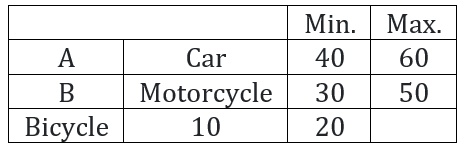
Anshuman travels at minimum speed by car over A and completes stretch B at the fastest speed. At what speed should he cover stretch C in order to break the previous record?
Passage / Data
Answer the next 3 questions based on the following information.
A certain race is made up of three stretches: A, B and C, each 2 km long, and to be covered by a certain mode of transport. The following table gives these modes of transport for the stretches, and the minimum and maximum possible speeds (in km/hr) over these stretches. The speed over a particular stretch is assumed to be constant. The previous record for the race is 10 min.
Mr Hare completes the first stretch at the minimum speed and takes the same time for stretch B. He takes 50% more time than the previous record to complete the race. What is Mr Hare's speed for the stretch C?
Passage / Data
Answer the next 3 questions based on the following information.
A certain race is made up of three stretches: A, B and C, each 2 km long, and to be covered by a certain mode of transport. The following table gives these modes of transport for the stretches, and the minimum and maximum possible speeds (in km/hr) over these stretches. The speed over a particular stretch is assumed to be constant. The previous record for the race is 10 min.
Mr Tortoise completes the race at an average speed of 20 km/hr. His average speed for the first two stretches is four times that for the last stretch. Find the speed over stretch C.
Passage / Data
Answer the next 3 questions based on the following information.
There are 60 students in a class. These students are divided into three groups A, B and C of 15, 20 and 25 students each. The groups A and C are combined to form group D.
What is the average weight of the students in group D?
Passage / Data
Answer the next 3 questions based on the following information.
There are 60 students in a class. These students are divided into three groups A, B and C of 15, 20 and 25 students each. The groups A and C are combined to form group D.
If one student from group A is shifted to group B, which of the following will be true?
Passage / Data
Answer the next 3 questions based on the following information.
There are 60 students in a class. These students are divided into three groups A, B and C of 15, 20 and 25 students each. The groups A and C are combined to form group D.
If all the students of the class have the same weight, then which of the following is false?
A student gets an aggregate of 60% marks in five subjects in the ratio 10 : 9 : 8 : 7 : 6. If the passing marks are 50% of the maximum marks and each subject has the same maximum marks, in how many subjects did he pass the examination?
In how many ways can eight directors, the vice chairman and chairman of a firm be seated at a round table, if the chairman has to sit between the vice chairman and a director?
After allowing a discount of 11.11%, a trader still makes a gain of 14.28%. At how many percentage above the cost price does he mark on his goods?
If n is an integer, how many values of n will give an integral value of ?
A dealer buys dry fruits at Rs. 100, Rs. 80 and Rs. 60 per kilogram. He mixes them in the ratio 3 : 4 : 5 by weight, and sells at a profit of 50%. At what price per kilogram does he sell the dry fruit?
Fresh grapes contain 90% water while dry grapes contain 20% water. What is the weight of dry grapes obtained from 20 kg fresh grapes?
An express train travelling at 80 km/hr overtakes a goods train, twice as long and going at 40 km/hr on a parallel track, in 54 s. How long will the express train take to cross a platform of 400 m long?
A student instead of finding the value of of a number, found the value of of the number. If his answer differed from the actual one by 770, find the number.
P and Q are two positive integers such that PQ = 64. Which of the following cannot be the value of P + Q?
The average marks of a student in 10 papers are 80. If the highest and the lowest scores are not considered, the average is 81. If his highest score is 92, find the lowest.
If the roots x1 and x2 of the quadratic equation x2 − 2x + c = 0 also satisfy the equation 7x2 – 4x1 = 47, then which of the following is true?
The sum of the areas of two circles, which touch each other externally, is 153π. If the sum of their radii is 15, find the ratio of the larger to the smaller radius.
If m and n are integers divisible by 5, which of the following is not necessarily true?
Passage / Data
Direction: Answer the questions based on the following information.
A survey of 200 people in a community who watched at least one of the three channels — BBC, CNN and DD — showed that 80% of the people watched DD, 22% watched BBC and 15% watched CNN.
What is the maximum percentage of people who can watch all the three channels?
Passage / Data
Direction: Answer the questions based on the following information.
A survey of 200 people in a community who watched at least one of the three channels — BBC, CNN and DD — showed that 80% of the people watched DD, 22% watched BBC and 15% watched CNN.
If 5% of people watched DD and CNN, 10% watched DD and BBC, then what percentage of people watched BBC and CNN only?
Passage / Data
Direction: Answer the questions based on the following information.
A survey of 200 people in a community who watched at least one of the three channels — BBC, CNN and DD — showed that 80% of the people watched DD, 22% watched BBC and 15% watched CNN.
Referring to the previous question, what percentage of people watched all the three channels?
A man earns x% on the first Rs. 2,000 and y% on the rest of his income. If he earns Rs. 700 from income of Rs. 4,000 and Rs. 900 from if his income is Rs. 5,000, find x%.
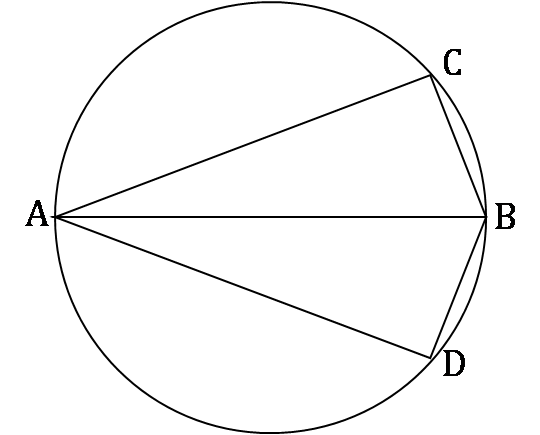
AB is the diameter of the given circle, while points C and D lie on the circumference as shown. If AB is 15 cm, AC is 12 cm and BD is 9 cm, find the area of the quadrilateral ACBD.
P, Q and R are three consecutive odd numbers in ascending order. If the value of three times P is 3 less than two times R, find the value of R.
Passage / Data
Direction: Answer the questions based on the following information.
For these questions the following functions have been defined.
la(x, y, z) = min(x + y, y + z)
le(x, y, z) = max (x − y, y − z)
ma(x, y, z) = [le(x, y, z) + la(x, y, z)]
Given that x > y > z > 0. Which of the following is necessarily true?
Passage / Data
Direction: Answer the questions based on the following information.
For these questions the following functions have been defined.
la(x, y, z) = min(x + y, y + z)
le(x, y, z) = max (x − y, y − z)
ma(x, y, z) = [le(x, y, z) + la(x, y, z)]
What is the value of ma(10, 4, le(la(10, 5, 3), 5, 3))?
Passage / Data
Direction: Answer the questions based on the following information.
For these questions the following functions have been defined.
la(x, y, z) = min(x + y, y + z)
le(x, y, z) = max (x − y, y − z)
ma(x, y, z) = [le(x, y, z) + la(x, y, z)]
For x = 15, y = 10 and z = 9 , find the value of le(x, min(y, x − z), le (9, 8, ma(x, y, z))).
ABC is a three-digit number in which A > 0. The value of ABC is equal to the sum of the factorials of its three digits. What is the value of B?
The adjoining figure shows a set of concentric squares. If the diagonal of the innermost square is 2 units, and if the distance between the corresponding corners of any two successive squares is 1 unit, find the difference between the areas of the eighth and the seventh squares, counting from the innermost square.

A, B and C are defined as follows.
A = 2.000004 ÷ [(2.000004)2 + (4.000008)]
B = 3.000003 ÷ [(3.000003)2 + (9.000009)]
C = 4.000002 ÷ [(4.000002)2 + (8.000004)]
Which of the following is true about the values of the above three expressions?
The value of each of a set of coins varies as the square of its diameter, if its thickness remains constant, and it varies as the thickness, if the diameter remains constant. If the diameter of two coins are in the ratio 4 : 3, what should be the ratio of their thickness if the value of the first is four times that of the second?
In ΔABC, points P, Q and R are the mid-points of sides AB, BC and CA respectively. If area of Δ ABC is 20 sq. units, find the area of Δ PQR.
In a rectangle, the difference between the sum of the adjacent sides and the diagonal is half the length of the longer side. What is the ratio of the shorter to the longer side?
Passage / Data
Answer the next 2 questions based on the following information.
The Weirdo Holiday Resort follows a particular system of holidays for its employees. People are given holidays on the days where the first letter of the day of the week is the same as the first letter of their names. All employees work at the same rate.
Raja starts working on February 25, 1996, and finishes the job on March 2, 1996. How much time would T and J take to finish the same job if both start on the same day as Raja?
Passage / Data
Answer the next 2 questions based on the following information.
The Weirdo Holiday Resort follows a particular system of holidays for its employees. People are given holidays on the days where the first letter of the day of the week is the same as the first letter of their names. All employees work at the same rate.
Starting on February 25, 1996, if Raja had finished his job on April 2, 1996, when would T and S together likely to have completed the job, had they started on the same day as Raja?
Passage / Data
Direction: Answer the questions based on the following information.
Boston is 4 hr ahead of Frankfurt and 2 hr behind India. X leaves Frankfurt at 6 p.m. on Friday and reaches Boston the next day. After waiting there for 2 hr, he leaves exactly at noon and reaches India at 1 a.m. On his return journey, he takes the same route as before, but halts at Boston for 1hr less than his previous halt there. He then proceeds to Frankfurt.
If his journey, including stoppage, is covered at an average speed of 180 mph, what is the distance between Frankfurt and India?
Passage / Data
Direction: Answer the questions based on the following information.
Boston is 4 hr ahead of Frankfurt and 2 hr behind India. X leaves Frankfurt at 6 p.m. on Friday and reaches Boston the next day. After waiting there for 2 hr, he leaves exactly at noon and reaches India at 1 a.m. On his return journey, he takes the same route as before, but halts at Boston for 1hr less than his previous halt there. He then proceeds to Frankfurt.
If X had started the return journey from India at 2.55 a.m. on the same day that he reached there, after how much time would he reach Frankfurt?
Passage / Data
Direction: Answer the questions based on the following information.
Boston is 4 hr ahead of Frankfurt and 2 hr behind India. X leaves Frankfurt at 6 p.m. on Friday and reaches Boston the next day. After waiting there for 2 hr, he leaves exactly at noon and reaches India at 1 a.m. On his return journey, he takes the same route as before, but halts at Boston for 1hr less than his previous halt there. He then proceeds to Frankfurt.
What is X's average speed for the entire journey (to and fro)?
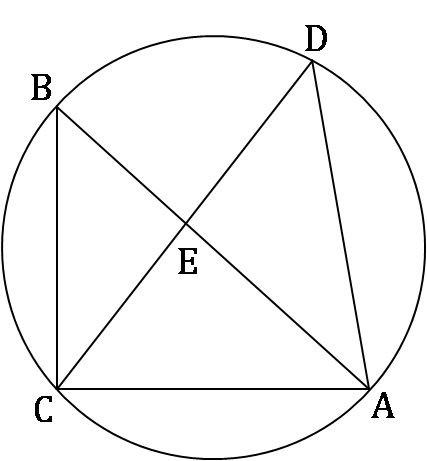
In the adjoining figure, points A, B, C and D lie on the circle. AD = 24 and BC = 12. What is the ratio of the area of Δ CBE to that of Δ ADE?
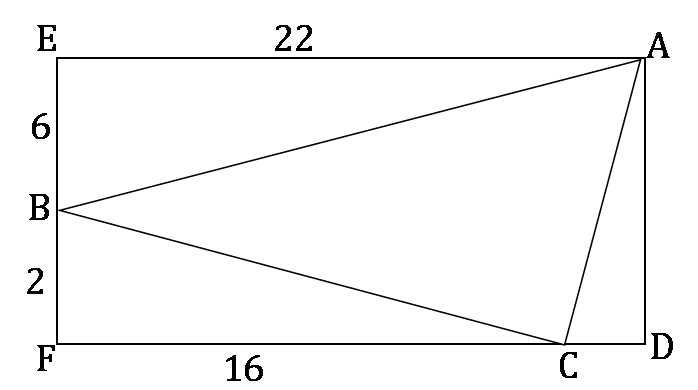
In the given figure, EADF is a rectangle and ABC is a triangle whose vertices lie on the sides of EADF and AE = 22, BE = 6, CF = 16 and BF = 2. Find the length of the line joining the mid-points of the sides AB and BC.
Passage / Data
Answer the next 2 questions based on the following information.
A thief, after committing the burglary, started fleeing at 12 noon, at a speed of 60 km/hr. He was then chased by a policeman X. X started the chase, 15 min after the thief had started, at a speed of 65 km/hr.
At what time did X catch the thief?
Passage / Data
Answer the next 2 questions based on the following information.
A thief, after committing the burglary, started fleeing at 12 noon, at a speed of 60 km/hr. He was then chased by a policeman X. X started the chase, 15 min after the thief had started, at a speed of 65 km/hr.
If another policeman had started the same chase along with X, but at a speed of 60 km/hr, then how far behind was he when X caught the thief?
Direction: Each of these items has a question followed by two statements, I and II. Mark the answer
1. if the question can be answered with the help of one statement alone.
2. if the question can be answered with the help of any one statement independently.
3. if the question can be answered with the help of both statements together.
4. if the question cannot be answered even with the help of both statements together.
What is the value of a3 + b3 ?
I. a2 + b2 = 22
II. ab = 3
Direction: Each of these items has a question followed by two statements, I and II. Mark the answer
1. if the question can be answered with the help of one statement alone.
2. if the question can be answered with the help of any one statement independently.
3. if the question can be answered with the help of both statements together.
4. if the question cannot be answered even with the help of both statements together.
Is the number completely divisible by 99?
I. The number is divisible by 9 and 11 simultaneously.
II. If the digits of the number are reversed, the number is divisible by 9 and 11.
Direction: Each of these items has a question followed by two statements, I and II. Mark the answer
1. if the question can be answered with the help of one statement alone.
2. if the question can be answered with the help of any one statement independently.
3. if the question can be answered with the help of both statements together.
4. if the question cannot be answered even with the help of both statements together.
A person is walking from Mali to Pali, which lies to its north-east. What is the distance between Mali and Pali?
I. When the person has covered the distance, he is 3 km east and 1 km north of Mali.
II. When the person has covered the distance, he is 6 km east and 2 km north of Mali.
Direction: Each of these items has a question followed by two statements, I and II. Mark the answer
1. if the question can be answered with the help of one statement alone.
2. if the question can be answered with the help of any one statement independently.
3. if the question can be answered with the help of both statements together.
4. if the question cannot be answered even with the help of both statements together.
What is the value of x and y?
I. 3x + 2y = 45
II. 10.5x + 7y = 157.5
Direction: Each of these items has a question followed by two statements, I and II. Mark the answer
1. if the question can be answered with the help of one statement alone.
2. if the question can be answered with the help of any one statement independently.
3. if the question can be answered with the help of both statements together.
4. if the question cannot be answered even with the help of both statements together.
Three friends P, Q and R are wearing hats, either black or white. Each person can see the hats of the other two persons. What is the colour of P's hat?
I. P says that he can see one black hat and one white hat.
II. Q says that he can see one white hat and one black hat.
Direction: Each of these items has a question followed by two statements, I and II. Mark the answer
1. if the question can be answered with the help of one statement alone.
2. if the question can be answered with the help of any one statement independently.
3. if the question can be answered with the help of both statements together.
4. if the question cannot be answered even with the help of both statements together.
What is the speed of the car?
I. The speed of a car is 10 (km/hr) more than that of a motorcycle.
II. The motorcycle takes 2 hr more than the car to cover 100 km.
Direction: Each of these items has a question followed by two statements, I and II. Mark the answer
1. if the question can be answered with the help of one statement alone.
2. if the question can be answered with the help of any one statement independently.
3. if the question can be answered with the help of both statements together.
4. if the question cannot be answered even with the help of both statements together.
What is the ratio of the volume of the given right circular cone to the one obtained from it?
I. The smaller cone is obtained by passing a plane parallel to the base and dividing the original height in the ratio 1 : 2.
II. The height and the base of the new cone are one-third those of the original cone.
Direction: Each of these items has a question followed by two statements, I and II. Mark the answer
1. if the question can be answered with the help of one statement alone.
2. if the question can be answered with the help of any one statement independently.
3. if the question can be answered with the help of both statements together.
4. if the question cannot be answered even with the help of both statements together.
What is the area bounded by the two lines and the coordinate axes in the first quadrant?
I. The lines intersect at a point which also lies on the lines 3x – 4y = 1 and 7x – 8y = 5.
II. The lines are perpendicular, and one of them intersects the Y-axis at an intercept of 4.
Direction: Each of these items has a question followed by two statements, I and II. Mark the answer
1. if the question can be answered with the help of one statement alone.
2. if the question can be answered with the help of any one statement independently.
3. if the question can be answered with the help of both statements together.
4. if the question cannot be answered even with the help of both statements together.
What is the cost price of the chair?
I. The chair and the table are sold at profits of 15% and 20% respectively.
II. If the cost price of the chair is increased by 10% and that of the table is increased by 20%, the profit reduces by Rs. 20.
Direction: Each of these items has a question followed by two statements, I and II. Mark the answer
1. if the question can be answered with the help of one statement alone.
2. if the question can be answered with the help of any one statement independently.
3. if the question can be answered with the help of both statements together.
4. if the question cannot be answered even with the help of both statements together.
After what time will the two persons Tez and Gati meet while moving around the circular track? Both of them start at the same point and at the same time.
I. Tez moves at a constant speed of 5 m/s, while Gati starts at a speed of 2 m/s and increases his speed by 0.5 m/s at the end of every second thereafter.
II. Gati can complete one entire lap in exactly 10 s.