CAT 1993 — QA
All 50 QA questions from CAT 1993, with the answer key and detailed solutions. Practise free — check answers as you go, or tap Show solution.
CAT 1993 · QA
Each of these questions is followed by two statements. As the answer,
Mark (a), If the question can be answered with the help of statement I alone,
Mark (b), If the question can be answered with the help of statement II, alone,
Mark (c), If both, statement I and statement II are needed to answer the question, and
Mark (d), If the question cannot be answered even with the help of both the statements.
Given that X and Y are non-negative. What is the value of X?
I. 2X + 2Y ≤ 40
II. X − 2Y ≥ 20
Each of these questions is followed by two statements. As the answer,
Mark (a), If the question can be answered with the help of statement I alone,
Mark (b), If the question can be answered with the help of statement II, alone,
Mark (c), If both, statement I and statement II are needed to answer the question, and
Mark (d), If the question cannot be answered even with the help of both the statements.
What are the values of 3 integers a, b, and c?
I. ab = 8
II. bc = 9
Each of these questions is followed by two statements. As the answer,
Mark (a), If the question can be answered with the help of statement I alone,
Mark (b), If the question can be answered with the help of statement II, alone,
Mark (c), If both, statement I and statement II are needed to answer the question, and
Mark (d), If the question cannot be answered even with the help of both the statements.
Is the average of the largest and the smallest of four given numbers greater than the average of the four numbers?
I. The difference between the largest and the second largest numbers is greater than the difference
between the second smallest and the smallest numbers.
II. The difference between the largest and the second largest numbers is less than the difference
between the second largest and the second smallest numbers.
Each of these questions is followed by two statements. As the answer,
Mark (a), If the question can be answered with the help of statement I alone,
Mark (b), If the question can be answered with the help of statement II, alone,
Mark (c), If both, statement I and statement II are needed to answer the question, and
Mark (d), If the question cannot be answered even with the help of both the statements.
What are the ages of the three brothers?
I. The product of their ages is 21.
II. The sum of their ages is not divisible by 3.
Each of these questions is followed by two statements. As the answer,
Mark (a), If the question can be answered with the help of statement I alone,
Mark (b), If the question can be answered with the help of statement II, alone,
Mark (c), If both, statement I and statement II are needed to answer the question, and
Mark (d), If the question cannot be answered even with the help of both the statements.
Two types of widgets, namely type A and type B, are produced on a machine. The number of machine hours available per week is 80. How many widgets of type A must be produced?
I. One unit of type A widget requires 2 machine hours and one unit of type B widget requires 4 machine hours.
II. The widget dealer wants supply of at least 10 units of type A widget per week and he would not accept less than 15 units of type B widget.
Each of these questions is followed by two statements. As the answer,
Mark (a), If the question can be answered with the help of statement I alone,
Mark (b), If the question can be answered with the help of statement II, alone,
Mark (c), If both, statement I and statement II are needed to answer the question, and
Mark (d), If the question cannot be answered even with the help of both the statements.
What is the area of a regular hexagon?
I. The length of the boundary line of the hexagon is 36 cm.
II. The area of the hexagon is 6 times the area of an equilateral triangle formed on one of the sides.
Each of these questions is followed by two statements. As the answer,
Mark (a), If the question can be answered with the help of statement I alone,
Mark (b), If the question can be answered with the help of statement II, alone,
Mark (c), If both, statement I and statement II are needed to answer the question, and
Mark (d), If the question cannot be answered even with the help of both the statements.
What is the price of mangoes per kg?
I. Ten kg of mangoes and two dozens of oranges cost Rs.252.
II. Two kg of mangoes could be bought in exchange for one dozen oranges.
Two oranges, three bananas and four apples cost Rs.15. Three oranges, two bananas and one apple cost Rs 10. I bought 3 oranges, 3 bananas and 3 apples. How much did I pay?
The rate of increase of the price of sugar is observed to be two percent more than the inflation rate expressed in percentage. The price of sugar, on January 1, 1994, is Rs. 20 per kg. The inflation rate for the years 1994 and 1995 are expected to be 8% each. The expected price of sugar on January 1, 1996 would be
An intelligence agency decides on a code of 2 digits selected from 0, 1, 2, …. , 9. But the slip on which the code is hand–written allows confusion between top and bottom, because these are indistinguishable. Thus, for example, the code 91 could be confused with 16. How many codes are there such that there is no possibility of any confusion?
Suppose one wishes to find distinct positive integers x, y such that (x + y)/xy is also a positive integer. Identify the correct alternative.
Given odd positive integers x, y and z, which of the following is not necessarily true?
139 persons have signed up for an elimination tournament. All players are to be paired up for the first round, but because 139 is an odd number one player gets a bye, which promotes him to the second round, without actually playing in the first round. The pairing continues on the next round, with a bye to any player left over. If the schedule is planned so that a minimum number of matches is required to determine the champion, the number of matches which must be played is
There are ten 50 paise coins placed on a table. Six of these show tails, four show heads. A coin is chosen at random and flipped over (not tossed). This operation is performed seven times. One of the coins is then covered. Of the remaining nine coins, five show tails and four show heads. The covered coin shows
From each of the two given numbers, half the smaller number is subtracted. Of the resulting numbers the larger one is three times as large as the smaller. What is the ratio of the two numbers?
Three identical cones with base radius r are placed on their bases so that each is touching the other two. The radius of the circle drawn through their vertices is
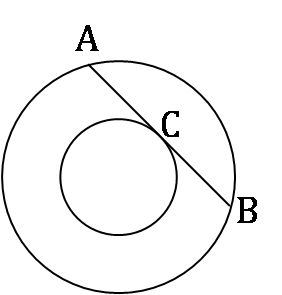
The line AB is 6 metres in length and is tangent to the inner one of the two concentric circles at point C. It is known that the radii of the two circles are integers. The radius of the outer circle is
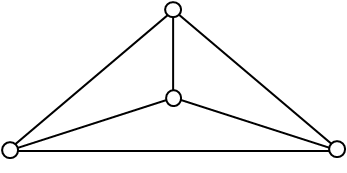
Four cities are connected by a road network as shown in the figure. In how many ways can you start from any city and come back to it without travelling on the same road more than once?
Passage / Data
Use the following information:
Eighty five children went to an amusement park where they could ride on the merry – go round, roller coaster, and Ferris wheel. It was known that 20 of them took all three rides, and 55 of them took at least two of the three rides. Each ride cost Re.1, and the total receipt of the amusement park was Rs.145.
How many children did not try any of the rides?
Passage / Data
Use the following information:
Eighty five children went to an amusement park where they could ride on the merry – go round, roller coaster, and Ferris wheel. It was known that 20 of them took all three rides, and 55 of them took at least two of the three rides. Each ride cost Re.1, and the total receipt of the amusement park was Rs.145.
How many children took exactly one ride?
John bought five mangoes and ten oranges together for forty rupees. Subsequently, he returned one mango and got two oranges in exchange. The price of an orange would be
The number of positive integers not greater than 100, which are not divisible by 2, 3 or 5 is
Let Un+1 = 2Un + 1 (n = 0, 1, 2, ...) and u0 = 0. Then u10 is nearest to
Passage / Data
Answer the next 2 questions based on the information given below:
A function f(x) is said to be even if f(–x) = f(x), and odd if f(–x) = –f(x). Thus, for example, the function given by f(x) = x2 is even, while the function given by f(x) = x3 is odd. Using this definition, answer the following questions.
The function given by f(x) = |x|3 is
Passage / Data
Answer the next 2 questions based on the information given below:
A function f(x) is said to be even if f(–x) = f(x), and odd if f(–x) = –f(x). Thus, for example, the function given by f(x) = x2 is even, while the function given by f(x) = x3 is odd. Using this definition, answer the following questions.
The sum of two odd functions
A five digit number is formed using digits 1, 3, 5, 7 and 9 without repeating any one of them. What is the sum of all such possible numbers?
A box contains 6 red balls, 7 green balls and 5 blue balls. Each ball is of a different size. The probability that the red ball selected is the smallest red ball, is
Passage / Data
Answer the following questions based on the information given below:
ABC forms an equilateral triangle in which B is 2 km from A. A person starts walking from B in a direction parallel to AC and stops when he reaches a point D directly east of C. He, then, reverses direction and walks till he reaches a point E directly south of C.
Then D is
Passage / Data
Answer the following questions based on the information given below:
ABC forms an equilateral triangle in which B is 2 km from A. A person starts walking from B in a direction parallel to AC and stops when he reaches a point D directly east of C. He, then, reverses direction and walks till he reaches a point E directly south of C.
The total distance walked by the person is
A slab of ice 8 inches in length, 11 inches in breadth, and 2 inches thick was melted and resolidified into the form of a rod of 8 inches diameter. The length of such a rod, in inches, is nearest to
Let x < 0.50, 0 < y < 1, z > 1. Given a set of numbers, the middle number, when they are arranged in ascending order, is called the median. So the median of the numbers x, y, and z would be
The maximum possible value of y = min (1/2 – 3x2/4, 5x2/4) for the range 0 < x < 1 is
A group of workers was put on a job. From the second day onwards, one worker was withdrawn each day. The job was finished when the last worker was withdrawn. Had no worker been withdrawn at any stage, the group would have finished the job in two-third the time. How many workers were there in the group?
Consider the five points comprising of the vertices of a square and the intersection point of its diagonals. How many triangles can be formed using these points?
Out of 100 families in the neighbourhood, 45 own radios, 75 have TVs, 25 have VCRs. Only 10 families have all three and each VCR owner also has a TV. If 25 families have radio only, how many have only TV?
Passage / Data
The following functions have been defined for three numbers A, B and C:
@ (A, B) = average of A and B
*(A, B) = product of A and B
/(A, B) = A divided by B
Answer these questions with the above data.
If A = 2 and B = 4, the value of @(/(*(A, B), B), A) would be
Passage / Data
The following functions have been defined for three numbers A, B and C:
@ (A, B) = average of A and B
*(A, B) = product of A and B
/(A, B) = A divided by B
Answer these questions with the above data.
The sum of A and B is given by
Passage / Data
The following functions have been defined for three numbers A, B and C:
@ (A, B) = average of A and B
*(A, B) = product of A and B
/(A, B) = A divided by B
Answer these questions with the above data.
The sum of A, B, and C is given by
A report consists of 20 sheets each of 55 lines and each such line consist of 65 characters. This report is retyped into sheets each of 65 lines such that each line consists of 70 characters. The percentage reduction in number of sheets is closest to
A young girl counted in the following way on the fingers of her left hand. She started calling the thumb 1, the index finger 2, middle finger 3, ring finger 4, little finger 5, then reversed direction, calling the ring finger 6, middle finger 7, index finger 8, thumb 9, then back to the index finger for 10, middle finger for 11, and so on. She counted up to 1994. She ended on her.
Passage / Data
Directions for next 3 questions:
Q started to move from point B towards point A exactly an hour after P started from A in the opposite direction. Q’s speed was twice that of P. When P had covered one-sixth of the distance between the points A and B, Q had also covered the same distance.
The point where P and Q would meet is
Passage / Data
Directions for next 3 questions:
Q started to move from point B towards point A exactly an hour after P started from A in the opposite direction. Q’s speed was twice that of P. When P had covered one-sixth of the distance between the points A and B, Q had also covered the same distance.
How many hours would P take to reach B?
Passage / Data
Directions for next 3 questions:
Q started to move from point B towards point A exactly an hour after P started from A in the opposite direction. Q’s speed was twice that of P. When P had covered one-sixth of the distance between the points A and B, Q had also covered the same distance.
How many more hours would P (compared to Q) take to complete his journey?
The smallest number which when divided by 4, 6 or 7 leaves a remainder of 2, is
The diameter of a hollow cone is equal to the diameter of a spherical ball. If the ball is placed at the base of the cone, what portion of the ball will be outside the cone?
A ship leave on a long voyage. When it is 18 miles from the shore, a seaplane, whose speed is ten times that of the ship, is sent to deliver mail. How far from the shore does the seaplane catch up with the ship?
The product of all integers from 1 to 100 will have the following numbers of zeros at the end.
Let x, y and z be distinct positive integers satisfying x < y < z and x + y + z = k. What is the smallest value of K that does not determine x, y, z uniquely?
Amar, Akbar, and Anthony came from the same public school in the Himalayas. Every boy in that school either fishes for trout or plays frisbee. All fishermen like snow while no frisbee player likes rain. Amar dislikes whatever Akbar likes and likes whatever Akbar dislikes. Akbar likes rain and snow. Anthony likes whatever the other two like. Who is a fisherman but not a frisbee player?