CAT 2024 Slot 1 — Question Paper with Solutions
The complete CAT 2024 Slot 1 previous-year paper with the answer key and detailed solutions for all 68 questions across 3 sections. Attempt each question and check it, or tap Show solution — free, and your progress saves when you sign in.
CAT 2024 Slot 1 — practice
There is a sentence that is missing in the paragraph below. Look at the paragraph and decide where (option 1, 2, 3, or 4) the following sentence would best fit.
Sentence: Many have had to leave their homes behind, with more than 1.3 million people being displaced due to the drought.
Passage: Somalia has been dealing with an enormous humanitarian catastrophe, driven by the longest and most severe drought the country has experienced in at least 40 years. ___(1)___. Five consecutive rainy seasons have failed, causing more than 8 million people - almost half of the country’s population – to experience acute food insecurity. ___(2)___. More than 43,000 people are believed to have lost their lives, with half of the lives lost likely being children under five. The damage the drought has caused is far-reaching. ___(3)___. Farmers have lost all their agricultural income, while pastoralists have lost more than 3 million livestock, impoverishing entire communities, and leaving them on the brink of famine. ___(4)___. Some, like the pastoralists, may never be able to go back as their livelihoods have been irreversibly wiped out.
Five jumbled up sentences (labelled 1, 2, 3, 4 and 5), related to a topic, are given below. Four of them can be put together to form a coherent paragraph. Identify the odd sentence and key in the number of that sentence as your answer.
1. To create a synapse, the neuron has specialized structures, often seen as tiny swellings, at its terminal end of the axon where it stores the chemicals that are emitted to transmit a signal to the next neuron.
2. This fetal warm-up act—the soldering of neural connections before the eyes actually function—is crucial to the performance of the visual system.
3. The reasons for this paring back of synapses is a mystery, but synaptic pruning is thought to sharpen and reinforce the “correct” synapses, while removing the weak and unnecessary ones.
4. Neural connections between the eyes and the brain are formed long before birth, establishing the wiring and the circuitry that allow a child to begin visualizing the world the minute she emerges from the womb.
5. During this rehearsal period, synapses—points of chemical connection—between nerve cells are generated in great excess, only to be pruned back during later development.
The passage given below is followed by four alternate summaries. Choose the option that best captures the essence of the passage.
When the tradwife puts on that georgic, pinstriped dress, she is not just admiring the visual cues of a fantastical past. She takes these dreams of storybook bliss literally, tracing them backward in time until she reaches a logical conclusion that satisfies her. And by doing so, she ends up delivering an unhappy reminder of just how much our lives consist of artifice and playacting. The tradwife outrages people because of her deliberately regressive ideals. And yet her behaviour is, on some level, indistinguishable from the nontradwife’s. The tradwife’s trollish genius is to beat us at our own dress-up game. By insisting that the idyllic cottage daydream should be real, right down to the primitive gender roles, she leaves others feeling hollow, cheated. The hullabaloo and headaches she causes may be the price we pay for taking too many things at face value: our just deserts, served Instagram-perfect by a manicured hand on a gorgeous ceramic dish, with fat, mouthwatering maraschino cherries on top.
Five jumbled up sentences (labelled 1, 2, 3, 4 and 5), related to a topic, are given below. Four of them can be put together to form a coherent paragraph. Identify the odd sentence and key in the number of that sentence as your answer.
1. Part of the appeal of forecasting is not just that it seems to work, but that you don’t seem to need specialized expertise to succeed at it.
2. The tight connection between forecasting and building a model of the world helps explain why so much of the early interest in the idea came from the intelligence community.
3. This was true even though the latter had access to classified intelligence.
4. One frequently cited study found that accurate forecasters’ predictions of geopolitical events, when aggregated using standard scientific methods, were more accurate than the forecasts of members of the US intelligence community who answered the same questions in a confidential prediction market.
5. The aggregated opinions of non-experts doing forecasting have proven to be a better guide to the future than the aggregated opinions of experts.
Passage / Data
The passage below is accompanied by four questions. Based on the passage, choose the best answer for each question.
There is a group in the space community who view the solar system not as an opportunity to expand human potential but as a nature preserve, forever the provenance of an elite group of scientists and their sanitary robotic probes. These planetary protection advocates [call] for avoiding “harmful contamination” of celestial bodies. Under this regime, NASA incurs great expense sterilizing robotic probes in order to prevent the contamination of entirely theoretical biospheres. . . .
Transporting bacteria would matter if Mars were the vital world once imagined by astronomers who mistook optical illusions for canals. Nobody wants to expose Martians to measles, but sadly, robotic exploration reveals a bleak, rusted landscape, lacking oxygen and flooded with radiation ready to sterilize any Earthly microbes. Simple life might exist underground, or down at the bottom of a deep canyon, but it has been very hard to find with robots. . . . The upsides from human exploration and development of Mars clearly outweigh the welfare of purely speculative Martian fungi. . . .
The other likely targets of human exploration, development, and settlement, our moon and the asteroids, exist in a desiccated, radiation-soaked realm of hard vacuum and extreme temperature variations that would kill nearly anything. It’s also important to note that many international competitors will ignore the demands of these protection extremists in any case. For example, China recently sent a terrarium to the moon and germinated a plant seed—with, unsurprisingly, no protest from its own scientific community. In contrast, when it was recently revealed that a researcher had surreptitiously smuggled super-resilient microscopic tardigrades aboard the ill-fated Israeli Beresheet lunar probe, a firestorm was unleashed within the space community. . . .
NASA’s previous human exploration efforts made no serious attempt at sterility, with little notice. As the Mars expert Robert Zubrin noted in the National Review, U.S. lunar landings did not leave the campsites cleaner than they found it. Apollo’s bacteria-infested litter included bags of feces. Forcing NASA’s proposed Mars exploration to do better, scrubbing everything and hauling out all the trash, would destroy NASA’s human exploration budget and encroach on the agency’s other directorates, too. Getting future astronauts off Mars is enough of a challenge, without trying to tote weeks of waste along as well. A reasonable compromise is to continue on the course laid out by the U.S. government and the National Research Council, which proposed a system of zones on Mars, some for science only, some for habitation, and some for resource exploitation. This approach minimizes contamination, maximizes scientific exploration . . .
Mars presents a stark choice of diverging human futures. We can turn inward, pursuing ever more limited futures while we await whichever natural or manmade disaster will eradicate our species and life on Earth. Alternatively, we can choose to propel our biosphere further into the solar system, simultaneously protecting our home planet and providing a backup plan for the only life we know exists in the universe. Are the lives on Earth worth less than some hypothetical microbe lurking under Martian rocks?
The author’s overall tone in the first paragraph can be described as
Passage / Data
The passage below is accompanied by four questions. Based on the passage, choose the best answer for each question.
There is a group in the space community who view the solar system not as an opportunity to expand human potential but as a nature preserve, forever the provenance of an elite group of scientists and their sanitary robotic probes. These planetary protection advocates [call] for avoiding “harmful contamination” of celestial bodies. Under this regime, NASA incurs great expense sterilizing robotic probes in order to prevent the contamination of entirely theoretical biospheres. . . .
Transporting bacteria would matter if Mars were the vital world once imagined by astronomers who mistook optical illusions for canals. Nobody wants to expose Martians to measles, but sadly, robotic exploration reveals a bleak, rusted landscape, lacking oxygen and flooded with radiation ready to sterilize any Earthly microbes. Simple life might exist underground, or down at the bottom of a deep canyon, but it has been very hard to find with robots. . . . The upsides from human exploration and development of Mars clearly outweigh the welfare of purely speculative Martian fungi. . . .
The other likely targets of human exploration, development, and settlement, our moon and the asteroids, exist in a desiccated, radiation-soaked realm of hard vacuum and extreme temperature variations that would kill nearly anything. It’s also important to note that many international competitors will ignore the demands of these protection extremists in any case. For example, China recently sent a terrarium to the moon and germinated a plant seed—with, unsurprisingly, no protest from its own scientific community. In contrast, when it was recently revealed that a researcher had surreptitiously smuggled super-resilient microscopic tardigrades aboard the ill-fated Israeli Beresheet lunar probe, a firestorm was unleashed within the space community. . . .
NASA’s previous human exploration efforts made no serious attempt at sterility, with little notice. As the Mars expert Robert Zubrin noted in the National Review, U.S. lunar landings did not leave the campsites cleaner than they found it. Apollo’s bacteria-infested litter included bags of feces. Forcing NASA’s proposed Mars exploration to do better, scrubbing everything and hauling out all the trash, would destroy NASA’s human exploration budget and encroach on the agency’s other directorates, too. Getting future astronauts off Mars is enough of a challenge, without trying to tote weeks of waste along as well. A reasonable compromise is to continue on the course laid out by the U.S. government and the National Research Council, which proposed a system of zones on Mars, some for science only, some for habitation, and some for resource exploitation. This approach minimizes contamination, maximizes scientific exploration . . .
Mars presents a stark choice of diverging human futures. We can turn inward, pursuing ever more limited futures while we await whichever natural or manmade disaster will eradicate our species and life on Earth. Alternatively, we can choose to propel our biosphere further into the solar system, simultaneously protecting our home planet and providing a backup plan for the only life we know exists in the universe. Are the lives on Earth worth less than some hypothetical microbe lurking under Martian rocks?
The author is unlikely to disagree with any of the following EXCEPT:
Passage / Data
The passage below is accompanied by four questions. Based on the passage, choose the best answer for each question.
There is a group in the space community who view the solar system not as an opportunity to expand human potential but as a nature preserve, forever the provenance of an elite group of scientists and their sanitary robotic probes. These planetary protection advocates [call] for avoiding “harmful contamination” of celestial bodies. Under this regime, NASA incurs great expense sterilizing robotic probes in order to prevent the contamination of entirely theoretical biospheres. . . .
Transporting bacteria would matter if Mars were the vital world once imagined by astronomers who mistook optical illusions for canals. Nobody wants to expose Martians to measles, but sadly, robotic exploration reveals a bleak, rusted landscape, lacking oxygen and flooded with radiation ready to sterilize any Earthly microbes. Simple life might exist underground, or down at the bottom of a deep canyon, but it has been very hard to find with robots. . . . The upsides from human exploration and development of Mars clearly outweigh the welfare of purely speculative Martian fungi. . . .
The other likely targets of human exploration, development, and settlement, our moon and the asteroids, exist in a desiccated, radiation-soaked realm of hard vacuum and extreme temperature variations that would kill nearly anything. It’s also important to note that many international competitors will ignore the demands of these protection extremists in any case. For example, China recently sent a terrarium to the moon and germinated a plant seed—with, unsurprisingly, no protest from its own scientific community. In contrast, when it was recently revealed that a researcher had surreptitiously smuggled super-resilient microscopic tardigrades aboard the ill-fated Israeli Beresheet lunar probe, a firestorm was unleashed within the space community. . . .
NASA’s previous human exploration efforts made no serious attempt at sterility, with little notice. As the Mars expert Robert Zubrin noted in the National Review, U.S. lunar landings did not leave the campsites cleaner than they found it. Apollo’s bacteria-infested litter included bags of feces. Forcing NASA’s proposed Mars exploration to do better, scrubbing everything and hauling out all the trash, would destroy NASA’s human exploration budget and encroach on the agency’s other directorates, too. Getting future astronauts off Mars is enough of a challenge, without trying to tote weeks of waste along as well. A reasonable compromise is to continue on the course laid out by the U.S. government and the National Research Council, which proposed a system of zones on Mars, some for science only, some for habitation, and some for resource exploitation. This approach minimizes contamination, maximizes scientific exploration . . .
Mars presents a stark choice of diverging human futures. We can turn inward, pursuing ever more limited futures while we await whichever natural or manmade disaster will eradicate our species and life on Earth. Alternatively, we can choose to propel our biosphere further into the solar system, simultaneously protecting our home planet and providing a backup plan for the only life we know exists in the universe. Are the lives on Earth worth less than some hypothetical microbe lurking under Martian rocks?
The contrasting reactions to the Chinese and Israeli “contaminations” of lunar space
Passage / Data
The passage below is accompanied by four questions. Based on the passage, choose the best answer for each question.
There is a group in the space community who view the solar system not as an opportunity to expand human potential but as a nature preserve, forever the provenance of an elite group of scientists and their sanitary robotic probes. These planetary protection advocates [call] for avoiding “harmful contamination” of celestial bodies. Under this regime, NASA incurs great expense sterilizing robotic probes in order to prevent the contamination of entirely theoretical biospheres. . . .
Transporting bacteria would matter if Mars were the vital world once imagined by astronomers who mistook optical illusions for canals. Nobody wants to expose Martians to measles, but sadly, robotic exploration reveals a bleak, rusted landscape, lacking oxygen and flooded with radiation ready to sterilize any Earthly microbes. Simple life might exist underground, or down at the bottom of a deep canyon, but it has been very hard to find with robots. . . . The upsides from human exploration and development of Mars clearly outweigh the welfare of purely speculative Martian fungi. . . .
The other likely targets of human exploration, development, and settlement, our moon and the asteroids, exist in a desiccated, radiation-soaked realm of hard vacuum and extreme temperature variations that would kill nearly anything. It’s also important to note that many international competitors will ignore the demands of these protection extremists in any case. For example, China recently sent a terrarium to the moon and germinated a plant seed—with, unsurprisingly, no protest from its own scientific community. In contrast, when it was recently revealed that a researcher had surreptitiously smuggled super-resilient microscopic tardigrades aboard the ill-fated Israeli Beresheet lunar probe, a firestorm was unleashed within the space community. . . .
NASA’s previous human exploration efforts made no serious attempt at sterility, with little notice. As the Mars expert Robert Zubrin noted in the National Review, U.S. lunar landings did not leave the campsites cleaner than they found it. Apollo’s bacteria-infested litter included bags of feces. Forcing NASA’s proposed Mars exploration to do better, scrubbing everything and hauling out all the trash, would destroy NASA’s human exploration budget and encroach on the agency’s other directorates, too. Getting future astronauts off Mars is enough of a challenge, without trying to tote weeks of waste along as well. A reasonable compromise is to continue on the course laid out by the U.S. government and the National Research Council, which proposed a system of zones on Mars, some for science only, some for habitation, and some for resource exploitation. This approach minimizes contamination, maximizes scientific exploration . . .
Mars presents a stark choice of diverging human futures. We can turn inward, pursuing ever more limited futures while we await whichever natural or manmade disaster will eradicate our species and life on Earth. Alternatively, we can choose to propel our biosphere further into the solar system, simultaneously protecting our home planet and providing a backup plan for the only life we know exists in the universe. Are the lives on Earth worth less than some hypothetical microbe lurking under Martian rocks?
The author mentions all of the following reasons to dismiss concerns about contaminating Mars EXCEPT:
Passage / Data
The passage below is accompanied by four questions. Based on the passage, choose the best answer for each question.
There is a group in the space community who view the solar system not as an opportunity to expand human potential but as a nature preserve, forever the provenance of an elite group of scientists and their sanitary robotic probes. These planetary protection advocates [call] for avoiding “harmful contamination” of celestial bodies. Under this regime, NASA incurs great expense sterilizing robotic probes in order to prevent the contamination of entirely theoretical biospheres. . . .
Transporting bacteria would matter if Mars were the vital world once imagined by astronomers who mistook optical illusions for canals. Nobody wants to expose Martians to measles, but sadly, robotic exploration reveals a bleak, rusted landscape, lacking oxygen and flooded with radiation ready to sterilize any Earthly microbes. Simple life might exist underground, or down at the bottom of a deep canyon, but it has been very hard to find with robots. . . . The upsides from human exploration and development of Mars clearly outweigh the welfare of purely speculative Martian fungi. . . .
The other likely targets of human exploration, development, and settlement, our moon and the asteroids, exist in a desiccated, radiation-soaked realm of hard vacuum and extreme temperature variations that would kill nearly anything. It’s also important to note that many international competitors will ignore the demands of these protection extremists in any case. For example, China recently sent a terrarium to the moon and germinated a plant seed—with, unsurprisingly, no protest from its own scientific community. In contrast, when it was recently revealed that a researcher had surreptitiously smuggled super-resilient microscopic tardigrades aboard the ill-fated Israeli Beresheet lunar probe, a firestorm was unleashed within the space community. . . .
NASA’s previous human exploration efforts made no serious attempt at sterility, with little notice. As the Mars expert Robert Zubrin noted in the National Review, U.S. lunar landings did not leave the campsites cleaner than they found it. Apollo’s bacteria-infested litter included bags of feces. Forcing NASA’s proposed Mars exploration to do better, scrubbing everything and hauling out all the trash, would destroy NASA’s human exploration budget and encroach on the agency’s other directorates, too. Getting future astronauts off Mars is enough of a challenge, without trying to tote weeks of waste along as well. A reasonable compromise is to continue on the course laid out by the U.S. government and the National Research Council, which proposed a system of zones on Mars, some for science only, some for habitation, and some for resource exploitation. This approach minimizes contamination, maximizes scientific exploration . . .
Mars presents a stark choice of diverging human futures. We can turn inward, pursuing ever more limited futures while we await whichever natural or manmade disaster will eradicate our species and life on Earth. Alternatively, we can choose to propel our biosphere further into the solar system, simultaneously protecting our home planet and providing a backup plan for the only life we know exists in the universe. Are the lives on Earth worth less than some hypothetical microbe lurking under Martian rocks?
The passage below is accompanied by four questions. Based on the passage, choose the best answer for each question.
Moutai has been the global booze sensation of the decade. A bottle of its Flying Fairy which sold in the 1980s for the equivalent of a dollar now retails for $400. Moutai’s listed shares have soared by almost 600% in the past five years, outpacing the likes of Amazon. . . .
It does this while disregarding every Western marketing mantra. It is not global, has meagre digital sales and does not appeal to millennials. It scores pitifully on environmental, social and governance measures. In the Boy Scout world of Western business it would leave a bad taste, in more ways than one.
Moutai owes its intoxicating success to three factors—not all of them easy to emulate. First, it profits from Chinese nationalism. Moutai is known as the “national liquor”. It was used to raise spirits and disinfect wounds in Mao’s Long March. It was Premier Zhou Enlai’s favourite tipple, shared with Richard Nixon in 1972. Its centuries-old craftsmanship—it is distilled eight times and stored for years in earthenware jars—is a source of national pride. It also claims to be hangover-proof, which would make it an invention to rival gunpowder....
Second, it chose to serve China’s super-rich rather than its middle class. Markets are littered with the corpses of firms that could not compete in the cut-throat battle for Chinese middleclass wallets. And the country’s premium market is massive—at 73m-strong, bigger than the population of France, notes Euan McLeish of Bernstein, an investment firm, and still less crowded with prestige brands than advanced economies. Moutai is to these well-heeled drinkers what vintage champagne is to the rest of the world.....
Third, Moutai looks beyond affluent millennials and digital natives. The elderly and the middle-aged, it found, can be just as lucrative. Its biggest market now is (male) drinkers in their mid-30s. Many have no siblings, thanks to four decades of China’s one-child policy—which also means their elderly parents can splash out on weddings and banquets. Moutai is often a guest of honour.
Moutai has succeeded thanks to nationalism, elitism and ageism, in other words—not in spite of this unholy trinity. But it faces risks. The government is its largest shareholder—and a meddlesome one. It appears to want prices to remain stable. Exorbitantly priced booze is at odds with its professed socialist ideals. Yet minority investors—including many foreign funds—lament that Moutai’s wholesale price is a third of what it sells for in shops. Raising it could boost the company’s profits further. Instead, in what some see as a travesty of corporate governance, its majority owner has plans to set up its own sales channel.....
In the long run, its biggest risk may be millennials. As they grow older, health concerns, work-life balance and the desire for more wholesome pursuits than binge-drinking may curb the “Ganbei!” toasting culture [heavy drinking] on which so much of the demand for Moutai rests. For the time being, though, the party goes on.
Passage / Data
The passage below is accompanied by four questions. Based on the passage, choose the best answer for each question.
There is a group in the space community who view the solar system not as an opportunity to expand human potential but as a nature preserve, forever the provenance of an elite group of scientists and their sanitary robotic probes. These planetary protection advocates [call] for avoiding “harmful contamination” of celestial bodies. Under this regime, NASA incurs great expense sterilizing robotic probes in order to prevent the contamination of entirely theoretical biospheres. . . .
Transporting bacteria would matter if Mars were the vital world once imagined by astronomers who mistook optical illusions for canals. Nobody wants to expose Martians to measles, but sadly, robotic exploration reveals a bleak, rusted landscape, lacking oxygen and flooded with radiation ready to sterilize any Earthly microbes. Simple life might exist underground, or down at the bottom of a deep canyon, but it has been very hard to find with robots. . . . The upsides from human exploration and development of Mars clearly outweigh the welfare of purely speculative Martian fungi. . . .
The other likely targets of human exploration, development, and settlement, our moon and the asteroids, exist in a desiccated, radiation-soaked realm of hard vacuum and extreme temperature variations that would kill nearly anything. It’s also important to note that many international competitors will ignore the demands of these protection extremists in any case. For example, China recently sent a terrarium to the moon and germinated a plant seed—with, unsurprisingly, no protest from its own scientific community. In contrast, when it was recently revealed that a researcher had surreptitiously smuggled super-resilient microscopic tardigrades aboard the ill-fated Israeli Beresheet lunar probe, a firestorm was unleashed within the space community. . . .
NASA’s previous human exploration efforts made no serious attempt at sterility, with little notice. As the Mars expert Robert Zubrin noted in the National Review, U.S. lunar landings did not leave the campsites cleaner than they found it. Apollo’s bacteria-infested litter included bags of feces. Forcing NASA’s proposed Mars exploration to do better, scrubbing everything and hauling out all the trash, would destroy NASA’s human exploration budget and encroach on the agency’s other directorates, too. Getting future astronauts off Mars is enough of a challenge, without trying to tote weeks of waste along as well. A reasonable compromise is to continue on the course laid out by the U.S. government and the National Research Council, which proposed a system of zones on Mars, some for science only, some for habitation, and some for resource exploitation. This approach minimizes contamination, maximizes scientific exploration . . .
Mars presents a stark choice of diverging human futures. We can turn inward, pursuing ever more limited futures while we await whichever natural or manmade disaster will eradicate our species and life on Earth. Alternatively, we can choose to propel our biosphere further into the solar system, simultaneously protecting our home planet and providing a backup plan for the only life we know exists in the universe. Are the lives on Earth worth less than some hypothetical microbe lurking under Martian rocks?
In the context of the passage we can infer that to succeed in the liquor industry in China, a marketing firm must consider all of the following factors affecting the Chinese liquor market EXCEPT that
Passage / Data
The passage below is accompanied by four questions. Based on the passage, choose the best answer for each question.
There is a group in the space community who view the solar system not as an opportunity to expand human potential but as a nature preserve, forever the provenance of an elite group of scientists and their sanitary robotic probes. These planetary protection advocates [call] for avoiding “harmful contamination” of celestial bodies. Under this regime, NASA incurs great expense sterilizing robotic probes in order to prevent the contamination of entirely theoretical biospheres. . . .
Transporting bacteria would matter if Mars were the vital world once imagined by astronomers who mistook optical illusions for canals. Nobody wants to expose Martians to measles, but sadly, robotic exploration reveals a bleak, rusted landscape, lacking oxygen and flooded with radiation ready to sterilize any Earthly microbes. Simple life might exist underground, or down at the bottom of a deep canyon, but it has been very hard to find with robots. . . . The upsides from human exploration and development of Mars clearly outweigh the welfare of purely speculative Martian fungi. . . .
The other likely targets of human exploration, development, and settlement, our moon and the asteroids, exist in a desiccated, radiation-soaked realm of hard vacuum and extreme temperature variations that would kill nearly anything. It’s also important to note that many international competitors will ignore the demands of these protection extremists in any case. For example, China recently sent a terrarium to the moon and germinated a plant seed—with, unsurprisingly, no protest from its own scientific community. In contrast, when it was recently revealed that a researcher had surreptitiously smuggled super-resilient microscopic tardigrades aboard the ill-fated Israeli Beresheet lunar probe, a firestorm was unleashed within the space community. . . .
NASA’s previous human exploration efforts made no serious attempt at sterility, with little notice. As the Mars expert Robert Zubrin noted in the National Review, U.S. lunar landings did not leave the campsites cleaner than they found it. Apollo’s bacteria-infested litter included bags of feces. Forcing NASA’s proposed Mars exploration to do better, scrubbing everything and hauling out all the trash, would destroy NASA’s human exploration budget and encroach on the agency’s other directorates, too. Getting future astronauts off Mars is enough of a challenge, without trying to tote weeks of waste along as well. A reasonable compromise is to continue on the course laid out by the U.S. government and the National Research Council, which proposed a system of zones on Mars, some for science only, some for habitation, and some for resource exploitation. This approach minimizes contamination, maximizes scientific exploration . . .
Mars presents a stark choice of diverging human futures. We can turn inward, pursuing ever more limited futures while we await whichever natural or manmade disaster will eradicate our species and life on Earth. Alternatively, we can choose to propel our biosphere further into the solar system, simultaneously protecting our home planet and providing a backup plan for the only life we know exists in the universe. Are the lives on Earth worth less than some hypothetical microbe lurking under Martian rocks?
The phrase “would make it an invention to rival gunpowder” has been used in the passage in a sense that is
Passage / Data
The passage below is accompanied by four questions. Based on the passage, choose the best answer for each question.
There is a group in the space community who view the solar system not as an opportunity to expand human potential but as a nature preserve, forever the provenance of an elite group of scientists and their sanitary robotic probes. These planetary protection advocates [call] for avoiding “harmful contamination” of celestial bodies. Under this regime, NASA incurs great expense sterilizing robotic probes in order to prevent the contamination of entirely theoretical biospheres. . . .
Transporting bacteria would matter if Mars were the vital world once imagined by astronomers who mistook optical illusions for canals. Nobody wants to expose Martians to measles, but sadly, robotic exploration reveals a bleak, rusted landscape, lacking oxygen and flooded with radiation ready to sterilize any Earthly microbes. Simple life might exist underground, or down at the bottom of a deep canyon, but it has been very hard to find with robots. . . . The upsides from human exploration and development of Mars clearly outweigh the welfare of purely speculative Martian fungi. . . .
The other likely targets of human exploration, development, and settlement, our moon and the asteroids, exist in a desiccated, radiation-soaked realm of hard vacuum and extreme temperature variations that would kill nearly anything. It’s also important to note that many international competitors will ignore the demands of these protection extremists in any case. For example, China recently sent a terrarium to the moon and germinated a plant seed—with, unsurprisingly, no protest from its own scientific community. In contrast, when it was recently revealed that a researcher had surreptitiously smuggled super-resilient microscopic tardigrades aboard the ill-fated Israeli Beresheet lunar probe, a firestorm was unleashed within the space community. . . .
NASA’s previous human exploration efforts made no serious attempt at sterility, with little notice. As the Mars expert Robert Zubrin noted in the National Review, U.S. lunar landings did not leave the campsites cleaner than they found it. Apollo’s bacteria-infested litter included bags of feces. Forcing NASA’s proposed Mars exploration to do better, scrubbing everything and hauling out all the trash, would destroy NASA’s human exploration budget and encroach on the agency’s other directorates, too. Getting future astronauts off Mars is enough of a challenge, without trying to tote weeks of waste along as well. A reasonable compromise is to continue on the course laid out by the U.S. government and the National Research Council, which proposed a system of zones on Mars, some for science only, some for habitation, and some for resource exploitation. This approach minimizes contamination, maximizes scientific exploration . . .
Mars presents a stark choice of diverging human futures. We can turn inward, pursuing ever more limited futures while we await whichever natural or manmade disaster will eradicate our species and life on Earth. Alternatively, we can choose to propel our biosphere further into the solar system, simultaneously protecting our home planet and providing a backup plan for the only life we know exists in the universe. Are the lives on Earth worth less than some hypothetical microbe lurking under Martian rocks?
In the context of the passage, it is most likely that the author refers to Moutai’s marketing strategy as “the unholy trinity” because
Passage / Data
The passage below is accompanied by four questions. Based on the passage, choose the best answer for each question.
There is a group in the space community who view the solar system not as an opportunity to expand human potential but as a nature preserve, forever the provenance of an elite group of scientists and their sanitary robotic probes. These planetary protection advocates [call] for avoiding “harmful contamination” of celestial bodies. Under this regime, NASA incurs great expense sterilizing robotic probes in order to prevent the contamination of entirely theoretical biospheres. . . .
Transporting bacteria would matter if Mars were the vital world once imagined by astronomers who mistook optical illusions for canals. Nobody wants to expose Martians to measles, but sadly, robotic exploration reveals a bleak, rusted landscape, lacking oxygen and flooded with radiation ready to sterilize any Earthly microbes. Simple life might exist underground, or down at the bottom of a deep canyon, but it has been very hard to find with robots. . . . The upsides from human exploration and development of Mars clearly outweigh the welfare of purely speculative Martian fungi. . . .
The other likely targets of human exploration, development, and settlement, our moon and the asteroids, exist in a desiccated, radiation-soaked realm of hard vacuum and extreme temperature variations that would kill nearly anything. It’s also important to note that many international competitors will ignore the demands of these protection extremists in any case. For example, China recently sent a terrarium to the moon and germinated a plant seed—with, unsurprisingly, no protest from its own scientific community. In contrast, when it was recently revealed that a researcher had surreptitiously smuggled super-resilient microscopic tardigrades aboard the ill-fated Israeli Beresheet lunar probe, a firestorm was unleashed within the space community. . . .
NASA’s previous human exploration efforts made no serious attempt at sterility, with little notice. As the Mars expert Robert Zubrin noted in the National Review, U.S. lunar landings did not leave the campsites cleaner than they found it. Apollo’s bacteria-infested litter included bags of feces. Forcing NASA’s proposed Mars exploration to do better, scrubbing everything and hauling out all the trash, would destroy NASA’s human exploration budget and encroach on the agency’s other directorates, too. Getting future astronauts off Mars is enough of a challenge, without trying to tote weeks of waste along as well. A reasonable compromise is to continue on the course laid out by the U.S. government and the National Research Council, which proposed a system of zones on Mars, some for science only, some for habitation, and some for resource exploitation. This approach minimizes contamination, maximizes scientific exploration . . .
Mars presents a stark choice of diverging human futures. We can turn inward, pursuing ever more limited futures while we await whichever natural or manmade disaster will eradicate our species and life on Earth. Alternatively, we can choose to propel our biosphere further into the solar system, simultaneously protecting our home planet and providing a backup plan for the only life we know exists in the universe. Are the lives on Earth worth less than some hypothetical microbe lurking under Martian rocks?
The passage given below is followed by four alternate summaries. Choose the option that best captures the essence of the passage.
Humans have managed to tweak the underlying biology of various plants and animals to produce high-tech crops and microbes. But regulating these entities is complicated,
as the framework of policies and procedures are outdated and not flexible enough to adapt to emerging technology. The question is whether regulation will ever be able to
keep up with human innovation, to regulate living things, which are apt to be unpredictable and unique; to capture all the potential risks when new biological entities are introduced, or when they pass on variations of their genes?
Passage / Data
The passage below is accompanied by four questions. Based on the passage, choose the best answer for each question.
There is a group in the space community who view the solar system not as an opportunity to expand human potential but as a nature preserve, forever the provenance of an elite group of scientists and their sanitary robotic probes. These planetary protection advocates [call] for avoiding “harmful contamination” of celestial bodies. Under this regime, NASA incurs great expense sterilizing robotic probes in order to prevent the contamination of entirely theoretical biospheres. . . .
Transporting bacteria would matter if Mars were the vital world once imagined by astronomers who mistook optical illusions for canals. Nobody wants to expose Martians to measles, but sadly, robotic exploration reveals a bleak, rusted landscape, lacking oxygen and flooded with radiation ready to sterilize any Earthly microbes. Simple life might exist underground, or down at the bottom of a deep canyon, but it has been very hard to find with robots. . . . The upsides from human exploration and development of Mars clearly outweigh the welfare of purely speculative Martian fungi. . . .
The other likely targets of human exploration, development, and settlement, our moon and the asteroids, exist in a desiccated, radiation-soaked realm of hard vacuum and extreme temperature variations that would kill nearly anything. It’s also important to note that many international competitors will ignore the demands of these protection extremists in any case. For example, China recently sent a terrarium to the moon and germinated a plant seed—with, unsurprisingly, no protest from its own scientific community. In contrast, when it was recently revealed that a researcher had surreptitiously smuggled super-resilient microscopic tardigrades aboard the ill-fated Israeli Beresheet lunar probe, a firestorm was unleashed within the space community. . . .
NASA’s previous human exploration efforts made no serious attempt at sterility, with little notice. As the Mars expert Robert Zubrin noted in the National Review, U.S. lunar landings did not leave the campsites cleaner than they found it. Apollo’s bacteria-infested litter included bags of feces. Forcing NASA’s proposed Mars exploration to do better, scrubbing everything and hauling out all the trash, would destroy NASA’s human exploration budget and encroach on the agency’s other directorates, too. Getting future astronauts off Mars is enough of a challenge, without trying to tote weeks of waste along as well. A reasonable compromise is to continue on the course laid out by the U.S. government and the National Research Council, which proposed a system of zones on Mars, some for science only, some for habitation, and some for resource exploitation. This approach minimizes contamination, maximizes scientific exploration . . .
Mars presents a stark choice of diverging human futures. We can turn inward, pursuing ever more limited futures while we await whichever natural or manmade disaster will eradicate our species and life on Earth. Alternatively, we can choose to propel our biosphere further into the solar system, simultaneously protecting our home planet and providing a backup plan for the only life we know exists in the universe. Are the lives on Earth worth less than some hypothetical microbe lurking under Martian rocks?
The passage given below is followed by four alternate summaries. Choose the option that best captures the essence of the passage.
Lyric poetry is a genre of private meditation rather than public commitment. The impulse in Marxism toward changing a society deemed unacceptable in its basic design would seem to place demands on lyric poetry that such poetry, with its tendency toward the personal, the small scale, and the idiosyncratic, could never answer. There is within Marxism, however, also a strand of thought that would locate in lyric poetry alternative modes of perception and description that call forth a vision of worlds at odds with a repressive reality or that draw attention to the workings of ideology within the hegemonic culture. The poetic imagination may indeed deflect larger social concerns, but it may also be implicitly critical and utopian.
Passage / Data
The passage below is accompanied by four questions. Based on the passage, choose the best answer for each question.
Languages become endangered and die out for many reasons. Sadly, the physical annihilation of communities of native speakers of a language is all too often the cause of language extinction. In North America, European colonists brought death and destruction to many Native American communities. This was followed by US federal policies restricting the use of indigenous languages, including the removal of native children from their communities to federal boarding schools where native languages and cultural practices were prohibited. As many as 75 percent of the languages spoken in the territories that became the United States have gone extinct, with slightly better language survival rates in Central and South America . . .
Even without physical annihilation and prohibitions against language use, the language of the "dominant" cultures may drive other languages into extinction; young people see education, jobs, culture and technology associated with the dominant language and focus their attention on that language. The largest language "killers" are English, Spanish, Portuguese, French, Russian, Hindi, and Chinese, all of which have privileged status as dominant languages threatening minority languages.
When we lose a language, we lose the worldview, culture and knowledge of the people who spoke it, constituting a loss to all humanity. People around the world live in direct contact with their native environment, their habitat. When the language they speak goes extinct, the rest of humanity loses their knowledge of that environment, their wisdom about the relationship between local plants and illness, their philosophical and religious beliefs as well as their native cultural expression (in music, visual art and poetry) that has enriched both the speakers of that language and others who would have encountered that culture. . . .
As educators deeply immersed in the liberal arts, we believe that educating students broadly in all facets of language and culture . . . yields immense rewards. Some individuals educated in the liberal arts tradition will pursue advanced study in linguistics and become actively engaged in language preservation, setting out for the Amazon, for example, with video recording equipment to interview the last surviving elders in a community to record and document a language spoken by no children.
Certainly, though, the vast majority of students will not pursue this kind of activity. For these students, a liberal arts education is absolutely critical from the twin perspectives of language extinction and global citizenship. When students study languages other than their own, they are sensitized to the existence of different cultural perspectives and practices. With such an education, students are more likely to be able to articulate insights into their own cultural biases, be more empathetic to individuals of other cultures, communicate successfully across linguistic and cultural differences, consider and resolve questions in a way that reflects multiple cultural perspectives, and, ultimately extend support to people, programs, practices, and policies that support the preservation of endangered languages.
There is ample evidence that such preservation can work in languages spiraling toward extinction. For example, Navajo, Cree and Inuit communities have established schools in which these languages are the language of instruction and the number of speakers of each has increased.
In the context of the passage, which one of the following hypothetical scenarios, if true, is NOT an example of the kind of loss that occurs when a language becomes extinct?
Passage / Data
The passage below is accompanied by four questions. Based on the passage, choose the best answer for each question.
Languages become endangered and die out for many reasons. Sadly, the physical annihilation of communities of native speakers of a language is all too often the cause of language extinction. In North America, European colonists brought death and destruction to many Native American communities. This was followed by US federal policies restricting the use of indigenous languages, including the removal of native children from their communities to federal boarding schools where native languages and cultural practices were prohibited. As many as 75 percent of the languages spoken in the territories that became the United States have gone extinct, with slightly better language survival rates in Central and South America . . .
Even without physical annihilation and prohibitions against language use, the language of the "dominant" cultures may drive other languages into extinction; young people see education, jobs, culture and technology associated with the dominant language and focus their attention on that language. The largest language "killers" are English, Spanish, Portuguese, French, Russian, Hindi, and Chinese, all of which have privileged status as dominant languages threatening minority languages.
When we lose a language, we lose the worldview, culture and knowledge of the people who spoke it, constituting a loss to all humanity. People around the world live in direct contact with their native environment, their habitat. When the language they speak goes extinct, the rest of humanity loses their knowledge of that environment, their wisdom about the relationship between local plants and illness, their philosophical and religious beliefs as well as their native cultural expression (in music, visual art and poetry) that has enriched both the speakers of that language and others who would have encountered that culture. . . .
As educators deeply immersed in the liberal arts, we believe that educating students broadly in all facets of language and culture . . . yields immense rewards. Some individuals educated in the liberal arts tradition will pursue advanced study in linguistics and become actively engaged in language preservation, setting out for the Amazon, for example, with video recording equipment to interview the last surviving elders in a community to record and document a language spoken by no children.
Certainly, though, the vast majority of students will not pursue this kind of activity. For these students, a liberal arts education is absolutely critical from the twin perspectives of language extinction and global citizenship. When students study languages other than their own, they are sensitized to the existence of different cultural perspectives and practices. With such an education, students are more likely to be able to articulate insights into their own cultural biases, be more empathetic to individuals of other cultures, communicate successfully across linguistic and cultural differences, consider and resolve questions in a way that reflects multiple cultural perspectives, and, ultimately extend support to people, programs, practices, and policies that support the preservation of endangered languages.
There is ample evidence that such preservation can work in languages spiraling toward extinction. For example, Navajo, Cree and Inuit communities have established schools in which these languages are the language of instruction and the number of speakers of each has increased.
It can be inferred from the passage that it is likely South America had a slightly better language survival rate than North America for all of the following reasons EXCEPT:
Passage / Data
The passage below is accompanied by four questions. Based on the passage, choose the best answer for each question.
Languages become endangered and die out for many reasons. Sadly, the physical annihilation of communities of native speakers of a language is all too often the cause of language extinction. In North America, European colonists brought death and destruction to many Native American communities. This was followed by US federal policies restricting the use of indigenous languages, including the removal of native children from their communities to federal boarding schools where native languages and cultural practices were prohibited. As many as 75 percent of the languages spoken in the territories that became the United States have gone extinct, with slightly better language survival rates in Central and South America . . .
Even without physical annihilation and prohibitions against language use, the language of the "dominant" cultures may drive other languages into extinction; young people see education, jobs, culture and technology associated with the dominant language and focus their attention on that language. The largest language "killers" are English, Spanish, Portuguese, French, Russian, Hindi, and Chinese, all of which have privileged status as dominant languages threatening minority languages.
When we lose a language, we lose the worldview, culture and knowledge of the people who spoke it, constituting a loss to all humanity. People around the world live in direct contact with their native environment, their habitat. When the language they speak goes extinct, the rest of humanity loses their knowledge of that environment, their wisdom about the relationship between local plants and illness, their philosophical and religious beliefs as well as their native cultural expression (in music, visual art and poetry) that has enriched both the speakers of that language and others who would have encountered that culture. . . .
As educators deeply immersed in the liberal arts, we believe that educating students broadly in all facets of language and culture . . . yields immense rewards. Some individuals educated in the liberal arts tradition will pursue advanced study in linguistics and become actively engaged in language preservation, setting out for the Amazon, for example, with video recording equipment to interview the last surviving elders in a community to record and document a language spoken by no children.
Certainly, though, the vast majority of students will not pursue this kind of activity. For these students, a liberal arts education is absolutely critical from the twin perspectives of language extinction and global citizenship. When students study languages other than their own, they are sensitized to the existence of different cultural perspectives and practices. With such an education, students are more likely to be able to articulate insights into their own cultural biases, be more empathetic to individuals of other cultures, communicate successfully across linguistic and cultural differences, consider and resolve questions in a way that reflects multiple cultural perspectives, and, ultimately extend support to people, programs, practices, and policies that support the preservation of endangered languages.
There is ample evidence that such preservation can work in languages spiraling toward extinction. For example, Navajo, Cree and Inuit communities have established schools in which these languages are the language of instruction and the number of speakers of each has increased.
The author believes that a liberal arts education combined with participation in language preservation empower students in all of the following ways EXCEPT that they will
Passage / Data
The passage below is accompanied by four questions. Based on the passage, choose the best answer for each question.
Languages become endangered and die out for many reasons. Sadly, the physical annihilation of communities of native speakers of a language is all too often the cause of language extinction. In North America, European colonists brought death and destruction to many Native American communities. This was followed by US federal policies restricting the use of indigenous languages, including the removal of native children from their communities to federal boarding schools where native languages and cultural practices were prohibited. As many as 75 percent of the languages spoken in the territories that became the United States have gone extinct, with slightly better language survival rates in Central and South America . . .
Even without physical annihilation and prohibitions against language use, the language of the "dominant" cultures may drive other languages into extinction; young people see education, jobs, culture and technology associated with the dominant language and focus their attention on that language. The largest language "killers" are English, Spanish, Portuguese, French, Russian, Hindi, and Chinese, all of which have privileged status as dominant languages threatening minority languages.
When we lose a language, we lose the worldview, culture and knowledge of the people who spoke it, constituting a loss to all humanity. People around the world live in direct contact with their native environment, their habitat. When the language they speak goes extinct, the rest of humanity loses their knowledge of that environment, their wisdom about the relationship between local plants and illness, their philosophical and religious beliefs as well as their native cultural expression (in music, visual art and poetry) that has enriched both the speakers of that language and others who would have encountered that culture. . . .
As educators deeply immersed in the liberal arts, we believe that educating students broadly in all facets of language and culture . . . yields immense rewards. Some individuals educated in the liberal arts tradition will pursue advanced study in linguistics and become actively engaged in language preservation, setting out for the Amazon, for example, with video recording equipment to interview the last surviving elders in a community to record and document a language spoken by no children.
Certainly, though, the vast majority of students will not pursue this kind of activity. For these students, a liberal arts education is absolutely critical from the twin perspectives of language extinction and global citizenship. When students study languages other than their own, they are sensitized to the existence of different cultural perspectives and practices. With such an education, students are more likely to be able to articulate insights into their own cultural biases, be more empathetic to individuals of other cultures, communicate successfully across linguistic and cultural differences, consider and resolve questions in a way that reflects multiple cultural perspectives, and, ultimately extend support to people, programs, practices, and policies that support the preservation of endangered languages.
There is ample evidence that such preservation can work in languages spiraling toward extinction. For example, Navajo, Cree and Inuit communities have established schools in which these languages are the language of instruction and the number of speakers of each has increased.
Which one of the following hypothetical scenarios, if true, would most strongly undermine the central ideas of the passage?
Passage / Data
The passage below is accompanied by four questions. Based on the passage, choose the best answer for each question.
Fears of artificial intelligence (AI) have haunted humanity since the very beginning of the computer age. Hitherto these fears focused on machines using physical means to kill, enslave or replace people. But over the past couple of years new AI tools have emerged that threaten the survival of human civilisation from an unexpected direction. AI has gained some remarkable abilities to manipulate and generate language, whether with words, sounds or images. AI has thereby hacked the operating system of our civilisation.
Language is the stuff almost all human culture is made of. Human rights, for example, aren’t inscribed in our DNA. Rather, they are cultural artefacts we created by telling stories and writing laws. Gods aren’t physical realities. Rather, they are cultural artefacts we created by inventing myths and writing scriptures….What would happen once a non-human intelligence becomes better than the average human at telling stories, composing melodies, drawing images, and writing laws and scriptures? When people think about Chatgpt and other new AI tools, they are often drawn to examples like school children using AI to write their essays. What will happen to the school system when kids do that? But this kind of question misses the big picture. Forget about school essays. Think of the next American presidential race in 2024, and try to imagine the impact of AI tools that can be made to mass-produce political content, fake-news stories and scriptures for new cults…
Through its mastery of language, AI could even form intimate relationships with people, and use the power of intimacy to change our opinions and worldviews. Although there is no indication that AI has any consciousness or feelings of its own, to foster fake intimacy with humans it is enough if the AI can make them feel emotionally attached to it….
What will happen to the course of history when AI takes over culture, and begins producing stories, melodies, laws and religions? Previous tools like the printing press and radio helped spread the cultural ideas of humans, but they never created new cultural ideas of their own. AI is fundamentally different. AI can create completely new ideas, completely new culture…. Of course, the new power of AI could be used for good purposes as well. I won’t dwell on this, because the people who develop AI talk about it enough….
We can still regulate the new AI tools, but we must act quickly. Whereas nukes cannot invent more powerful nukes, AI can make exponentially more powerful AI.… Unregulated AI deployments would create social chaos, which would benefit autocrats and ruin democracies. Democracy is a conversation, and conversations rely on language. When AI hacks language, it could destroy our ability to have meaningful conversations, thereby destroying democracy….And the first regulation I would suggest is to make it mandatory for AI to disclose that it is an AI. If I am having a conversation with someone, and I cannot tell whether it is a human or an AI—that’s the end of democracy. This text has been generated by a human. Or has it?
The author terms language “the operating system of our civilization” for all the following reasons EXCEPT that it
Passage / Data
The passage below is accompanied by four questions. Based on the passage, choose the best answer for each question.
Fears of artificial intelligence (AI) have haunted humanity since the very beginning of the computer age. Hitherto these fears focused on machines using physical means to kill, enslave or replace people. But over the past couple of years new AI tools have emerged that threaten the survival of human civilisation from an unexpected direction. AI has gained some remarkable abilities to manipulate and generate language, whether with words, sounds or images. AI has thereby hacked the operating system of our civilisation.
Language is the stuff almost all human culture is made of. Human rights, for example, aren’t inscribed in our DNA. Rather, they are cultural artefacts we created by telling stories and writing laws. Gods aren’t physical realities. Rather, they are cultural artefacts we created by inventing myths and writing scriptures….What would happen once a non-human intelligence becomes better than the average human at telling stories, composing melodies, drawing images, and writing laws and scriptures? When people think about Chatgpt and other new AI tools, they are often drawn to examples like school children using AI to write their essays. What will happen to the school system when kids do that? But this kind of question misses the big picture. Forget about school essays. Think of the next American presidential race in 2024, and try to imagine the impact of AI tools that can be made to mass-produce political content, fake-news stories and scriptures for new cults…
Through its mastery of language, AI could even form intimate relationships with people, and use the power of intimacy to change our opinions and worldviews. Although there is no indication that AI has any consciousness or feelings of its own, to foster fake intimacy with humans it is enough if the AI can make them feel emotionally attached to it….
What will happen to the course of history when AI takes over culture, and begins producing stories, melodies, laws and religions? Previous tools like the printing press and radio helped spread the cultural ideas of humans, but they never created new cultural ideas of their own. AI is fundamentally different. AI can create completely new ideas, completely new culture…. Of course, the new power of AI could be used for good purposes as well. I won’t dwell on this, because the people who develop AI talk about it enough….
We can still regulate the new AI tools, but we must act quickly. Whereas nukes cannot invent more powerful nukes, AI can make exponentially more powerful AI.… Unregulated AI deployments would create social chaos, which would benefit autocrats and ruin democracies. Democracy is a conversation, and conversations rely on language. When AI hacks language, it could destroy our ability to have meaningful conversations, thereby destroying democracy….And the first regulation I would suggest is to make it mandatory for AI to disclose that it is an AI. If I am having a conversation with someone, and I cannot tell whether it is a human or an AI—that’s the end of democracy. This text has been generated by a human. Or has it?
The tone of the passage could best be described as
Passage / Data
The passage below is accompanied by four questions. Based on the passage, choose the best answer for each question.
Fears of artificial intelligence (AI) have haunted humanity since the very beginning of the computer age. Hitherto these fears focused on machines using physical means to kill, enslave or replace people. But over the past couple of years new AI tools have emerged that threaten the survival of human civilisation from an unexpected direction. AI has gained some remarkable abilities to manipulate and generate language, whether with words, sounds or images. AI has thereby hacked the operating system of our civilisation.
Language is the stuff almost all human culture is made of. Human rights, for example, aren’t inscribed in our DNA. Rather, they are cultural artefacts we created by telling stories and writing laws. Gods aren’t physical realities. Rather, they are cultural artefacts we created by inventing myths and writing scriptures….What would happen once a non-human intelligence becomes better than the average human at telling stories, composing melodies, drawing images, and writing laws and scriptures? When people think about Chatgpt and other new AI tools, they are often drawn to examples like school children using AI to write their essays. What will happen to the school system when kids do that? But this kind of question misses the big picture. Forget about school essays. Think of the next American presidential race in 2024, and try to imagine the impact of AI tools that can be made to mass-produce political content, fake-news stories and scriptures for new cults…
Through its mastery of language, AI could even form intimate relationships with people, and use the power of intimacy to change our opinions and worldviews. Although there is no indication that AI has any consciousness or feelings of its own, to foster fake intimacy with humans it is enough if the AI can make them feel emotionally attached to it….
What will happen to the course of history when AI takes over culture, and begins producing stories, melodies, laws and religions? Previous tools like the printing press and radio helped spread the cultural ideas of humans, but they never created new cultural ideas of their own. AI is fundamentally different. AI can create completely new ideas, completely new culture…. Of course, the new power of AI could be used for good purposes as well. I won’t dwell on this, because the people who develop AI talk about it enough….
We can still regulate the new AI tools, but we must act quickly. Whereas nukes cannot invent more powerful nukes, AI can make exponentially more powerful AI.… Unregulated AI deployments would create social chaos, which would benefit autocrats and ruin democracies. Democracy is a conversation, and conversations rely on language. When AI hacks language, it could destroy our ability to have meaningful conversations, thereby destroying democracy….And the first regulation I would suggest is to make it mandatory for AI to disclose that it is an AI. If I am having a conversation with someone, and I cannot tell whether it is a human or an AI—that’s the end of democracy. This text has been generated by a human. Or has it?
We can infer that the author is most likely to agree with which of the following statements?
Passage / Data
The passage below is accompanied by four questions. Based on the passage, choose the best answer for each question.
Fears of artificial intelligence (AI) have haunted humanity since the very beginning of the computer age. Hitherto these fears focused on machines using physical means to kill, enslave or replace people. But over the past couple of years new AI tools have emerged that threaten the survival of human civilisation from an unexpected direction. AI has gained some remarkable abilities to manipulate and generate language, whether with words, sounds or images. AI has thereby hacked the operating system of our civilisation.
Language is the stuff almost all human culture is made of. Human rights, for example, aren’t inscribed in our DNA. Rather, they are cultural artefacts we created by telling stories and writing laws. Gods aren’t physical realities. Rather, they are cultural artefacts we created by inventing myths and writing scriptures….What would happen once a non-human intelligence becomes better than the average human at telling stories, composing melodies, drawing images, and writing laws and scriptures? When people think about Chatgpt and other new AI tools, they are often drawn to examples like school children using AI to write their essays. What will happen to the school system when kids do that? But this kind of question misses the big picture. Forget about school essays. Think of the next American presidential race in 2024, and try to imagine the impact of AI tools that can be made to mass-produce political content, fake-news stories and scriptures for new cults…
Through its mastery of language, AI could even form intimate relationships with people, and use the power of intimacy to change our opinions and worldviews. Although there is no indication that AI has any consciousness or feelings of its own, to foster fake intimacy with humans it is enough if the AI can make them feel emotionally attached to it….
What will happen to the course of history when AI takes over culture, and begins producing stories, melodies, laws and religions? Previous tools like the printing press and radio helped spread the cultural ideas of humans, but they never created new cultural ideas of their own. AI is fundamentally different. AI can create completely new ideas, completely new culture…. Of course, the new power of AI could be used for good purposes as well. I won’t dwell on this, because the people who develop AI talk about it enough….
We can still regulate the new AI tools, but we must act quickly. Whereas nukes cannot invent more powerful nukes, AI can make exponentially more powerful AI.… Unregulated AI deployments would create social chaos, which would benefit autocrats and ruin democracies. Democracy is a conversation, and conversations rely on language. When AI hacks language, it could destroy our ability to have meaningful conversations, thereby destroying democracy….And the first regulation I would suggest is to make it mandatory for AI to disclose that it is an AI. If I am having a conversation with someone, and I cannot tell whether it is a human or an AI—that’s the end of democracy. This text has been generated by a human. Or has it?
The author identifies all of the following as dire outcomes of the capture of language by AI EXCEPT that it could
Passage / Data
The passage below is accompanied by four questions. Based on the passage, choose the best answer for each question.
Fears of artificial intelligence (AI) have haunted humanity since the very beginning of the computer age. Hitherto these fears focused on machines using physical means to kill, enslave or replace people. But over the past couple of years new AI tools have emerged that threaten the survival of human civilisation from an unexpected direction. AI has gained some remarkable abilities to manipulate and generate language, whether with words, sounds or images. AI has thereby hacked the operating system of our civilisation.
Language is the stuff almost all human culture is made of. Human rights, for example, aren’t inscribed in our DNA. Rather, they are cultural artefacts we created by telling stories and writing laws. Gods aren’t physical realities. Rather, they are cultural artefacts we created by inventing myths and writing scriptures….What would happen once a non-human intelligence becomes better than the average human at telling stories, composing melodies, drawing images, and writing laws and scriptures? When people think about Chatgpt and other new AI tools, they are often drawn to examples like school children using AI to write their essays. What will happen to the school system when kids do that? But this kind of question misses the big picture. Forget about school essays. Think of the next American presidential race in 2024, and try to imagine the impact of AI tools that can be made to mass-produce political content, fake-news stories and scriptures for new cults…
Through its mastery of language, AI could even form intimate relationships with people, and use the power of intimacy to change our opinions and worldviews. Although there is no indication that AI has any consciousness or feelings of its own, to foster fake intimacy with humans it is enough if the AI can make them feel emotionally attached to it….
What will happen to the course of history when AI takes over culture, and begins producing stories, melodies, laws and religions? Previous tools like the printing press and radio helped spread the cultural ideas of humans, but they never created new cultural ideas of their own. AI is fundamentally different. AI can create completely new ideas, completely new culture…. Of course, the new power of AI could be used for good purposes as well. I won’t dwell on this, because the people who develop AI talk about it enough….
We can still regulate the new AI tools, but we must act quickly. Whereas nukes cannot invent more powerful nukes, AI can make exponentially more powerful AI.… Unregulated AI deployments would create social chaos, which would benefit autocrats and ruin democracies. Democracy is a conversation, and conversations rely on language. When AI hacks language, it could destroy our ability to have meaningful conversations, thereby destroying democracy….And the first regulation I would suggest is to make it mandatory for AI to disclose that it is an AI. If I am having a conversation with someone, and I cannot tell whether it is a human or an AI—that’s the end of democracy. This text has been generated by a human. Or has it?
There is a sentence that is missing in the paragraph below. Look at the paragraph and decide where (option 1, 2, 3, or 4) the following sentence would best fit.
Sentence: This reality is putting stress on employees who have to pay for transport, desk lunches, more childcare, clothing and that after-work socialisation – costs they haven’t incurred for nearly two years.
Paragraph: ___(1)___. Prices are rising at their fastest rate in 40 years, consequently, return-to-office-related costs have shot up – think petrol and food, for instance. ___(2)___. Yet wages haven’t kept up with inflation – even despite the salary growth many workers have enjoyed during a favourable pandemic labour market. ___(3)___. This is especially jarring for workers who were able to save during remote work, when these expenditures weren’t a factor. ___(4)___. In April 2022, Umus, a London university lecturer, told BBC Worklife that they were spending nearly a quarter of what they made every day on return-to-work costs.
Passage / Data
The passage below is accompanied by four questions. Based on the passage, choose the best answer for each question.
Fears of artificial intelligence (AI) have haunted humanity since the very beginning of the computer age. Hitherto these fears focused on machines using physical means to kill, enslave or replace people. But over the past couple of years new AI tools have emerged that threaten the survival of human civilisation from an unexpected direction. AI has gained some remarkable abilities to manipulate and generate language, whether with words, sounds or images. AI has thereby hacked the operating system of our civilisation.
Language is the stuff almost all human culture is made of. Human rights, for example, aren’t inscribed in our DNA. Rather, they are cultural artefacts we created by telling stories and writing laws. Gods aren’t physical realities. Rather, they are cultural artefacts we created by inventing myths and writing scriptures….What would happen once a non-human intelligence becomes better than the average human at telling stories, composing melodies, drawing images, and writing laws and scriptures? When people think about Chatgpt and other new AI tools, they are often drawn to examples like school children using AI to write their essays. What will happen to the school system when kids do that? But this kind of question misses the big picture. Forget about school essays. Think of the next American presidential race in 2024, and try to imagine the impact of AI tools that can be made to mass-produce political content, fake-news stories and scriptures for new cults…
Through its mastery of language, AI could even form intimate relationships with people, and use the power of intimacy to change our opinions and worldviews. Although there is no indication that AI has any consciousness or feelings of its own, to foster fake intimacy with humans it is enough if the AI can make them feel emotionally attached to it….
What will happen to the course of history when AI takes over culture, and begins producing stories, melodies, laws and religions? Previous tools like the printing press and radio helped spread the cultural ideas of humans, but they never created new cultural ideas of their own. AI is fundamentally different. AI can create completely new ideas, completely new culture…. Of course, the new power of AI could be used for good purposes as well. I won’t dwell on this, because the people who develop AI talk about it enough….
We can still regulate the new AI tools, but we must act quickly. Whereas nukes cannot invent more powerful nukes, AI can make exponentially more powerful AI.… Unregulated AI deployments would create social chaos, which would benefit autocrats and ruin democracies. Democracy is a conversation, and conversations rely on language. When AI hacks language, it could destroy our ability to have meaningful conversations, thereby destroying democracy….And the first regulation I would suggest is to make it mandatory for AI to disclose that it is an AI. If I am having a conversation with someone, and I cannot tell whether it is a human or an AI—that’s the end of democracy. This text has been generated by a human. Or has it?
There is a sentence that is missing in the paragraph below. Look at the paragraph and decide where (option 1, 2, 3, or 4) the following sentence would best fit.
Sentence: Taken outside the village of Trang Bang on June 8, 1972, the picture captured the trauma and indiscriminate violence of a conflict that claimed, by some estimates, a million or more civilian lives.
Paragraph: The horrifying photograph of children fleeing a deadly napalm attack has become a defining image not only of the Vietnam War but the 20th century. ___(1)___. Dark smoke billowing behind them, the young subjects’ faces are painted with a mixture of terror, pain and confusion. ___(2)___. Soldiers from the South Vietnamese army’s 25th Division follow helplessly behind. ___(3)___. The picture was officially titled “The Terror of War,” but the photo is better known by the nickname given to naked 9-year-old at its centre “Napalm Girl”. ___(4)___.
Passage / Data
Answer the following questions based on the information given.
The chart below shows the price data for seven shares – A, B, C, D, E, F, and G as a candlestick plot for a particular day. The vertical axis shows the price of the share in rupees. A share whose closing price (price at the end of the day) is more than its opening price (price at the start of the day) is called a bullish share; otherwise, it is called a bearish share. All bullish and bearish shares are shown in green and red colour respectively.
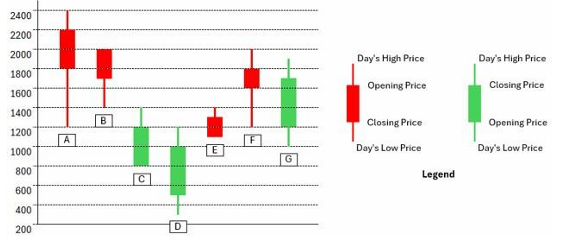
Reading the candles against the gridlines (each gridline = ₹200), the open / close / high / low values are approximately:
| Share | Open | Close | High | Low | Type |
|---|---|---|---|---|---|
| A | 2100 | 1900 | 2400 | 1500 | Bearish (red) |
| B | 2000 | 1750 | 2050 | 1300 | Bearish (red) |
| C | 850 | 1350 | 1400 | 750 | Bullish (green) |
| D | 600 | 1050 | 1150 | 300 | Bullish (green) |
| E | 1300 | 1150 | 1450 | 1100 | Bearish (red) |
| F | 1900 | 1700 | 2150 | 1650 | Bearish (red) |
| G | 1300 | 1750 | 1800 | 1250 | Bullish (green) |
For a red (bearish) candle the body top is the opening and the body bottom is the closing; for a green (bullish) candle the body bottom is the opening and the body top is the closing. The thin wicks mark the day’s high and low.
Daily Share Price Variability (SPV) is defined as (Day’s high price - Day’s low price) / (Average of the opening and closing prices during the day). Which among the shares A, C, D and F had the highest SPV on that day?
Passage / Data
Answer the following questions based on the information given.
The chart below shows the price data for seven shares – A, B, C, D, E, F, and G as a candlestick plot for a particular day. The vertical axis shows the price of the share in rupees. A share whose closing price (price at the end of the day) is more than its opening price (price at the start of the day) is called a bullish share; otherwise, it is called a bearish share. All bullish and bearish shares are shown in green and red colour respectively.
Reading the candles against the gridlines (each gridline = ₹200), the open / close / high / low values are approximately:
| Share | Open | Close | High | Low | Type |
|---|---|---|---|---|---|
| A | 2100 | 1900 | 2400 | 1500 | Bearish (red) |
| B | 2000 | 1750 | 2050 | 1300 | Bearish (red) |
| C | 850 | 1350 | 1400 | 750 | Bullish (green) |
| D | 600 | 1050 | 1150 | 300 | Bullish (green) |
| E | 1300 | 1150 | 1450 | 1100 | Bearish (red) |
| F | 1900 | 1700 | 2150 | 1650 | Bearish (red) |
| G | 1300 | 1750 | 1800 | 1250 | Bullish (green) |
For a red (bearish) candle the body top is the opening and the body bottom is the closing; for a green (bullish) candle the body bottom is the opening and the body top is the closing. The thin wicks mark the day’s high and low.
Daily Share Price Variability (SPV) is defined as (Day’s high price - Day’s low price) / (Average of the opening and closing prices during the day). How many shares had an SPV greater than 0.5 on that day?
Passage / Data
Answer the following questions based on the information given.
The chart below shows the price data for seven shares – A, B, C, D, E, F, and G as a candlestick plot for a particular day. The vertical axis shows the price of the share in rupees. A share whose closing price (price at the end of the day) is more than its opening price (price at the start of the day) is called a bullish share; otherwise, it is called a bearish share. All bullish and bearish shares are shown in green and red colour respectively.
Reading the candles against the gridlines (each gridline = ₹200), the open / close / high / low values are approximately:
| Share | Open | Close | High | Low | Type |
|---|---|---|---|---|---|
| A | 2100 | 1900 | 2400 | 1500 | Bearish (red) |
| B | 2000 | 1750 | 2050 | 1300 | Bearish (red) |
| C | 850 | 1350 | 1400 | 750 | Bullish (green) |
| D | 600 | 1050 | 1150 | 300 | Bullish (green) |
| E | 1300 | 1150 | 1450 | 1100 | Bearish (red) |
| F | 1900 | 1700 | 2150 | 1650 | Bearish (red) |
| G | 1300 | 1750 | 1800 | 1250 | Bullish (green) |
For a red (bearish) candle the body top is the opening and the body bottom is the closing; for a green (bullish) candle the body bottom is the opening and the body top is the closing. The thin wicks mark the day’s high and low.
Daily loss for a share is defined as (Opening price – Closing price) / (Opening price). Which among the shares A, B, F and G had the highest daily loss on that day?
Passage / Data
Answer the following questions based on the information given.
The chart below shows the price data for seven shares – A, B, C, D, E, F, and G as a candlestick plot for a particular day. The vertical axis shows the price of the share in rupees. A share whose closing price (price at the end of the day) is more than its opening price (price at the start of the day) is called a bullish share; otherwise, it is called a bearish share. All bullish and bearish shares are shown in green and red colour respectively.
Reading the candles against the gridlines (each gridline = ₹200), the open / close / high / low values are approximately:
| Share | Open | Close | High | Low | Type |
|---|---|---|---|---|---|
| A | 2100 | 1900 | 2400 | 1500 | Bearish (red) |
| B | 2000 | 1750 | 2050 | 1300 | Bearish (red) |
| C | 850 | 1350 | 1400 | 750 | Bullish (green) |
| D | 600 | 1050 | 1150 | 300 | Bullish (green) |
| E | 1300 | 1150 | 1450 | 1100 | Bearish (red) |
| F | 1900 | 1700 | 2150 | 1650 | Bearish (red) |
| G | 1300 | 1750 | 1800 | 1250 | Bullish (green) |
For a red (bearish) candle the body top is the opening and the body bottom is the closing; for a green (bullish) candle the body bottom is the opening and the body top is the closing. The thin wicks mark the day’s high and low.
What would have been the percentage wealth gain for a trader, who bought equal numbers of all bullish shares at opening price and sold them at their day’s high?
Passage / Data
Answer the following questions based on the information given below.
Six web surfers M, N, O, P, X, and Y each had 30 stars which they distributed among four bloggers A, B, C, and D. The number of stars received by A and B from the six web surfers is shown in the figure below.
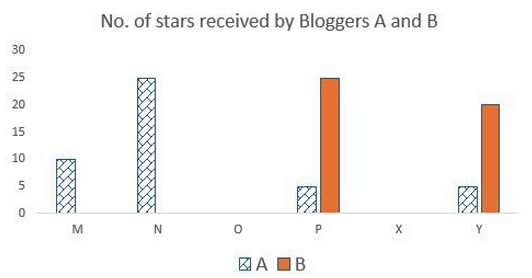
| Surfer | to A | to B |
|---|---|---|
| M | 10 | 0 |
| N | 25 | 0 |
| O | 0 | 0 |
| P | 5 | 25 |
| X | 0 | 0 |
| Y | 5 | 20 |
The following additional facts are known regarding the number of stars received by the bloggers from the surfers.
- The numbers of stars received by the bloggers from the surfers were all multiples of 5 (including 0).
- The total numbers of stars received by the bloggers were the same.
- Each blogger received a different number of stars from M.
- Two surfers gave all their stars to a single blogger.
- D received more stars than C from Y.
What was the total number of stars received by D?
Passage / Data
Answer the following questions based on the information given below.
Six web surfers M, N, O, P, X, and Y each had 30 stars which they distributed among four bloggers A, B, C, and D. The number of stars received by A and B from the six web surfers is shown in the figure below.
| Surfer | to A | to B |
|---|---|---|
| M | 10 | 0 |
| N | 25 | 0 |
| O | 0 | 0 |
| P | 5 | 25 |
| X | 0 | 0 |
| Y | 5 | 20 |
The following additional facts are known regarding the number of stars received by the bloggers from the surfers.
- The numbers of stars received by the bloggers from the surfers were all multiples of 5 (including 0).
- The total numbers of stars received by the bloggers were the same.
- Each blogger received a different number of stars from M.
- Two surfers gave all their stars to a single blogger.
- D received more stars than C from Y.
What was the number of stars received by D from Y?
Passage / Data
Answer the following questions based on the information given below.
Six web surfers M, N, O, P, X, and Y each had 30 stars which they distributed among four bloggers A, B, C, and D. The number of stars received by A and B from the six web surfers is shown in the figure below.
| Surfer | to A | to B |
|---|---|---|
| M | 10 | 0 |
| N | 25 | 0 |
| O | 0 | 0 |
| P | 5 | 25 |
| X | 0 | 0 |
| Y | 5 | 20 |
The following additional facts are known regarding the number of stars received by the bloggers from the surfers.
- The numbers of stars received by the bloggers from the surfers were all multiples of 5 (including 0).
- The total numbers of stars received by the bloggers were the same.
- Each blogger received a different number of stars from M.
- Two surfers gave all their stars to a single blogger.
- D received more stars than C from Y.
How many surfers distributed their stars among exactly 2 bloggers?
Passage / Data
Answer the following questions based on the information given below.
Six web surfers M, N, O, P, X, and Y each had 30 stars which they distributed among four bloggers A, B, C, and D. The number of stars received by A and B from the six web surfers is shown in the figure below.
| Surfer | to A | to B |
|---|---|---|
| M | 10 | 0 |
| N | 25 | 0 |
| O | 0 | 0 |
| P | 5 | 25 |
| X | 0 | 0 |
| Y | 5 | 20 |
The following additional facts are known regarding the number of stars received by the bloggers from the surfers.
- The numbers of stars received by the bloggers from the surfers were all multiples of 5 (including 0).
- The total numbers of stars received by the bloggers were the same.
- Each blogger received a different number of stars from M.
- Two surfers gave all their stars to a single blogger.
- D received more stars than C from Y.
Which of the following can be determined with certainty?
I. The number of stars received by C from M
II. The number of stars received by D from O
Passage / Data
Answer the following questions based on the information given below.
The game of QUIET is played between two teams. Six teams, numbered 1, 2, 3, 4, 5, and 6, play in a QUIET tournament. These teams are divided equally into two groups. In the tournament, each team plays every other team in the same group only once, and each team in the other group exactly twice. The tournament has several rounds, each of which consists of a few games. Every team plays exactly one game in each round.
The following additional facts are known about the schedule of games in the tournament.
1. Each team played against a team from the other group in Round 8.
2. In Round 4 and Round 7, the match-ups, that is the pair of teams playing against each other, were identical. In Round 5 and Round 8, the match-ups were identical.
3. Team 4 played Team 6 in both Round 1 and Round 2.
4. Team 1 played Team 5 ONLY once and that was in Round 2.
5. Team 3 played Team 4 in Round 3. Team 1 played Team 6 in Round 6.
6. In Round 8, Team 3 played Team 6, while Team 2 played Team 5.
How many rounds were there in the tournament?
Passage / Data
Answer the following questions based on the information given below.
The game of QUIET is played between two teams. Six teams, numbered 1, 2, 3, 4, 5, and 6, play in a QUIET tournament. These teams are divided equally into two groups. In the tournament, each team plays every other team in the same group only once, and each team in the other group exactly twice. The tournament has several rounds, each of which consists of a few games. Every team plays exactly one game in each round.
The following additional facts are known about the schedule of games in the tournament.
1. Each team played against a team from the other group in Round 8.
2. In Round 4 and Round 7, the match-ups, that is the pair of teams playing against each other, were identical. In Round 5 and Round 8, the match-ups were identical.
3. Team 4 played Team 6 in both Round 1 and Round 2.
4. Team 1 played Team 5 ONLY once and that was in Round 2.
5. Team 3 played Team 4 in Round 3. Team 1 played Team 6 in Round 6.
6. In Round 8, Team 3 played Team 6, while Team 2 played Team 5.
What is the number of the team that played Team 1 in Round 5?
Passage / Data
Answer the following questions based on the information given below.
The game of QUIET is played between two teams. Six teams, numbered 1, 2, 3, 4, 5, and 6, play in a QUIET tournament. These teams are divided equally into two groups. In the tournament, each team plays every other team in the same group only once, and each team in the other group exactly twice. The tournament has several rounds, each of which consists of a few games. Every team plays exactly one game in each round.
The following additional facts are known about the schedule of games in the tournament.
1. Each team played against a team from the other group in Round 8.
2. In Round 4 and Round 7, the match-ups, that is the pair of teams playing against each other, were identical. In Round 5 and Round 8, the match-ups were identical.
3. Team 4 played Team 6 in both Round 1 and Round 2.
4. Team 1 played Team 5 ONLY once and that was in Round 2.
5. Team 3 played Team 4 in Round 3. Team 1 played Team 6 in Round 6.
6. In Round 8, Team 3 played Team 6, while Team 2 played Team 5.
Which team among the teams numbered 2, 3, 4, and 5 was not part of the same group?
Passage / Data
Answer the following questions based on the information given below.
The game of QUIET is played between two teams. Six teams, numbered 1, 2, 3, 4, 5, and 6, play in a QUIET tournament. These teams are divided equally into two groups. In the tournament, each team plays every other team in the same group only once, and each team in the other group exactly twice. The tournament has several rounds, each of which consists of a few games. Every team plays exactly one game in each round.
The following additional facts are known about the schedule of games in the tournament.
1. Each team played against a team from the other group in Round 8.
2. In Round 4 and Round 7, the match-ups, that is the pair of teams playing against each other, were identical. In Round 5 and Round 8, the match-ups were identical.
3. Team 4 played Team 6 in both Round 1 and Round 2.
4. Team 1 played Team 5 ONLY once and that was in Round 2.
5. Team 3 played Team 4 in Round 3. Team 1 played Team 6 in Round 6.
6. In Round 8, Team 3 played Team 6, while Team 2 played Team 5.
What is the number of the team that played Team 1 in Round 7?
Passage / Data
Answer the following questions based on the information given below.
The game of QUIET is played between two teams. Six teams, numbered 1, 2, 3, 4, 5, and 6, play in a QUIET tournament. These teams are divided equally into two groups. In the tournament, each team plays every other team in the same group only once, and each team in the other group exactly twice. The tournament has several rounds, each of which consists of a few games. Every team plays exactly one game in each round.
The following additional facts are known about the schedule of games in the tournament.
1. Each team played against a team from the other group in Round 8.
2. In Round 4 and Round 7, the match-ups, that is the pair of teams playing against each other, were identical. In Round 5 and Round 8, the match-ups were identical.
3. Team 4 played Team 6 in both Round 1 and Round 2.
4. Team 1 played Team 5 ONLY once and that was in Round 2.
5. Team 3 played Team 4 in Round 3. Team 1 played Team 6 in Round 6.
6. In Round 8, Team 3 played Team 6, while Team 2 played Team 5.
What is the number of the team that played Team 6 in Round 3?
Passage / Data
Answer the following questions based on the information given below.
The chart below provides complete information about the number of countries visited by Dheeraj, Samantha and Nitesh, in Asia, Europe and the rest of the world (ROW).
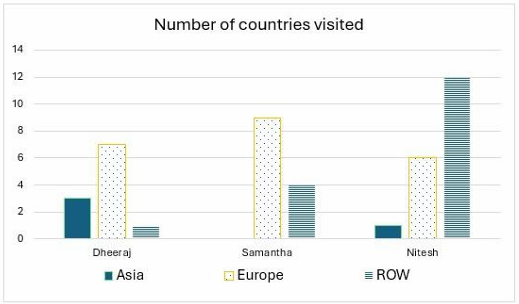
The following additional facts are known about the countries visited by them.
1. 32 countries were visited by at least one of them.
2. USA (in ROW) is the only country that was visited by all three of them.
3. China (in Asia) is the only country that was visited by both Dheeraj and Nitesh, but not by Samantha.
4. France (in Europe) is the only country outside Asia, which was visited by both Dheeraj and Samantha, but not by Nitesh.
5. Half of the countries visited by both Samantha and Nitesh are in Europe.
How many countries in Asia were visited by at least one of Dheeraj, Samantha and Nitesh?
Passage / Data
Answer the following questions based on the information given below.
The chart below provides complete information about the number of countries visited by Dheeraj, Samantha and Nitesh, in Asia, Europe and the rest of the world (ROW).
The following additional facts are known about the countries visited by them.
1. 32 countries were visited by at least one of them.
2. USA (in ROW) is the only country that was visited by all three of them.
3. China (in Asia) is the only country that was visited by both Dheeraj and Nitesh, but not by Samantha.
4. France (in Europe) is the only country outside Asia, which was visited by both Dheeraj and Samantha, but not by Nitesh.
5. Half of the countries visited by both Samantha and Nitesh are in Europe.
How many countries in Europe were visited only by Nitesh?
Passage / Data
Answer the following questions based on the information given below.
The chart below provides complete information about the number of countries visited by Dheeraj, Samantha and Nitesh, in Asia, Europe and the rest of the world (ROW).
The following additional facts are known about the countries visited by them.
1. 32 countries were visited by at least one of them.
2. USA (in ROW) is the only country that was visited by all three of them.
3. China (in Asia) is the only country that was visited by both Dheeraj and Nitesh, but not by Samantha.
4. France (in Europe) is the only country outside Asia, which was visited by both Dheeraj and Samantha, but not by Nitesh.
5. Half of the countries visited by both Samantha and Nitesh are in Europe.
How many countries in the ROW were visited by both Nitesh and Samantha?
Passage / Data
Answer the following questions based on the information given below.
The chart below provides complete information about the number of countries visited by Dheeraj, Samantha and Nitesh, in Asia, Europe and the rest of the world (ROW).
The following additional facts are known about the countries visited by them.
1. 32 countries were visited by at least one of them.
2. USA (in ROW) is the only country that was visited by all three of them.
3. China (in Asia) is the only country that was visited by both Dheeraj and Nitesh, but not by Samantha.
4. France (in Europe) is the only country outside Asia, which was visited by both Dheeraj and Samantha, but not by Nitesh.
5. Half of the countries visited by both Samantha and Nitesh are in Europe.
How many countries in Europe were visited by exactly one of Dheeraj, Samantha and Nitesh?
Passage / Data
Answer the following questions based on the information given below.
Two students, Amiya and Ramya are the only candidates in an election for the position of class representative. Students will vote based on the intensity level of Amiya’s and Ramya’s campaigns and the type of campaigns they run. Each campaign is said to have a level of 1 if it is a staid campaign and a level of 2 if it is a vigorous campaign. Campaigns can be of two types, they can either focus on issues, or on attacking the other candidate.
If Amiya and Ramya both run campaigns focusing on issues, then
- The percentage of students voting in the election will be 20 times the sum of the levels of campaigning of the two students. For example, if Amiya and Ramya both run vigorous campaigns, then 20 × (2+2)%, that is, 80% of the students will vote in the election.
- Among voting students, the percentage of votes for each candidate will be proportional to the levels of their campaigns. For example, if Amiya runs a staid (i.e., level 1) campaign while Ramya runs a vigorous (i.e., level 2) campaign, then Amiya will receive 1/3 of the votes cast, and Ramya will receive the other 2/3. The above-mentioned percentages change as follows if at least one of them runs a campaign attacking their opponent.
- If Amiya runs a campaign attacking Ramya and Ramya runs a campaign focusing on issues, then 10% of the students who would have otherwise voted for Amiya will vote for Ramya, and another 10% who would have otherwise voted for Amiya, will not vote at all.
- If Ramya runs a campaign attacking Amiya and Amiya runs a campaign focusing on issues, then 20% of the students who would have otherwise voted for Ramya will vote for Amiya, and another 5% who would have otherwise voted for Ramya, will not vote at all.
- If both run campaigns attacking each other, then 10% of the students who would have otherwise voted for them had they run campaigns focusing on issues, will not vote at all.
If both of them run staid campaigns attacking the other, then what percentage of students will vote in the election?
Passage / Data
Answer the following questions based on the information given below.
Two students, Amiya and Ramya are the only candidates in an election for the position of class representative. Students will vote based on the intensity level of Amiya’s and Ramya’s campaigns and the type of campaigns they run. Each campaign is said to have a level of 1 if it is a staid campaign and a level of 2 if it is a vigorous campaign. Campaigns can be of two types, they can either focus on issues, or on attacking the other candidate.
If Amiya and Ramya both run campaigns focusing on issues, then
- The percentage of students voting in the election will be 20 times the sum of the levels of campaigning of the two students. For example, if Amiya and Ramya both run vigorous campaigns, then 20 × (2+2)%, that is, 80% of the students will vote in the election.
- Among voting students, the percentage of votes for each candidate will be proportional to the levels of their campaigns. For example, if Amiya runs a staid (i.e., level 1) campaign while Ramya runs a vigorous (i.e., level 2) campaign, then Amiya will receive 1/3 of the votes cast, and Ramya will receive the other 2/3. The above-mentioned percentages change as follows if at least one of them runs a campaign attacking their opponent.
- If Amiya runs a campaign attacking Ramya and Ramya runs a campaign focusing on issues, then 10% of the students who would have otherwise voted for Amiya will vote for Ramya, and another 10% who would have otherwise voted for Amiya, will not vote at all.
- If Ramya runs a campaign attacking Amiya and Amiya runs a campaign focusing on issues, then 20% of the students who would have otherwise voted for Ramya will vote for Amiya, and another 5% who would have otherwise voted for Ramya, will not vote at all.
- If both run campaigns attacking each other, then 10% of the students who would have otherwise voted for them had they run campaigns focusing on issues, will not vote at all.
What is the minimum percentage of students who will vote in the election?
Passage / Data
Answer the following questions based on the information given below.
Two students, Amiya and Ramya are the only candidates in an election for the position of class representative. Students will vote based on the intensity level of Amiya’s and Ramya’s campaigns and the type of campaigns they run. Each campaign is said to have a level of 1 if it is a staid campaign and a level of 2 if it is a vigorous campaign. Campaigns can be of two types, they can either focus on issues, or on attacking the other candidate.
If Amiya and Ramya both run campaigns focusing on issues, then
- The percentage of students voting in the election will be 20 times the sum of the levels of campaigning of the two students. For example, if Amiya and Ramya both run vigorous campaigns, then 20 × (2+2)%, that is, 80% of the students will vote in the election.
- Among voting students, the percentage of votes for each candidate will be proportional to the levels of their campaigns. For example, if Amiya runs a staid (i.e., level 1) campaign while Ramya runs a vigorous (i.e., level 2) campaign, then Amiya will receive 1/3 of the votes cast, and Ramya will receive the other 2/3. The above-mentioned percentages change as follows if at least one of them runs a campaign attacking their opponent.
- If Amiya runs a campaign attacking Ramya and Ramya runs a campaign focusing on issues, then 10% of the students who would have otherwise voted for Amiya will vote for Ramya, and another 10% who would have otherwise voted for Amiya, will not vote at all.
- If Ramya runs a campaign attacking Amiya and Amiya runs a campaign focusing on issues, then 20% of the students who would have otherwise voted for Ramya will vote for Amiya, and another 5% who would have otherwise voted for Ramya, will not vote at all.
- If both run campaigns attacking each other, then 10% of the students who would have otherwise voted for them had they run campaigns focusing on issues, will not vote at all.
If Amiya runs a campaign focusing on issues, then what is the maximum percentage of votes that she can get?
Passage / Data
Answer the following questions based on the information given below.
Two students, Amiya and Ramya are the only candidates in an election for the position of class representative. Students will vote based on the intensity level of Amiya’s and Ramya’s campaigns and the type of campaigns they run. Each campaign is said to have a level of 1 if it is a staid campaign and a level of 2 if it is a vigorous campaign. Campaigns can be of two types, they can either focus on issues, or on attacking the other candidate.
If Amiya and Ramya both run campaigns focusing on issues, then
- The percentage of students voting in the election will be 20 times the sum of the levels of campaigning of the two students. For example, if Amiya and Ramya both run vigorous campaigns, then 20 × (2+2)%, that is, 80% of the students will vote in the election.
- Among voting students, the percentage of votes for each candidate will be proportional to the levels of their campaigns. For example, if Amiya runs a staid (i.e., level 1) campaign while Ramya runs a vigorous (i.e., level 2) campaign, then Amiya will receive 1/3 of the votes cast, and Ramya will receive the other 2/3. The above-mentioned percentages change as follows if at least one of them runs a campaign attacking their opponent.
- If Amiya runs a campaign attacking Ramya and Ramya runs a campaign focusing on issues, then 10% of the students who would have otherwise voted for Amiya will vote for Ramya, and another 10% who would have otherwise voted for Amiya, will not vote at all.
- If Ramya runs a campaign attacking Amiya and Amiya runs a campaign focusing on issues, then 20% of the students who would have otherwise voted for Ramya will vote for Amiya, and another 5% who would have otherwise voted for Ramya, will not vote at all.
- If both run campaigns attacking each other, then 10% of the students who would have otherwise voted for them had they run campaigns focusing on issues, will not vote at all.
If Ramya runs a campaign attacking Amiya, then what is the minimum percentage of votes that she is guaranteed to get?
Passage / Data
Answer the following questions based on the information given below.
Two students, Amiya and Ramya are the only candidates in an election for the position of class representative. Students will vote based on the intensity level of Amiya’s and Ramya’s campaigns and the type of campaigns they run. Each campaign is said to have a level of 1 if it is a staid campaign and a level of 2 if it is a vigorous campaign. Campaigns can be of two types, they can either focus on issues, or on attacking the other candidate.
If Amiya and Ramya both run campaigns focusing on issues, then
- The percentage of students voting in the election will be 20 times the sum of the levels of campaigning of the two students. For example, if Amiya and Ramya both run vigorous campaigns, then 20 × (2+2)%, that is, 80% of the students will vote in the election.
- Among voting students, the percentage of votes for each candidate will be proportional to the levels of their campaigns. For example, if Amiya runs a staid (i.e., level 1) campaign while Ramya runs a vigorous (i.e., level 2) campaign, then Amiya will receive 1/3 of the votes cast, and Ramya will receive the other 2/3. The above-mentioned percentages change as follows if at least one of them runs a campaign attacking their opponent.
- If Amiya runs a campaign attacking Ramya and Ramya runs a campaign focusing on issues, then 10% of the students who would have otherwise voted for Amiya will vote for Ramya, and another 10% who would have otherwise voted for Amiya, will not vote at all.
- If Ramya runs a campaign attacking Amiya and Amiya runs a campaign focusing on issues, then 20% of the students who would have otherwise voted for Ramya will vote for Amiya, and another 5% who would have otherwise voted for Ramya, will not vote at all.
- If both run campaigns attacking each other, then 10% of the students who would have otherwise voted for them had they run campaigns focusing on issues, will not vote at all.
What is the maximum possible voting margin with which one of the candidates can win?
If (a + b√n) is the positive square root of (29 - 12√5), where a and b are integers, and n is a natural number, then the maximum possible value of (a + b + n) is
The surface area of a closed rectangular box, which is inscribed in a sphere, is 846 sq. cm., and the sum of the lengths of all its edges is 144 cm. The volume, in cubic cm, of the sphere is
Renu would take 15 days working 4 hours per day to complete a certain task whereas Seema would take 8 days working 5 hours per day to complete the same task. They decide to work together to complete this task. Seema agrees to work for double the number of hours per day as Renu, while Renu agrees to work for double the number of days as Seema. If Renu works 2 hours per day, then the number of days Seema will work, is
For any natural number n, let an be the largest integer not exceeding √n. Then the value of a1 + a2 + a3 + ... + a50 is
The sum of all four-digit numbers that can be formed with the distinct non-zero digits a, b, c and d, with each digit appearing exactly once in every number, is 153310 + n, where n is a single digit natural number. Then, the value of (a + b + c + d + n) is
In September, the incomes of Kamal, Amal and Vimal are in the ratio 8 ∶ 6 ∶ 5. They rent a house together, and Kamal pays 15%, Amal pays 12% and Vimal pays 18% of their respective incomes to cover the total house rent in that month. In October, the house rent remains unchanged while their incomes increase by 10%, 12% and 15%, respectively. In October, the percentage of their total income that will be paid as house rent, is nearest to
Let x, y, and z be real numbers satisfying
4(x2 + y2 + z2) = a,
4(x - y - z) = 3 + a
Then a equals
The selling price of a product is fixed to ensure 40% profit. If the product had cost 40% less and had been sold for 5 rupees less, then the resulting profit would have been 50%. The original selling price, in rupees, of the product is
Two places A and B are 45 kms apart and connected by a straight road. Anil goes from A to B while Sunil goes from B to A. Starting at the same time, they cross each other in exactly 1 hour 30 minutes. If Anil reaches B exactly 1 hour 15 minutes after Sunil reaches A, the speed of Anil, in km per hour, is
When 10100 is divided by 7, the remainder is
In the XY-plane, the area, in sq. units, of the region defined by the inequalities
y ≥ x + 4 and -4 ≤ x2 + y2 + 4(x - y) ≤ 0 is
If the equations x2 + mx + 9 = 0, x2 + nx + 17 = 0 and x2 + (m + n)x + 35 = 0 have a common negative root, then the value of (2m + 3n) is
An amount of Rs 10000 is deposited in bank A for a certain number of years at a simple interest of 5% per annum. On maturity, the total amount received is deposited in bank B for another 5 years at a simple interest of 6% per annum. If the interests received from bank A and bank B are in the ratio 10 : 13, then the investment period, in years, in bank A is
ABCD is a rectangle with sides AB = 56 cm and BC = 45 cm, and E is the midpoint of side CD. Then, the length, in cm, of radius of incircle of ∆ADE is
A glass is filled with milk. Two-thirds of its content is poured out and replaced with water. If this process of pouring out two-thirds the content and replacing with water is repeated three more times, then the final ratio of milk to water in the glass, is
A fruit seller has a total of 187 fruits consisting of apples, mangoes and oranges. The number of apples and mangoes are in the ratio 5 : 2. After she sells 75 apples, 26 mangoes and half of the oranges, the ratio of number of unsold apples to number of unsold oranges becomes 3 : 2. The total number of unsold fruits is
Suppose x1, x2, x3, ..., x100 are in arithmetic progression such that x5 = -4 and 2x6 + 2x9 = x11 + x13. Then x100 equals
There are four numbers such that average of first two numbers is 1 more than the first number, average of first three numbers is 2 more than average of first two numbers, and average of first four numbers is 3 more than average of first three numbers. Then, the difference between the largest and the smallest numbers, is
A shop wants to sell a certain quantity (in kg) of grains. It sells half the quantity and an additional 3 kg of these grains to the first customer. Then, it sells half of the remaining quantity and an additional 3 kg of these grains to the second customer. Finally, when the shop sells half of the remaining quantity and an additional 3 kg of these grains to the third customer, there are no grains left. The initial quantity, in kg, of grains is
Consider two sets A = {2, 3, 5, 7, 11, 13} and B = {1, 8, 27}. Let f be a function from A to B such that for every element b in B, there is at least one element a in A such that f(a) = b. Then, the total number of such function f is
The sum of all real values of k for which × = × , is
If x is a positive number such that 4 log10x + 4 log100x + 8 log1000x = 13, then the greatest integer not exceeding x, is
More CAT previous-year papers
View allPractise CAT the smart way
Get adaptive practice, spaced revision, and full mock tests — free to start.
Create your free account