CAT 2003 Slot 2 — QA
All 50 QA questions from CAT 2003 Slot 2, with the answer key and detailed solutions. Practise free — check answers as you go, or tap Show solution.
CAT 2003 Slot 2 · QA
A piece of paper is in the shape of a right angled triangle and is cut along a line that is parallel to the hypotenuse, leaving a smaller triangle. There was a 35% reduction in the length of the hypotenuse of the triangle. If the area of the original triangle was 34 square inches before the cut, what is the area (in square inches) of the smaller triangle?
In a coastal village, every year floods destroy exactly half of the huts. After the flood water recedes, twice the number of huts destroyed are rebuilt. The floods occurred consecutively in the last three years namely 2001, 2002 and 2003. If floods are again expected in 2004, the number of huts expected to be destroyed is:
Let a, b, c, d and e be integers such that a = 6b = 12c, and 2b = 9d = 12e. Then which of the following pairs contains a number that is not an integer?
If a, a + 2 and a + 4 are prime numbers, then the number of possible solutions for a is:
A square tin sheet of side 12 inches is converted into a box with open top in the following steps – the sheet is placed horizontally. Then, equal sized squares, each of side x inches, are cut from the four corners of the sheet. Finally, the four resulting sides are bent vertically upwards in the shape of a box. If x is an integer, then what value of x maximizes the volume of the box?
Two straight roads R1 and R2 diverge from a point A at an angle of 120°. Ram starts walking from point A along R1 at a uniform speed of 3 km/hr. Shyam starts walking at the same time from A along R2 at a uniform speed of 2 km/hr. They continue walking for 4 hours along their respective roads and reach points B and C on R1 and R2, respectively. There is a straight line path connecting B and C. Then Ram returns to point A after walking along the line segments BC and CA. Shyam also returns to A after walking along line segments CB and BA. Their speeds remain unchanged. The time interval (in hours) between Ram’s and Shyam’s return to the point A is:
Let x and y be positive integers such that x is prime and y is composite. Then,
A survey on a sample of 25 new cars being sold at a local auto dealer was conducted to see which of the three popular options- air conditioning, radio and power windows- were already installed. The survey found
- 15 had air conditioning,
- 2 had air conditioning and power windows but no radios,
- 12 had radio,
- 6 had air conditioning and radio, but no power windows,
- 11 had power windows,
- 4 had radio and power windows and
- 3 had all three options.
What is the number of cars that had none of the options?
If n is such that 36 ≤ n ≤ 72, then x = satisfies
If 13x + 1 < 2z, and z + 3 = 5y2, then
Let n(>1) be a composite integer such that is not an integer.
Consider the following statements:
A: n has a perfect integer - valued divisor which is greater than 1 and less than .
B: n has a perfect integer- valued divisor which is greater than but less than n.
Then,
If |b| ≥ 1 and x = –|a|b, then which one of the following is necessarily true?
Answer the following question based on the information given below.
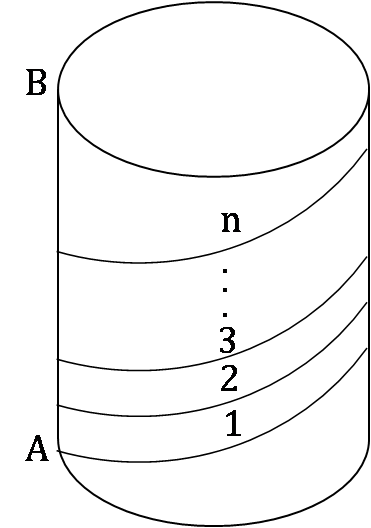
Consider a cylinder of height h cms and radius r = 2/π cms as shown in the figure (not drawn to scale). A string of a certain length, when wound on its cylindrical surface, starting at point A and ending at point B, gives a maximum of n turns (in other words, the string’s length is the minimum length required to wind n turns.)
What is the vertical spacing in cms between two consecutive turns?
Answer the following question based on the information given below.
Consider a cylinder of height h cms and radius r = 2/π cms as shown in the figure (not drawn to scale). A string of a certain length, when wound on its cylindrical surface, starting at point A and ending at point B, gives a maximum of n turns (in other words, the string’s length is the minimum length required to wind n turns.)
The same string, when wound on the exterior four walls of a cube of side n cms, starting at point C and ending at point D, can give exactly one turn (see figure, not drawn to scale).

The length of the string, in cms, is
Answer the following question based on the information given below.
Consider a cylinder of height h cms and radius r = 2/π cms as shown in the figure (not drawn to scale). A string of a certain length, when wound on its cylindrical surface, starting at point A and ending at point B, gives a maximum of n turns (in other words, the string’s length is the minimum length required to wind n turns.)
In the setup of the previous two questions, how is h related to n?
Answer the following question based on the information given below.
Consider three circular parks of equal size with centres at A1, A2 and A3 respectively. The parks touch each other at the edge as shown in the figure (not drawn to scale). There are three paths formed by the triangles A1A2A3, B1B2B3 and C1C2C3, as shown. Three sprinters A, B, and C begin running from points A1, B1 and C1 respectively. Each sprinter traverses her respective triangular path clockwise and returns to her starting point.
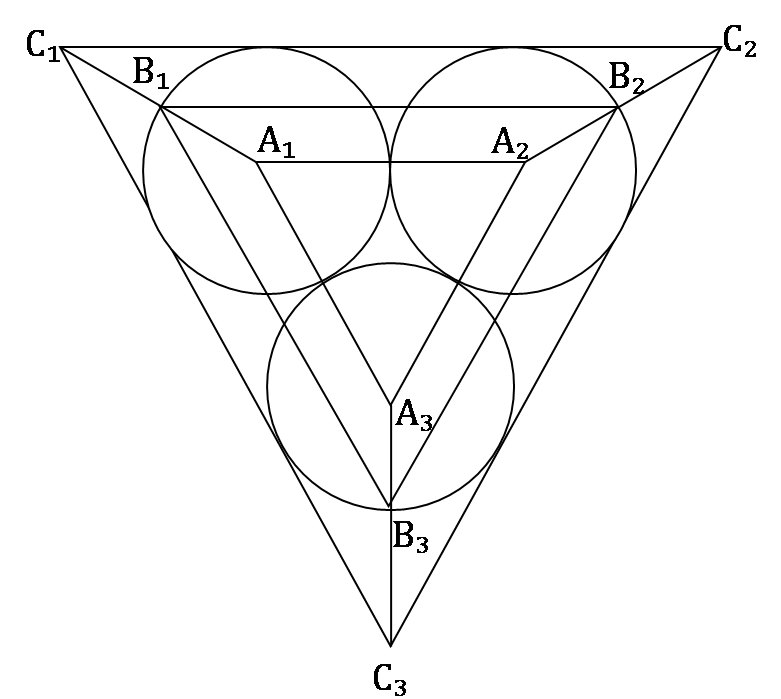
Let the radius of each circular park be r, and the distances to be traversed by the sprinters A, B and C be a, b and c, respectively. Which of the following is true?
Answer the following question based on the information given below.
Consider three circular parks of equal size with centres at A1, A2 and A3 respectively. The parks touch each other at the edge as shown in the figure (not drawn to scale). There are three paths formed by the triangles A1A2A3, B1B2B3 and C1C2C3, as shown. Three sprinters A, B, and C begin running from points A1, B1 and C1 respectively. Each sprinter traverses her respective triangular path clockwise and returns to her starting point.
Sprinter A traverses distances A1A2, A2A3, and A3A1 at average speeds of 20, 30 and 15 respectively. B traverses her entire path at a uniform speed of C traverses distances C1C2, C2C3, and C3C1 at average speeds of and 120 respectively. All speeds are in the same unit. Where would B and C be respectively when A finishes her sprint?
Answer the following question based on the information given below.
Consider three circular parks of equal size with centres at A1, A2 and A3 respectively. The parks touch each other at the edge as shown in the figure (not drawn to scale). There are three paths formed by the triangles A1A2A3, B1B2B3 and C1C2C3, as shown. Three sprinters A, B, and C begin running from points A1, B1 and C1 respectively. Each sprinter traverses her respective triangular path clockwise and returns to her starting point.
Sprinters A, B and C traverse their respective paths at uniform speeds u, v and w respectively. It is known that u2 : v2 : w2 is equal to Area A : Area B : Area C, where Area A, Area B and Area C are the areas of triangles A1A2A3, B1B2B3, and C1C2C3 respectively.
Where would A and C be when B reaches point B3?
The infinite sum equals
Consider the sets Tn = {n, n + 1, n + 2, n + 3, n + 4}, where n = 1, 2, 3, … , 96.
How many of these sets contain 6 or any integral multiple thereof (i.e., any one of the numbers 6, 12, 18, ...)?
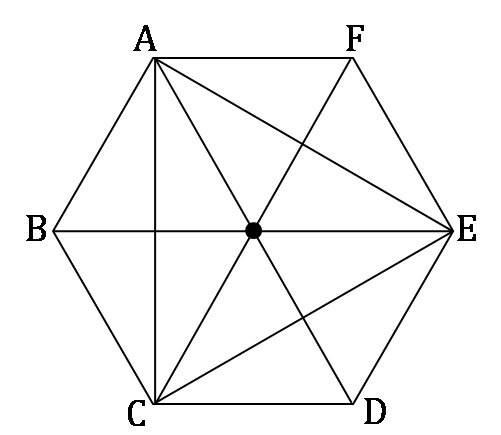
Let ABCDEF be a regular hexagon. What is the ratio of the area of the triangle ACE to that of the hexagon ABCDEF?
The number of roots common between the two equations x3 + 3x2 + 4x + 5 = 0 and x3 + 2x2 + 7x + 3 = 0 is:
A real number x satisfying for every positive integer n, is best described by:
If then
Using only 2, 5, 10, 25 and 50 paise coins, what will be the minimum number of coins required to pay exactly 78 paise, 69 paise and Rs 1.01 to three different persons?
The length of the circumference of a circle equals the perimeter of a triangle of equal sides, and also the perimeter of a square. The areas covered by the circle, triangle, and square are c, t, and s, respectively. Then,
What is the remainder when 496 is divided by 6?
If x and y are integers then the equation 5x + 19y = 64 has:
Answer the following question based on the information given below.
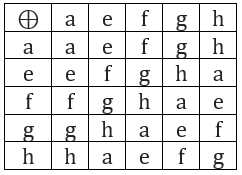
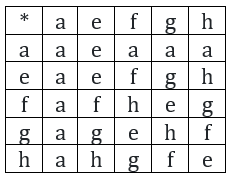
Two binary operations ⊕ and * are defined over the set {a, e, f, g, h} as per the following tables:
 âââââââ
 âââââââ
Thus, according to the first table f ⊕ g = a, while according to the second table g * h = f, and so on.
Also, let f2 = f * f, g3 = g * g * g, and so on.
What is the smallest positive integer n such that gn = e?
Answer the following question based on the information given below.
Two binary operations ⊕ and * are defined over the set {a, e, f, g, h} as per the following tables:
âââââââ
âââââââ
Thus, according to the first table f ⊕ g = a, while according to the second table g * h = f, and so on.
Also, let f2 = f * f, g3 = g * g * g, and so on.
Upon simplification, f ⊕ [f * {f ⊕ (f * f)}] equals:
Answer the following question based on the information given below.
Two binary operations ⊕ and * are defined over the set {a, e, f, g, h} as per the following tables:
âââââââ
âââââââ
Thus, according to the first table f ⊕ g = a, while according to the second table g * h = f, and so on.
Also, let f2 = f * f, g3 = g * g * g, and so on.
Upon simplification, (a10 * (f10 ⊕ g9)} ⊕ e8 equals
Answer the following question based on the information given below.
A string of three English letters is formed as per the following rules:
- The first letter is any vowel.
- The second letter is m, n or p.
- If the second letter is m, then the third letter is any vowel which is different from the first letter.
- If the second letter is n, then the third letter is e or u.
- If the second letter is p, then the third letter is the same as the first letter.
How many strings of letters can possibly be formed using the above rules?
Answer the following question based on the information given below.
A string of three English letters is formed as per the following rules:
- The first letter is any vowel.
- The second letter is m, n or p.
- If the second letter is m, then the third letter is any vowel which is different from the first letter.
- If the second letter is n, then the third letter is e or u.
- If the second letter is p, then the third letter is the same as the first letter.
How many strings of letters can possibly be formed using the above rules such that the third letter of the string is e?
There are 12 towns grouped into four zones with three towns per zone. It is intended to connect the towns with telephone lines such that every two towns are connected with three direct lines if they belong to the same zone, and with only one direct line otherwise. How many direct telephone lines are required?
In the figure (not drawn to scale) given below, P is a point on AB such that AP : PB = 4 : 3. PQ is parallel to AC and QD is parallel to CP. In âARC, ∠ARC = 90°, and in ΔPQS, ∠PSQ = 90°. The length of QS is 6 cm. What is the ratio AP : PD?

A car is being driven, in a straight line and at a uniform speed, towards the base of a vertical tower. The top of the tower is observed from the car and, in the process, it takes 10 minutes for the angle of elevation to change from 45° to 60°. After how much more time will this car reach the base of the tower?
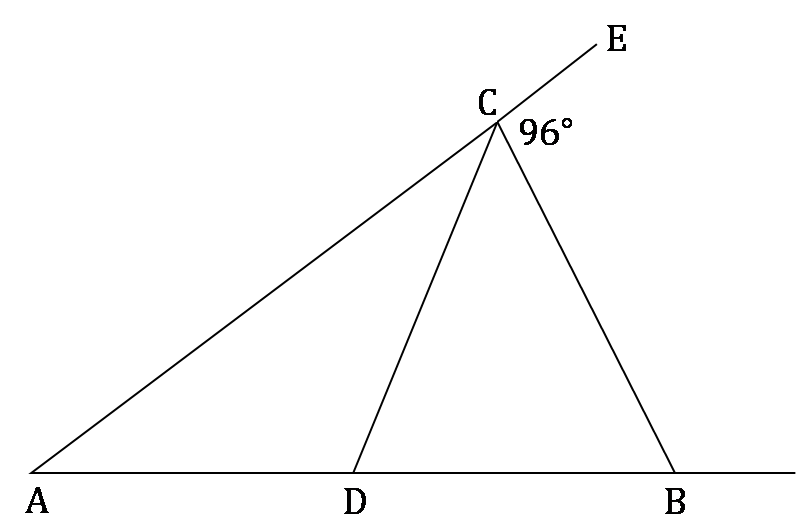
In the figure (not drawn to scale) given below, if AD = CD = BC, and ∠BCE = 96°, how much is ∠DBC?
If both a and b belong to the set {1, 2, 3, 4}, then the number of equations of the form ax2 + bx + 1 = 0 having real roots is:
If three positive real numbers x, y, z satisfy y – x = z – y and xyz = 4, then what is the minimum possible value of y?
An intelligence agency forms a code of two distinct digits selected from 0, 1, 2, ... , 9 such that the first digit of the code is non-zero. The code, handwritten on a slip, can however potentially create confusion, when read upside down – for example, the code 91 may appear as 16. How many codes are there for which no such confusion can arise?
Consider two different cloth-cutting processes. In the first one, n circular cloth pieces are cut from a square cloth piece of side a in the following steps: the original square of side a is divided into n smaller squares, not necessarily of the same size; then a circle of maximum possible area is cut from each of the smaller squares. In the second process, only one circle of maximum possible area is cut from the square of side a and the process ends there. The cloth pieces remaining after cutting the circles are scrapped in both the processes. The ratio of the total area of scrap cloth generated in the former to that in the latter is:
In the figure below (not drawn to scale), rectangle ABCD is inscribed in the circle with centre at O. The length of side AB is greater than that of side BC.
The ratio of the area of the circle to the area of the recrangle ABCD is π : .
The line segment DE intersects AB at E such that ∠ODC = ∠ADE. What is the ratio AE : AD?

If log10 x - log10 = 2 logx 10, then a possible value of x is given by:
What is the sum of all two-digit numbers that give a remainder of 3 when they are divided by 7?
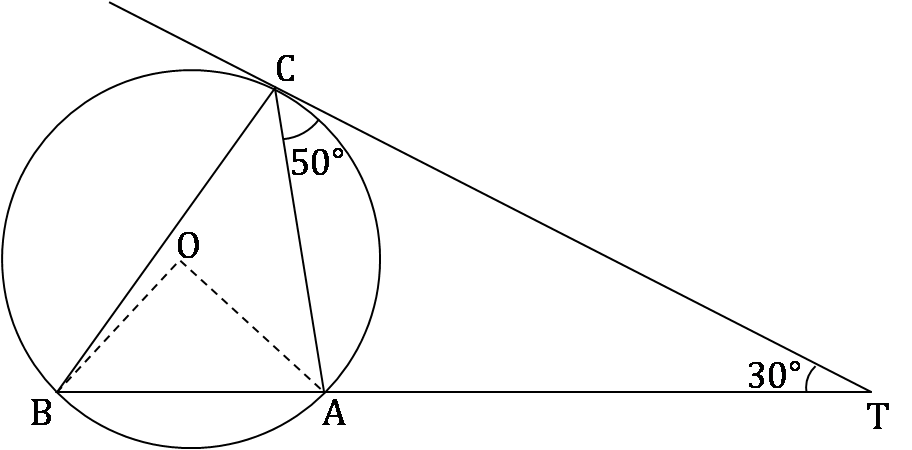
In the figure given below (not drawn to scale), A, B and C are three points on a circle with centre O. The chord BA is extended to a point T such that CT becomes a tangent to the circle at point C. If ∠ATC = 30° and ∠ACT = 50°, then the angle ∠BOA is:
What is the sum of n terms in the series
Let S1 be a square of side a. Another square S2 is formed by joining the mid-points of the sides of S1. The same process is applied to S2 to form yet another square S3, and so on. If A1, A2, A3... are the areas and P1, P2, P3... are the perimeters of S1, S2, S3... respectively,
then the ratio equals:
Answer the following question based on the information given below.
The seven basic symbols in a certain numeral system and their respective values are as follows:
I = 1, V = 5, X = 10, L = 50, C = 100, D = 500, and M = 1000
In general, the symbols in the numeral system are read from left to right, starting with the symbol representing the largest value; the same symbol cannot occur continuously more than three times; the value of the numeral is the sum of the values of the symbols.
For example, XXVII = 10 + 10 + 5 + 1 + 1 = 27.
An exception to the left-to-right reading occurs when a symbol is followed immediately by a symbol of greater value; then, the smaller value is subtracted from the larger.
For example, XLVI = (50 – 10) + 5 + 1 = 46.
The value of the numeral MDCCLXXXVII is:
Answer the following question based on the information given below.
The seven basic symbols in a certain numeral system and their respective values are as follows:
I = 1, V = 5, X = 10, L = 50, C = 100, D = 500, and M = 1000
In general, the symbols in the numeral system are read from left to right, starting with the symbol representing the largest value; the same symbol cannot occur continuously more than three times; the value of the numeral is the sum of the values of the symbols.
For example, XXVII = 10 + 10 + 5 + 1 + 1 = 27.
An exception to the left-to-right reading occurs when a symbol is followed immediately by a symbol of greater value; then, the smaller value is subtracted from the larger.
For example, XLVI = (50 – 10) + 5 + 1 = 46.
The value of the numeral MCMXCIX is
Answer the following question based on the information given below.
The seven basic symbols in a certain numeral system and their respective values are as follows:
I = 1, V = 5, X = 10, L = 50, C = 100, D = 500, and M = 1000
In general, the symbols in the numeral system are read from left to right, starting with the symbol representing the largest value; the same symbol cannot occur continuously more than three times; the value of the numeral is the sum of the values of the symbols.
For example, XXVII = 10 + 10 + 5 + 1 + 1 = 27.
An exception to the left-to-right reading occurs when a symbol is followed immediately by a symbol of greater value; then, the smaller value is subtracted from the larger.
For example, XLVI = (50 – 10) + 5 + 1 = 46.
Which of the following can represent the numeral for 1995?
a. MCMLXXV
b. MCMXCV
c. MVD
d. MVM