CAT 1996 — QA
All 48 QA questions from CAT 1996, with the answer key and detailed solutions. Practise free — check answers as you go, or tap Show solution.
CAT 1996 · QA
Passage / Data
Direction: Answer the questions based on the following information.
In a locality, there are five small cities: A, B, C, D and E. The distances of these cities from each other are as follows.
AB = 2 km AC = 2km AD > 2 km AE > 3 km BC = 2 km
BD = 4 km BE = 3 km CD = 2 km CE = 3 km DE > 3 km
If a ration shop is to be set up within 2 km of each city, how many ration shops will be required?
Passage / Data
Direction: Answer the questions based on the following information.
In a locality, there are five small cities: A, B, C, D and E. The distances of these cities from each other are as follows.
AB = 2 km AC = 2km AD > 2 km AE > 3 km BC = 2 km
BD = 4 km BE = 3 km CD = 2 km CE = 3 km DE > 3 km
If a ration shop is to be set up within 3 km of each city, how many ration shops will be required?
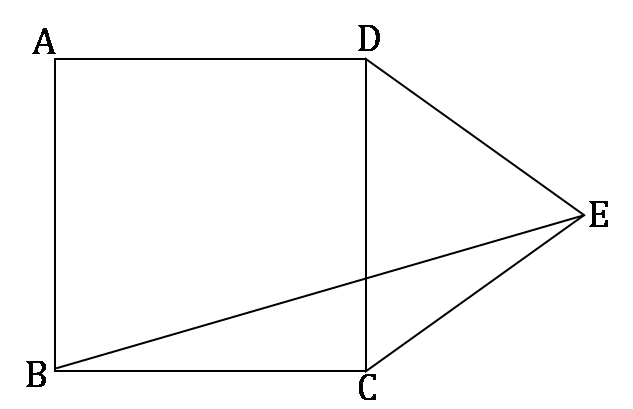
If ABCD is a square and BCE is an equilateral triangle, what is the measure of ∠DEC?
Instead of a metre scale, a cloth merchant uses a 120 cm scale while buying, but uses an 80 cm scale while selling the same cloth. If he offers a discount of 20% on cash payment, what is his overall profit percentage?
From a circular sheet of paper with a radius 20 cm, four circles of radius 5 cm each are cut out. What is the ratio of the uncut to the cut portion?
A wooden box (open at the top) of thickness 0.5 cm, length 21 cm, width 11 cm and height 6 cm is painted on the inside. The expenses of painting are Rs. 70. What is the rate of painting per square centimetres?
Passage / Data
Direction: Answer the questions based on the following information.
A, S, M and D are functions of x and y, and they are defined as follows.
A(x, y) = x + y
S(x, y) = x – y
M(x, y) = xy
D(x, y) = , y ≠ 0
What is the value of M(M(A(M(x, y), S(y, x)), x), A(y, x)) for x = 2, y = 3?
Passage / Data
Direction: Answer the questions based on the following information.
A, S, M and D are functions of x and y, and they are defined as follows.
A(x, y) = x + y
S(x, y) = x – y
M(x, y) = xy
D(x, y) = , y ≠ 0
What is the value of S[M(D(A(a, b), 2), D(A(a, b), 2)), M(D(S(a, b), 2), D(S(a, b), 2))]?
The cost of diamond varies directly as the square of its weight. Once, this diamond broke into four pieces with weights in the ratio 1 : 2 : 3 : 4. When the pieces were sold, the merchant got Rs. 70,000 less. Find the original price of the diamond.
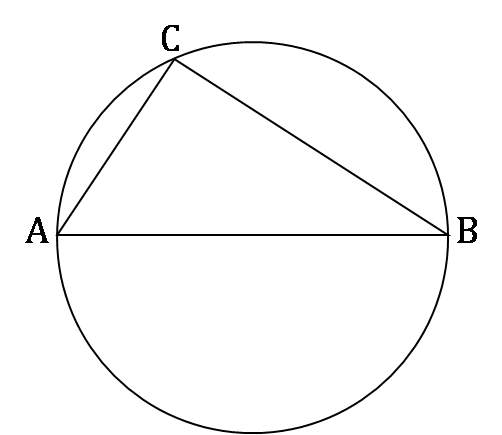
The figure shows a circle of diameter AB and radius 6.5 cm. If chord CA is 5 cm long, find the area of ΔABC.
Passage / Data
Direction: Answer the questions based on the following information.
A watch dealer incurs an expense of Rs. 150 for producing every watch. He also incurs an additional expenditure of Rs. 30,000, which is independent of the number of watches produced. If he is able to sell a watch during the season, he sells it for Rs. 250. If he fails to do so, he has to sell each watch for Rs. 100.
If he is able to sell only 1,200 out of 1,500 watches he has made in the season, then he has made a profit of
Passage / Data
Direction: Answer the questions based on the following information.
A watch dealer incurs an expense of Rs. 150 for producing every watch. He also incurs an additional expenditure of Rs. 30,000, which is independent of the number of watches produced. If he is able to sell a watch during the season, he sells it for Rs. 250. If he fails to do so, he has to sell each watch for Rs. 100.
If he produces 1,500 watches, what is the number of watches that he must sell during the season in order to break-even, given that he is able to sell all the watches produced?
Once I had been to the post office to buy five-rupee, two-rupee and one-rupee stamps. I paid the clerk Rs. 20, and since he had no change, he gave me three more one-rupee stamps. If the number of stamps of each type that I had ordered initially was more than one, what was the total number of stamps that I bought?
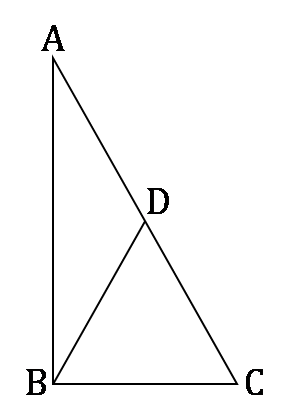
In ΔABC, ∠B is a right angle, AC = 6 cm, and D is the mid-point of AC. The length of BD is
Passage / Data
Direction: Answer the questions based on the following information.
A salesman enters the quantity sold and the price into the computer. Both the numbers are two-digit numbers. But, by mistake, both the numbers were entered with their digits interchanged. The total sales value remained the same, i.e. Rs. 1,148, but the inventory reduced by 54.
What is the actual price per piece?
Passage / Data
Direction: Answer the questions based on the following information.
A salesman enters the quantity sold and the price into the computer. Both the numbers are two-digit numbers. But, by mistake, both the numbers were entered with their digits interchanged. The total sales value remained the same, i.e. Rs. 1,148, but the inventory reduced by 54.
What is the actual quantity sold?
In a locality, two-thirds of the people have cable TV, one-fifth have VCR, and one-tenth have both. What is the fraction of people having either cable-TV or VCR?
Given the quadratic equation x2 – (A – 3)x – (A – 2), for what value of A will the sum of the squares of the roots be zero?
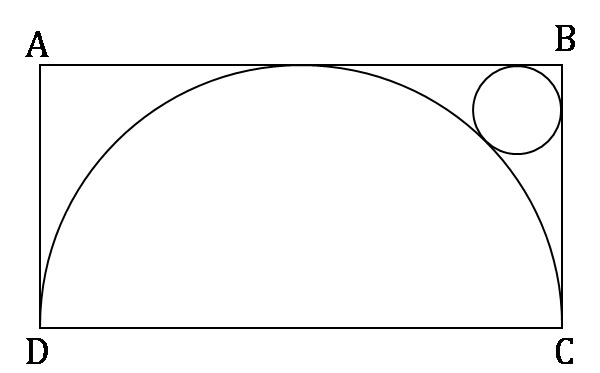
The figure shows the rectangle ABCD with a semicircle and a circle inscribed inside in it as shown. What is the ratio of the area of the circle to that of the semicircle?
I bought 5 pens, 7 pencils and 4 erasers. Rajan bought 6 pens, 8 erasers and 14 pencils for an amount which was half more what I had paid. What per cent of the total amount paid by me was paid for the pens?
In a mile race, Akshay can be given a start of 128 m by Bhairav. If Bhairav can give Chinmay a start of 4 m in a 100 m dash, then who out of Akshay and Chinmay will win a race of one and half miles, and what will be the final lead given by the winner to the loser? (One mile is 1,600 m.)
Two liquids A and B are in the ratio 5 : 1 in container 1 and 1 : 3 in container 2. In what ratio should the contents of the two containers be mixed so as to obtain a mixture of A and B in the ratio 1 : 1?
A man travels three-fifths of a distance AB at a speed 3a, and the remaining at a speed 2b. If he goes from B to A and return at a speed 5c in the same time, then
A man travels from A to B at a speed x km/hr. He then rests at B for x hours. He then travels from B to C at a speed 2x km/hr and rests for 2x hours. He moves further to D at a speed twice as that between B and C. He thus reaches D in 16 hr. If distances A-B, B-C and C-D are all equal to 12 km, the time for which he rested at B could be
Out of two-thirds of the total number of basketball matches, a team has won 17 matches and lost 3 of them. What is the maximum number of matches that the team can lose and still win more than threefourths of the total number of matches, if it is true that no match can end in a tie?
The price of a Maruti car rises by 30% while the sales of the car come down by 20%. What is the percentage change in the total revenue?
The points of intersection of three lines 2X + 3Y – 5 = 0, 5X – 7Y + 2 = 0 and 9X – 5Y – 4= 0
A man has 9 friends: 4 boys and 5 girls. In how many ways can he invite them, if there have to be exactly 3 girls in the invitees?
I sold two watches for Rs. 300 each, one at the loss of 10% and the other at the profit of 10%. What is the percentage of loss(–) or profit(+) that resulted from the transaction?
Passage / Data
Answer the questions based on the following information.
A series S1 of five positive integers is such that the third term is half the first term and the fifth term is 20 more than the first term. In series S2, the nth term defined as the difference between the (n + 1)th term and the nth term of series S1, is an arithmetic progression with a common difference of 30.
First term of S1 is
Passage / Data
Answer the questions based on the following information.
A series S1 of five positive integers is such that the third term is half the first term and the fifth term is 20 more than the first term. In series S2, the nth term defined as the difference between the (n + 1)th term and the nth term of series S1, is an arithmetic progression with a common difference of 30.
Second term of S2 is
Passage / Data
Answer the questions based on the following information.
A series S1 of five positive integers is such that the third term is half the first term and the fifth term is 20 more than the first term. In series S2, the nth term defined as the difference between the (n + 1)th term and the nth term of series S1, is an arithmetic progression with a common difference of 30.
What is the difference between second and fourth terms of S1?
Passage / Data
Answer the questions based on the following information.
A series S1 of five positive integers is such that the third term is half the first term and the fifth term is 20 more than the first term. In series S2, the nth term defined as the difference between the (n + 1)th term and the nth term of series S1, is an arithmetic progression with a common difference of 30.
What is the average value of the terms of series S1?
Passage / Data
Answer the questions based on the following information.
A series S1 of five positive integers is such that the third term is half the first term and the fifth term is 20 more than the first term. In series S2, the nth term defined as the difference between the (n + 1)th term and the nth term of series S1, is an arithmetic progression with a common difference of 30.
What is the sum of series S2?
Direction: Each question is followed by two statements, I and II. Mark the answer as
1. if the question cannot be answered even with the help of both the statements taken together.
2. if the question can be answered by any one of the two statements.
3. if each statement alone is sufficient to answer the question, but not the other one (e.g. statement I alone is required to answer the question, but not statement II and vice versa).
4. if both statements I and II together are needed to answer the question.
A tractor travelled a distance 5 m. What is the radius of the rear wheel?
I. The front wheel rotates ‘N’ times more than the rear wheel over this distance.
II. The circumference of the rear wheel is ‘t’ times that of the front wheel.
Direction: Each question is followed by two statements, I and II. Mark the answer as
1. if the question cannot be answered even with the help of both the statements taken together.
2. if the question can be answered by any one of the two statements.
3. if each statement alone is sufficient to answer the question, but not the other one (e.g. statement I alone is required to answer the question, but not statement II and vice versa).
4. if both statements I and II together are needed to answer the question.
What is the ratio of the two liquids A and B in the mixture finally, if these two liquids kept in three vessels are mixed together? (The containers are of equal volume.)
I. The ratio of liquid A to liquid B in the first and second vessel is 3 : 5, 2 : 3 respectively.
II. The ratio of liquid A to liquid B in vessel 3 is 4 : 3.
Direction: Each question is followed by two statements, I and II. Mark the answer as
1. if the question cannot be answered even with the help of both the statements taken together.
2. if the question can be answered by any one of the two statements.
3. if each statement alone is sufficient to answer the question, but not the other one (e.g. statement I alone is required to answer the question, but not statement II and vice versa).
4. if both statements I and II together are needed to answer the question.
If a, b and c are integers, is (a – b + c) > (a + b – c)?
I. b is negative.
II. c is positive.
Direction: Each question is followed by two statements, I and II. Mark the answer as
1. if the question cannot be answered even with the help of both the statements taken together.
2. if the question can be answered by any one of the two statements.
3. if each statement alone is sufficient to answer the question, but not the other one (e.g. statement I alone is required to answer the question, but not statement II and vice versa).
4. if both statements I and II together are needed to answer the question.
If α and β are the roots of the equation (ax2 + bx + c = 0), then what is the value of (α2 + β2)?
I. α + ß = -
II. 2αß =
Direction: Each question is followed by two statements, I and II. Mark the answer as
1. if the question cannot be answered even with the help of both the statements taken together.
2. if the question can be answered by any one of the two statements.
3. if each statement alone is sufficient to answer the question, but not the other one (e.g. statement I alone is required to answer the question, but not statement II and vice versa).
4. if both statements I and II together are needed to answer the question.
What is the cost price of the article?
I. After selling the article, a loss of 25% on cost price is incurred.
II. The selling price is three-fourths of the cost price.
Direction: Each question is followed by two statements, I and II. Mark the answer as
1. if the question cannot be answered even with the help of both the statements taken together.
2. if the question can be answered by any one of the two statements.
3. if each statement alone is sufficient to answer the question, but not the other one (e.g. statement I alone is required to answer the question, but not statement II and vice versa).
4. if both statements I and II together are needed to answer the question.
What is the selling price of the article?
I. The profit on sales is 20%.
II. The profit on each unit is 25% and the cost price is Rs. 250.
Direction: Each question is followed by two statements, I and II. Mark the answer as
1. if the question cannot be answered even with the help of both the statements taken together.
2. if the question can be answered by any one of the two statements.
3. if each statement alone is sufficient to answer the question, but not the other one (e.g. statement I alone is required to answer the question, but not statement II and vice versa).
4. if both statements I and II together are needed to answer the question.
How many different triangles can be formed?
I. There are 16 coplanar, straight lines.
II. No two lines are parallel.
Direction: Each question is followed by two statements, I and II. Mark the answer as
1. if the question cannot be answered even with the help of both the statements taken together.
2. if the question can be answered by any one of the two statements.
3. if each statement alone is sufficient to answer the question, but not the other one (e.g. statement I alone is required to answer the question, but not statement II and vice versa).
4. if both statements I and II together are needed to answer the question.
What is the total worth of Lakhiram's assets?
I. A compound interest at 10% on his assets, followed by a tax of 4% on the interest, fetches him Rs. 1,500 this year.
II. The interest is compounded once every four months.
Direction: Each question is followed by two statements, I and II. Mark the answer as
1. if the question cannot be answered even with the help of both the statements taken together.
2. if the question can be answered by any one of the two statements.
3. if each statement alone is sufficient to answer the question, but not the other one (e.g. statement I alone is required to answer the question, but not statement II and vice versa).
4. if both statements I and II together are needed to answer the question.
How old is Sachin in 1997?
I. Sachin is 11 years younger than Anil whose age will be a prime number in 1998.
II. Anil's age was a prime number in 1996.
Direction: Each question is followed by two statements, I and II. Mark the answer as
1. if the question cannot be answered even with the help of both the statements taken together.
2. if the question can be answered by any one of the two statements.
3. if each statement alone is sufficient to answer the question, but not the other one (e.g. statement I alone is required to answer the question, but not statement II and vice versa).
4. if both statements I and II together are needed to answer the question.
What is the number of type-2 widgets produced, if the total number of widgets produced is 20,000?
I. If the production of type-1 widgets increases by 10% and that of type-2 decreases by 6%, the total production remains the same.
II. The ratio in which type-1 and type-2 widgets are produced is 2 : 1.
If a number 774958A96B is to be divisible by 8 and 9, the respective values of A and B will be
Which of the following values of x do not satisfy the inequality (x2 – 3x + 2 > 0) at all?