CAT 1999 — QA
All 58 QA questions from CAT 1999, with the answer key and detailed solutions. Practise free — check answers as you go, or tap Show solution.
CAT 1999 · QA
The number of positive integer valued pairs (x, y) satisfying 4x – 17y = 1 and x ≤ 1000 is
Let a, b, c be distinct digits. Consider a two-digit number ‘ab’ and a three-digit number ‘ccb’, both defined under the usual decimal number system, if (ab)2 = ccb > 300, then the value of b is
The remainder when 784 is divided by 342 is
Ten points are marked on a straight-line and 11 points are marked on another straight-line. How many triangles can be constructed with vertices from among the above points?
For a scholarship, at the most n candidates out of 2n + 1 can be selected. If the number of different ways of selection of at least one candidate is 63, the maximum number of candidates that can be selected for the scholarship is
The speed of a railway engine is 42 kmph when no compartment is attached, and the reduction in speed is directly proportional to the square root of the number of compartments attached. If the speed of the train carried by this engine is 24 kmph when 9 compartments are attached, the maximum number of compartments that can be carried by the engine is
Total expenses of a boarding house are partly fixed and partly varying linearly with the number of boarders. The average expense per boarder is Rs. 700 when there are 25 boarders and Rs. 600 when there are 50 boarders. What is the average expense per boarder when there are 100 boarders?
Forty per cent of the employees of a certain company are men, and 75% of the men earn more than Rs. 25,000 per year. If 45% of the company’s employees earn more than Rs. 25,000 per year, what fraction of the women employed by the company earn less than or equal to Rs. 25,000 per year?
If n = 1 + x where x is the product of four consecutive positive integers, then which of the following
is/are true?
A. n is odd
B. n is prime
C. n is a perfect square
In a survey of political preferences, 78% of those asked were in favour of at least one of the proposals: I, II and III.
50% of those asked favoured proposal I, 30% favoured proposal II and 20% favoured proposal III. If 5% of those asked favoured all three of the proposals, what percentage of those asked favoured more than one of the three proposals?
For two positive integers a and b define the function h(a,b) as the greatest common factor (G.C.F) of a, b. Let A be a set of n positive integers. G(A), the G.C.F of the elements of set A is computed by repeatedly using the function h. The minimum number of times h is required to be used to compute G is
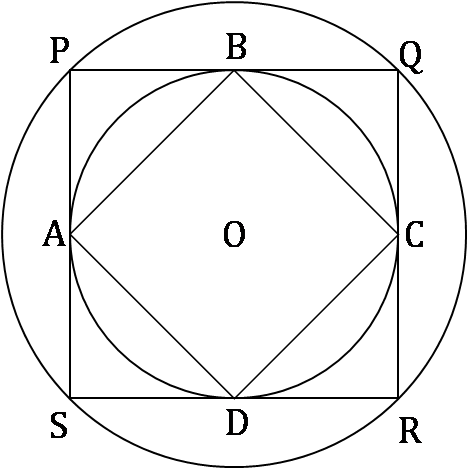
The figure below shows two concentric circles with centre O. PQRS is a square inscribed in the outer circle. It also circumscribes the inner circle, touching it at points B, C, D and A. What is the ratio of the perimeter of the outer circle to that of polygon ABCD?
Three labelled boxes containing red and white cricket balls are all mislabelled. It is known that one of the boxes contains only white balls and another one contains only red balls. The third contains a mixture of red and white balls. You are required to correctly label the boxes with the labels red, white and red and white by picking a sample of one ball from only one box. What is the label on the box you should sample?
Navjivan Express from Ahmedabad to Chennai leaves Ahmedabad at 6.30 a.m. and travels at 50 kmph towards Baroda situated 100 km away. At 7.00 a.m. Howrah-Ahmedabad Express leaves Baroda towards Ahmedabad and travels at 40 kmph. At 7.30 a.m. Mr Shah, the traffic controller at Baroda realizes that both the trains are running on the same track. How much time does he have to avert a head-on collision between the two trains?
There is a circle of radius 1 cm. Each member of a sequence of regular polygons S1(n), n = 4, 5, 6, …, where n is the number of sides of the polygon, is circumscribing the circle: and each member of the sequence of regular polygons S2(n), n = 4, 5, 6, … here n is the number of sides of the polygon, is inscribed in the circle. Let L1(n) and L2(n) denote the perimeters of the corresponding
polygons of S1(n) and S2(n), then is
There is a square field of side 500 m long each. It has a compound wall along its perimeter. At onec of its corners, a triangular area of the field is to be cordoned off by erecting a straight-line fence. The compound wall and the fence will form its borders. If the length of the fence is 100 m, what is the maximum area that can be cordoned off?
Passage / Data
Answer the next 3 questions based on the following information.
A young girl Roopa leaves home with x flowers, goes to the bank of a nearby river. On the bank of the river, there are four places of worship, standing in a row. She dips all the x flowers into the river. The number of flowers doubles. Then she enters the first place of worship, offers y flowers to the deity. She dips the remaining flowers into the river, and again the number of flowers doubles. She goes to the second place of worship, offers y flowers to the deity. She dips the remaining flowers into the river, and again the number of flowers doubles. She goes to the third place of worship, offers y flowers to the deity. She dips the remaining flowers into the river, and again the number of flowers doubles. She goes to the fourth place of worship, offers y flowers to the deity. Now she is left with no flowers in hand.
If Roopa leaves home with 30 flowers, the number of flowers she offers to each deity is
Passage / Data
Answer the next 3 questions based on the following information.
A young girl Roopa leaves home with x flowers, goes to the bank of a nearby river. On the bank of the river, there are four places of worship, standing in a row. She dips all the x flowers into the river. The number of flowers doubles. Then she enters the first place of worship, offers y flowers to the deity. She dips the remaining flowers into the river, and again the number of flowers doubles. She goes to the second place of worship, offers y flowers to the deity. She dips the remaining flowers into the river, and again the number of flowers doubles. She goes to the third place of worship, offers y flowers to the deity. She dips the remaining flowers into the river, and again the number of flowers doubles. She goes to the fourth place of worship, offers y flowers to the deity. Now she is left with no flowers in hand.
The minimum number of flowers that could be offered to each deity is
Passage / Data
Answer the next 3 questions based on the following information.
A young girl Roopa leaves home with x flowers, goes to the bank of a nearby river. On the bank of the river, there are four places of worship, standing in a row. She dips all the x flowers into the river. The number of flowers doubles. Then she enters the first place of worship, offers y flowers to the deity. She dips the remaining flowers into the river, and again the number of flowers doubles. She goes to the second place of worship, offers y flowers to the deity. She dips the remaining flowers into the river, and again the number of flowers doubles. She goes to the third place of worship, offers y flowers to the deity. She dips the remaining flowers into the river, and again the number of flowers doubles. She goes to the fourth place of worship, offers y flowers to the deity. Now she is left with no flowers in hand.
The minimum number of flowers with which Roopa leaves home is
Passage / Data
Answer the next 2 questions based on the following information.
The following table presents the sweetness of different items relative to sucrose, whose sweetness is taken to be 1.00.
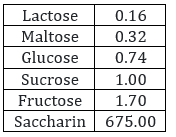
What is the minimum amount of sucrose (to the nearest gram) that must be added to one gram of saccharin to make a mixture that will be at least 100 times as sweet as glucose?
Passage / Data
Answer the next 2 questions based on the following information.
The following table presents the sweetness of different items relative to sucrose, whose sweetness is taken to be 1.00.
Approximately how many times sweeter than sucrose is a mixture consisting of glucose, sucrose and fructose in the ratio of 1 : 2 : 3?
Passage / Data
Directions : Answer the questions based on the following information.
A rectangle PRSU, is divided into two smaller rectangles PQTU, and QRST by the line TQ. PQ = 10 cm. QR = 5 cm and RS = 10 cm. Points A, B, F are within rectangle PQTU, and points C, D, E are within the rectangle QRST. The closest pair of points among the pairs (A, C), (A, D), (A, E), (F, C), (F, D), (F, E), (B, C), (B, D), (B, E) are cm apart.
Which of the following statements is necessarily true?
Passage / Data
Directions : Answer the questions based on the following information.
A rectangle PRSU, is divided into two smaller rectangles PQTU, and QRST by the line TQ. PQ = 10 cm. QR = 5 cm and RS = 10 cm. Points A, B, F are within rectangle PQTU, and points C, D, E are within the rectangle QRST. The closest pair of points among the pairs (A, C), (A, D), (A, E), (F, C), (F, D), (F, E), (B, C), (B, D), (B, E) are cm apart.
AB > AF > BF ; CD > DE >CE ; and BF = 6 cm. Which is the closest pair of points among all the six given points?
Passage / Data
Answer the next 4 questions based on the following information.
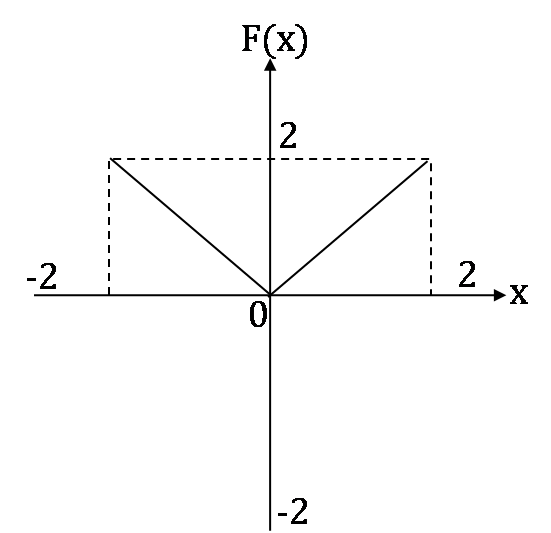
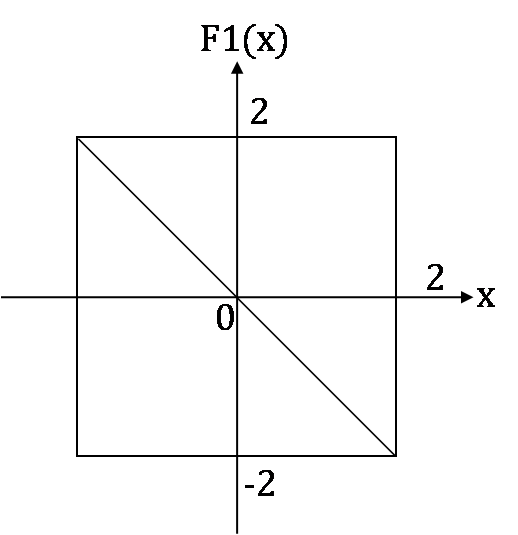
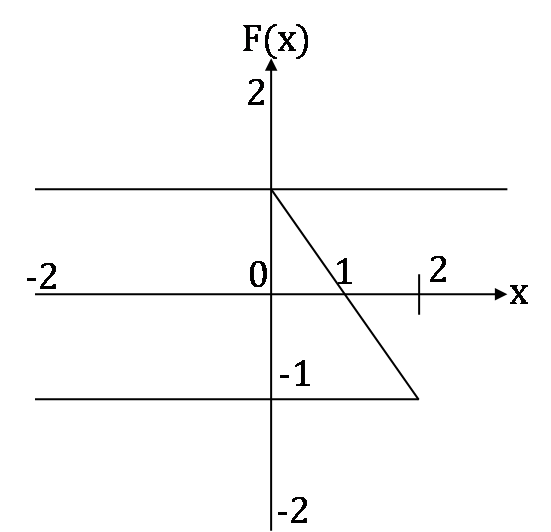
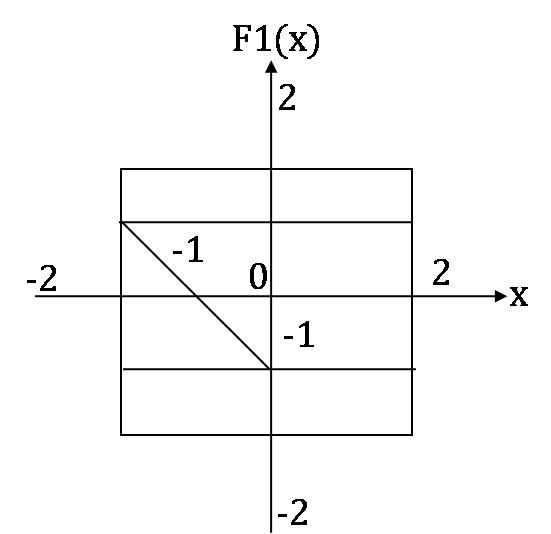
In each of the following questions, a pair of graphs F(x) and F1(x) is given. These are composed of straightline segments, shown as solid lines, in the domain x ∈ (−2, 2).
Choose the answer as
a. if F1(x) = –F(x)
b. if F1(x) = F(–x)
c. if F1(x) = –F(–x)
d. if none of the above is true
Passage / Data
Answer the next 4 questions based on the following information.
In each of the following questions, a pair of graphs F(x) and F1(x) is given. These are composed of straightline segments, shown as solid lines, in the domain x ∈ (−2, 2).
Choose the answer as
a. if F1(x) = –F(x)
b. if F1(x) = F(–x)
c. if F1(x) = –F(–x)
d. if none of the above is true
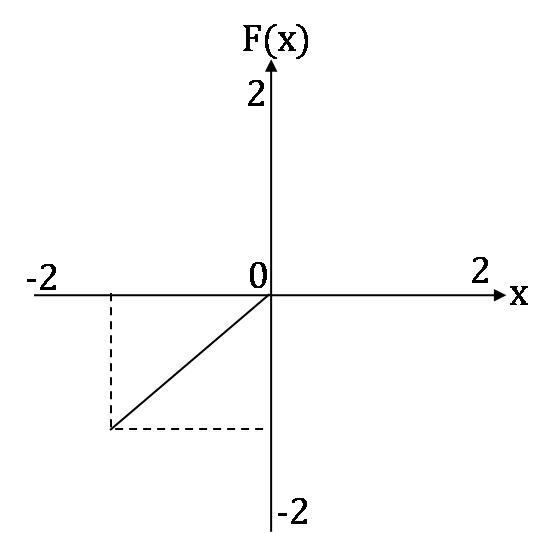
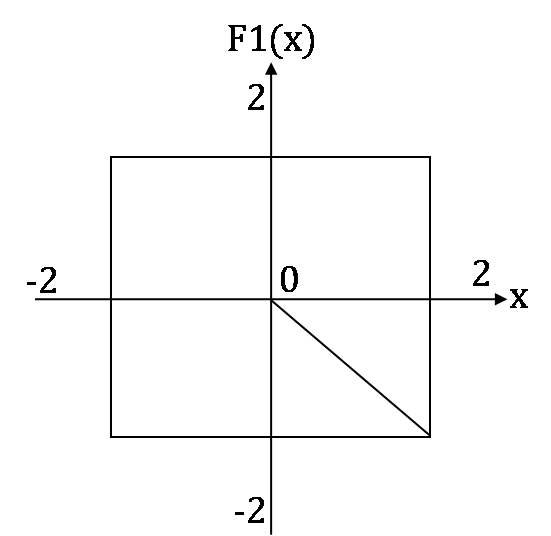
Passage / Data
Answer the next 4 questions based on the following information.
In each of the following questions, a pair of graphs F(x) and F1(x) is given. These are composed of straightline segments, shown as solid lines, in the domain x ∈ (−2, 2).
Choose the answer as
a. if F1(x) = –F(x)
b. if F1(x) = F(–x)
c. if F1(x) = –F(–x)
d. if none of the above is true
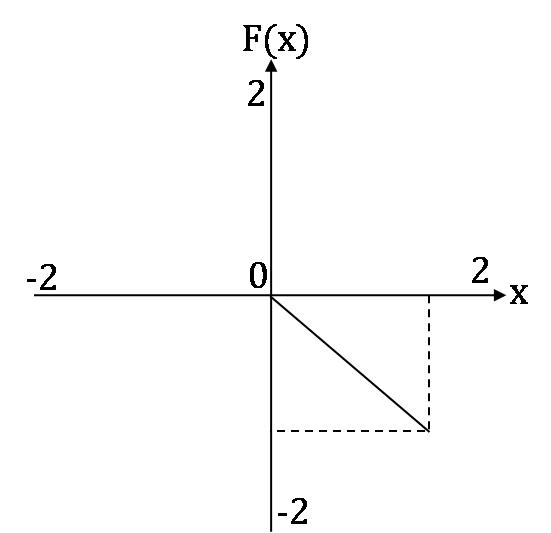
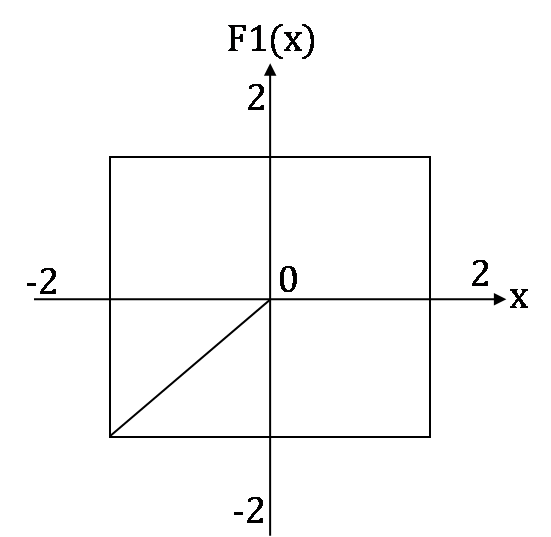
Passage / Data
Answer the next 4 questions based on the following information.
In each of the following questions, a pair of graphs F(x) and F1(x) is given. These are composed of straightline segments, shown as solid lines, in the domain x ∈ (−2, 2).
Choose the answer as
a. if F1(x) = –F(x)
b. if F1(x) = F(–x)
c. if F1(x) = –F(–x)
d. if none of the above is true
Passage / Data
Answer the next 2 questions based on the following information.
There are blue vessels with known volumes v1, v2..., vm, arranged in ascending order of volume, v1 > 0.5 litre, and vm < 1 litre. Each of these is full of water initially. The water from each of these is emptied into a minimum number of empty white vessels, each having volume 1 litre. The water from a blue vessel is not emptied into a white vessel unless the white vessel has enough empty volume to hold all the water of the blue vessel. The number of white vessels required to empty all the blue vessels according to the above rules was n.
Among the four values given below, which is the least upper bound on e, where e is the total empty volume in the white vessels at the end of the above process?
Passage / Data
Answer the next 2 questions based on the following information.
There are blue vessels with known volumes v1, v2..., vm, arranged in ascending order of volume, v1 > 0.5 litre, and vm < 1 litre. Each of these is full of water initially. The water from each of these is emptied into a minimum number of empty white vessels, each having volume 1 litre. The water from a blue vessel is not emptied into a white vessel unless the white vessel has enough empty volume to hold all the water of the blue vessel. The number of white vessels required to empty all the blue vessels according to the above rules was n.
Let the number of white vessels needed be n1 for the emptying process described above, if the volume of each white vessel is 2 litres. Among the following values, which is the least upper bound on n1?
Passage / Data
Directions: Answer the questions based on the following information.
There are 50 integers a1, a2 … a50, not all of them necessarily different. Let the greatest integer of these 50 integers be referred to as G, and the smallest integer be referred to as L. The integers a1 through a24 form sequence S1, and the rest form sequence S2. Each member of S1 is less than or equal to each member of S2.
All values in S1 are changed in sign, while those in S2 remain unchanged. Which of the following statements is true?
Passage / Data
Directions: Answer the questions based on the following information.
There are 50 integers a1, a2 … a50, not all of them necessarily different. Let the greatest integer of these 50 integers be referred to as G, and the smallest integer be referred to as L. The integers a1 through a24 form sequence S1, and the rest form sequence S2. Each member of S1 is less than or equal to each member of S2.
Elements of S1 are in ascending order, and those of S2 are in descending order. a24 and a25 are interchanged. Then which of the following statements is true?
Passage / Data
Directions: Answer the questions based on the following information.
There are 50 integers a1, a2 … a50, not all of them necessarily different. Let the greatest integer of these 50 integers be referred to as G, and the smallest integer be referred to as L. The integers a1 through a24 form sequence S1, and the rest form sequence S2. Each member of S1 is less than or equal to each member of S2.
Every element of S1 is made greater than or equal to every element of S2 by adding to each element of S1 an integer x. Then x cannot be less than
Passage / Data
Directions: Answer the questions based on the following information.
Let x and y be real numbers and let
f (x,y) = |x + y| , F(f (x,y)) = −f (x,y)
and G(f (x, y)) = −F(f (x, y))
Which of the following statements is true?
Passage / Data
Directions: Answer the questions based on the following information.
Let x and y be real numbers and let
f (x,y) = |x + y| , F(f (x,y)) = −f (x,y)
and G(f (x, y)) = −F(f (x, y))
What is the value of f(G(f(1, 0)), f(F(f(1, 2)), G(f(1, 2))))?
Passage / Data
Directions: Answer the questions based on the following information.
Let x and y be real numbers and let
f (x,y) = |x + y| , F(f (x,y)) = −f (x,y)
and G(f (x, y)) = −F(f (x, y))
Which of the following expressions yields x2 as its result?
Passage / Data
Directions: Answer the questions based on the following information.
A robot moves on a graph sheet with X and Y-axis. The robot is moved by feeding it with a sequence of instructions. The different instructions that can be used in moving it, and their meanings are:
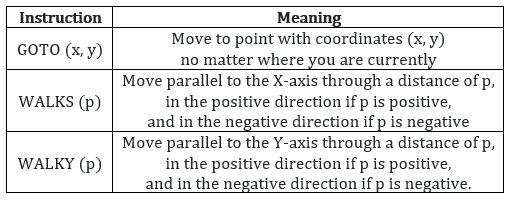
The robot reaches point (6, 6) when a sequence of three instructions is executed, the first of which is a GOTO(x,y) instruction, the second is WALKX(2) and the third is WALKY(4). What are the value of x and y?
Passage / Data
Directions: Answer the questions based on the following information.
A robot moves on a graph sheet with X and Y-axis. The robot is moved by feeding it with a sequence of instructions. The different instructions that can be used in moving it, and their meanings are:
The robot is initially at (x, y), x > 0 and y < 0. The minimum number of instructions needed to be executed to bring it to the origin (0, 0) if you are prohibited from using the GOTO instruction is
Passage / Data
Directions: Answer the questions based on the following information.
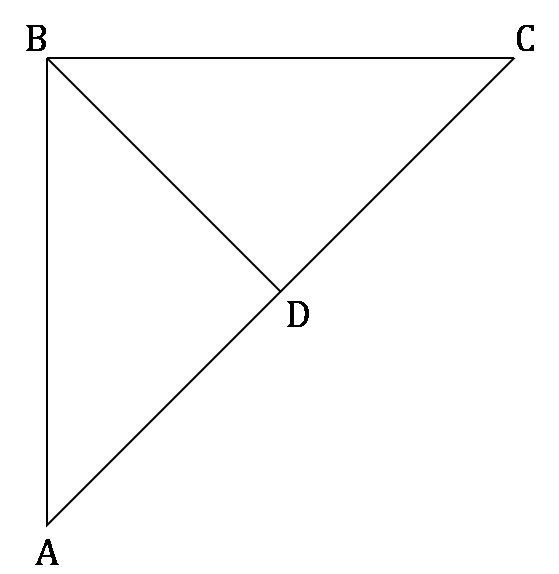
A road network (shown in the figure below) connects cities A, B, C and D. All road segments are straight lines. D is the mid-point on the road connecting A and C. Roads AB and BC are at right angles to each other with BC shorter than AB. The segment AB is 100 km long.
Ms X and Mr Y leave A at 8.00 a.m., take different routes to city C and reach at the same time. X takes the highway from A to B to C and travels at an average speed of 61.875 kmph. Y takes the direct route AC and travels at 45 kmph on segment AD. Y’s speed on segment DC is 55 kmph.
What is the average speed of Y?
Passage / Data
Directions: Answer the questions based on the following information.
A road network (shown in the figure below) connects cities A, B, C and D. All road segments are straight lines. D is the mid-point on the road connecting A and C. Roads AB and BC are at right angles to each other with BC shorter than AB. The segment AB is 100 km long.
Ms X and Mr Y leave A at 8.00 a.m., take different routes to city C and reach at the same time. X takes the highway from A to B to C and travels at an average speed of 61.875 kmph. Y takes the direct route AC and travels at 45 kmph on segment AD. Y’s speed on segment DC is 55 kmph.
The total distance travelled by Y during the journey is approximately
Passage / Data
Directions: Answer the questions based on the following information.
A road network (shown in the figure below) connects cities A, B, C and D. All road segments are straight lines. D is the mid-point on the road connecting A and C. Roads AB and BC are at right angles to each other with BC shorter than AB. The segment AB is 100 km long.
Ms X and Mr Y leave A at 8.00 a.m., take different routes to city C and reach at the same time. X takes the highway from A to B to C and travels at an average speed of 61.875 kmph. Y takes the direct route AC and travels at 45 kmph on segment AD. Y’s speed on segment DC is 55 kmph.
What is the length of the road segment BD?
Passage / Data
Directions: Answer the questions based on the following information.
Rajiv reaches city B from city A in 4 hours, driving at speed of 35 kmph for the first two hour and at 45 kmph for the next two hours. Aditi follows the same route, but drives at three different speeds: 30, 40 and 50 kmph, covering an equal distance in each speed segment. The two cars are similar with petrol consumption characteristics (km per litre) shown in the figure below.
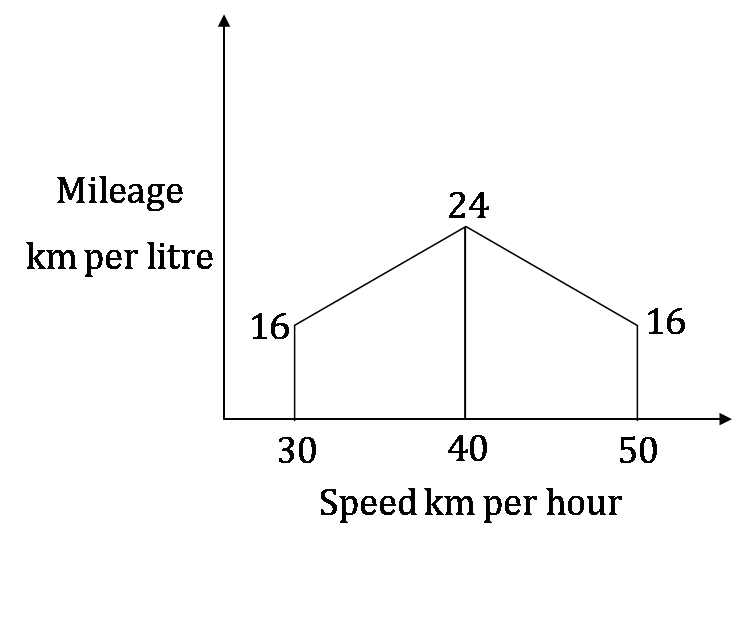
The quantity of petrol consumed by Aditi for the journey is
Passage / Data
Directions: Answer the questions based on the following information.
Rajiv reaches city B from city A in 4 hours, driving at speed of 35 kmph for the first two hour and at 45 kmph for the next two hours. Aditi follows the same route, but drives at three different speeds: 30, 40 and 50 kmph, covering an equal distance in each speed segment. The two cars are similar with petrol consumption characteristics (km per litre) shown in the figure below.
Zoheb would like to drive Aditi’s car over the same route from A to B and minimize the petrol consumption for the trip. What is the quantity of petrol required by him?
Passage / Data
Directions: Answer the questions based on the following information.
Recently, Ghosh Babu spent his winter vacation on Kyakya Island. During the vacation, he visited the local casino where he came across a new card game. Two players, using a normal deck of 52 playing cards, play this game. One player is called the ‘dealer’ and the other is called the ‘player’. First, the player picks a card at random from the deck. This is called the base card. The amount in rupees equal to the face value of the base card is called the base amount. The face values of ace, king, queen and jack are ten. For other cards the face value is the number on the card. Once the ‘player’ picks a card from the deck, the ‘dealer’ pays him the base amount. Then the ‘dealer’ picks a card from the deck and this card is called the top card. If the top card is of the same suit as the base card, the ‘player’ pays twice the base amount to the ‘dealer’. If the top card is of the same colour as the base card (but not the same suit), then the ‘player’ pays the base amount to the ‘dealer’. If the top card happens to be of a different colour than the base card, the ‘dealer’ pays the base amount to the ‘player’.
Ghosh Babu played the game four times. First time he picked eight of clubs and the ‘dealer’ picked queen of clubs. Second time, he picked ten of hearts and the ‘dealer’ picked two of spades. Next time, Ghosh Babu picked six of diamonds and the ‘dealer’ picked ace of hearts. Lastly, he picked eight of spades and the ‘dealer’ picked jack of spades. Answer the following questions based on these four games.
If Ghosh Babu stopped playing the game when his gain would be maximized, the gain in Rs. would have been
Passage / Data
Directions: Answer the questions based on the following information.
Recently, Ghosh Babu spent his winter vacation on Kyakya Island. During the vacation, he visited the local casino where he came across a new card game. Two players, using a normal deck of 52 playing cards, play this game. One player is called the ‘dealer’ and the other is called the ‘player’. First, the player picks a card at random from the deck. This is called the base card. The amount in rupees equal to the face value of the base card is called the base amount. The face values of ace, king, queen and jack are ten. For other cards the face value is the number on the card. Once the ‘player’ picks a card from the deck, the ‘dealer’ pays him the base amount. Then the ‘dealer’ picks a card from the deck and this card is called the top card. If the top card is of the same suit as the base card, the ‘player’ pays twice the base amount to the ‘dealer’. If the top card is of the same colour as the base card (but not the same suit), then the ‘player’ pays the base amount to the ‘dealer’. If the top card happens to be of a different colour than the base card, the ‘dealer’ pays the base amount to the ‘player’.
Ghosh Babu played the game four times. First time he picked eight of clubs and the ‘dealer’ picked queen of clubs. Second time, he picked ten of hearts and the ‘dealer’ picked two of spades. Next time, Ghosh Babu picked six of diamonds and the ‘dealer’ picked ace of hearts. Lastly, he picked eight of spades and the ‘dealer’ picked jack of spades. Answer the following questions based on these four games.
The initial money Ghosh Babu had (before the beginning of the game sessions) was Rs. X. At no point did he have to borrow any money. What is the minimum possible value of X?
Passage / Data
Directions: Answer the questions based on the following information.
Recently, Ghosh Babu spent his winter vacation on Kyakya Island. During the vacation, he visited the local casino where he came across a new card game. Two players, using a normal deck of 52 playing cards, play this game. One player is called the ‘dealer’ and the other is called the ‘player’. First, the player picks a card at random from the deck. This is called the base card. The amount in rupees equal to the face value of the base card is called the base amount. The face values of ace, king, queen and jack are ten. For other cards the face value is the number on the card. Once the ‘player’ picks a card from the deck, the ‘dealer’ pays him the base amount. Then the ‘dealer’ picks a card from the deck and this card is called the top card. If the top card is of the same suit as the base card, the ‘player’ pays twice the base amount to the ‘dealer’. If the top card is of the same colour as the base card (but not the same suit), then the ‘player’ pays the base amount to the ‘dealer’. If the top card happens to be of a different colour than the base card, the ‘dealer’ pays the base amount to the ‘player’.
Ghosh Babu played the game four times. First time he picked eight of clubs and the ‘dealer’ picked queen of clubs. Second time, he picked ten of hearts and the ‘dealer’ picked two of spades. Next time, Ghosh Babu picked six of diamonds and the ‘dealer’ picked ace of hearts. Lastly, he picked eight of spades and the ‘dealer’ picked jack of spades. Answer the following questions based on these four games.
If the final amount of money that Ghosh Babu had with him was Rs. 100, what was the initial amount he had with him?
Directions: Each question is followed by two statements I and II. Mark:
1. if the question can be answered by any one of the statements alone, but cannot be answered by using the other statement alone.
2. if the question can be answered by using either statement alone.
3. if the question can be answered by using both the statements together, but cannot be answered by using either statement alone.
4. if the question cannot be answered even by using both the statements together.
The average weight of students in a class is 50 kg. What is the number of students in the class?
I. The heaviest and the lightest members of the class weigh 60 kg and 40 kg respectively.
II. Exclusion of the heaviest and the lightest members from the class does not change the average weight of the students.
Directions: Each question is followed by two statements I and II. Mark:
1. if the question can be answered by any one of the statements alone, but cannot be answered by using the other statement alone.
2. if the question can be answered by using either statement alone.
3. if the question can be answered by using both the statements together, but cannot be answered by using either statement alone.
4. if the question cannot be answered even by using both the statements together.
A small storage tank is spherical in shape. What is the storage volume of the tank?
I. The wall thickness of the tank is 1 cm.
II. When an empty spherical tank is immersed in a large tank filled with water, 20 l of water overflow from the large tank.
Directions: Each question is followed by two statements I and II. Mark:
1. if the question can be answered by any one of the statements alone, but cannot be answered by using the other statement alone.
2. if the question can be answered by using either statement alone.
3. if the question can be answered by using both the statements together, but cannot be answered by using either statement alone.
4. if the question cannot be answered even by using both the statements together.
Mr X starts walking northwards along the boundary of a field from point A on the boundary, and after walking for 150 m reaches B, and then walks westwards, again along the boundary, for another 100 m when he reaches C. What is the maximum distance between any pair of points on the boundary of the field?
I. The field is rectangular in shape.
II. The field is a polygon, with C as one of its vertices and A as the mid-point of a side.
Directions: Each question is followed by two statements I and II. Mark:
1. if the question can be answered by any one of the statements alone, but cannot be answered by using the other statement alone.
2. if the question can be answered by using either statement alone.
3. if the question can be answered by using both the statements together, but cannot be answered by using either statement alone.
4. if the question cannot be answered even by using both the statements together.
A line graph on a graph sheet shows the revenue for each year from 1990 through 1998 by points and joins the successive points by straight-line segments. The point for revenue of 1990 is labelled A, that for 1991 as B, and that for 1992 as C. What is the ratio of growth in revenue between 1991-92 and 1990-91?
I. The angle between AB and X-axis when measured with a protractor is 40°, and the angle between CB and X-axis is 80°.
II. The scale of Y-axis is 1 cm = Rs. 100
Directions: Each question is followed by two statements I and II. Mark:
1. if the question can be answered by any one of the statements alone, but cannot be answered by using the other statement alone.
2. if the question can be answered by using either statement alone.
3. if the question can be answered by using both the statements together, but cannot be answered by using either statement alone.
4. if the question cannot be answered even by using both the statements together.
There is a circle with centre C at the origin and radius r cm. Two tangents are drawn from an external
point D at a distance d cm from the centre. What are the angles between each tangent and the X-axis.
I. The coordinates of D are given.
II. The X-axis bisects one of the tangents.
Directions: Each question is followed by two statements I and II. Mark:
1. if the question can be answered by any one of the statements alone, but cannot be answered by using the other statement alone.
2. if the question can be answered by using either statement alone.
3. if the question can be answered by using both the statements together, but cannot be answered by using either statement alone.
4. if the question cannot be answered even by using both the statements together.
Find a pair of real numbers x and y that satisfy the following two equations simultaneously. It is known that the values of a, b, c, d, e and f are non-zero.
ax + by = c
dx + ey = f
I. a = kd and b = ke, c = kf, k ≠ 0
II. a = b = 1, d = e = 2, f ≠ 2c
Directions: Each question is followed by two statements I and II. Mark:
1. if the question can be answered by any one of the statements alone, but cannot be answered by using the other statement alone.
2. if the question can be answered by using either statement alone.
3. if the question can be answered by using both the statements together, but cannot be answered by using either statement alone.
4. if the question cannot be answered even by using both the statements together.
Three professors A, B and C are separately given three sets of numbers to add. They were expected to find the answers to 1 + 1, 1 + 1 + 2, and 1 + 1 respectively. Their respective answers were 3, 3 and 2. How many of the professors are mathematicians?
I. A mathematician can never add two numbers correctly, but can always add three numbers correctly.
II. When a mathematician makes a mistake in a sum, the error is +1 or –1.
Directions: Each question is followed by two statements I and II. Mark:
1. if the question can be answered by any one of the statements alone, but cannot be answered by using the other statement alone.
2. if the question can be answered by using either statement alone.
3. if the question can be answered by using both the statements together, but cannot be answered by using either statement alone.
4. if the question cannot be answered even by using both the statements together.
How many students among A, B, C and D have passed the examination?
I. The following is a true statement: A and B passed the examination.
II. The following is a false statement: At least one among C and D has passed the examination.
Directions: Each question is followed by two statements I and II. Mark:
1. if the question can be answered by any one of the statements alone, but cannot be answered by using the other statement alone.
2. if the question can be answered by using either statement alone.
3. if the question can be answered by using both the statements together, but cannot be answered by using either statement alone.
4. if the question cannot be answered even by using both the statements together.
What is the distance x between two cities A and B in integral number of kilometres?
I. x satisfies the equation
II. x ≤ 10 km
Directions: Each question is followed by two statements I and II. Mark:
1. if the question can be answered by any one of the statements alone, but cannot be answered by using the other statement alone.
2. if the question can be answered by using either statement alone.
3. if the question can be answered by using both the statements together, but cannot be answered by using either statement alone.
4. if the question cannot be answered even by using both the statements together.
Mr Mendel grew 100 flowering plants from black seeds and white seeds, each seed giving rise to one plant. A plant gives flowers of only one colour. From a black seed comes a plant giving red or blue flowers. From a white seed comes a plant giving red or white flowers. How many black seeds were used by Mr Mendel?
I. The number of plants with white flowers was 10.
II. The number of plants with red flowers was 70.
Directions: Each question is followed by two statements I and II. Mark:
1. if the question can be answered by any one of the statements alone, but cannot be answered by using the other statement alone.
2. if the question can be answered by using either statement alone.
3. if the question can be answered by using both the statements together, but cannot be answered by using either statement alone.
4. if the question cannot be answered even by using both the statements together.
What is the distance x between two cities A and B in integral number of kilometres?
I. x satisfies the equation
II. x ≤ 10 km