CAT 2004 — QA
All 40 QA questions from CAT 2004, with the answer key and detailed solutions. Practise free — check answers as you go, or tap Show solution.
CAT 2004 · QA
A father and his son are waiting at a bus stop in the evening. There is a lamp post behind them. The lamp post, the father and his son stand on the same straight line. The father observes that the shadows of his head and his son's head are incident at the same point on the ground. If the heights of the lamp post, the father and his son are 6 metres, 1.8 metres and 0.9 metres respectively, and the father is standing 2.1 metres away from the post, then how far (in metres) is the son standing from his father?
A milkman mixes 20 litres of water with 80 litres of milk. After selling one-fourth of this mixture, he adds water to replenish the quantity that he has sold. What is the current proportion of water to milk?
Karan and Arjun run a 100 metre race, where Karan beats Arjun by 10 metres. To do a favour to Arjun, Karan starts 10 metres behind the starting line in a second 100 metre race. They both run at their earlier speeds. Which of the following is true in connection with the second race?
N persons stand on the circumference of a circle at distinct points. Each possible pair of persons, not standing next to each other, sings a two-minute song one pair after the other. If the total time taken for singing is 28 minutes, what is N?
If the sum of the first 11 terms of an arithmetic progression equals that of the first 19 terms, then what is the sum of the first 30 terms?
If a man cycles at 10 km/hr, then he arrives at a certain place at 1 p.m. If he cycles at 15 km/hr, he will arrive at the same place at 11 a.m. At what speed must he cycle to get there at noon?
On January 1, 2004 two new societies, S1, and S2, are formed, each with n members. On the first day of each subsequent month, S1 adds b members while S2 multiplies its current number of members by a constant factor r. Both the societies have the same number of members on July 2, 2004. If b = 10.5n, what is the value of r?
If f(x) = x3 – 4x + p, and f(0) and f(1) are of opposite signs, then which of the following is necessarily true?
Suppose n is an integer such that the sum of the digits of n is 2, and 1010 < n < 1011. The number of different values for n is
Let f(x) = ax2 – b|x|, where a and b are constants. Then at x = 0, f(x) is
Two boats, travelling at 5 and 10 kms per hour, head directly towards each other. They begin at a distance of 20 kms from each other. How far apart are they (in kms) one minute before they collide?
Each family in a locality has at most two adults, and no family has fewer than 3 children. Considering all the families together, there are more adults than boys, more boys than girls, and more girls than families. Then the minimum possible number of families in the locality is:
In Nuts And Bolts factory, one machine produces only nuts at the rate of 100 nuts per minute and needs to be cleaned for 5 minutes after production of every 1000 nuts. Another machine produces only bolts at the rate of 75 bolts per minute and needs to be cleaned for 10 minutes after production of every 1500 bolts. If both the machines start production at the same time, what is the minimum duration required for producing 9000 pairs of nuts and bolts?
A rectangular sheet of paper, when halved by folding it at the mid-point of its longer side, results in a rectangle, whose longer and shorter sides are in the same proportion as the longer and shorter sides of the original rectangle. If the shorter side of the original rectangle is 2, what is the area of the smaller rectangle?
Passage / Data
Answer the following question based on the information given below.
In the adjoining figure, I and II are circles with centres P and Q respectively. The two circles touch each other and have a common tangent that touches them at points R and S respectively. This common tangent meets the line joining P and Q at O. The diameters of I and II are in the ratio 4 : 3. It is also known that the length of PO is 28 cm.
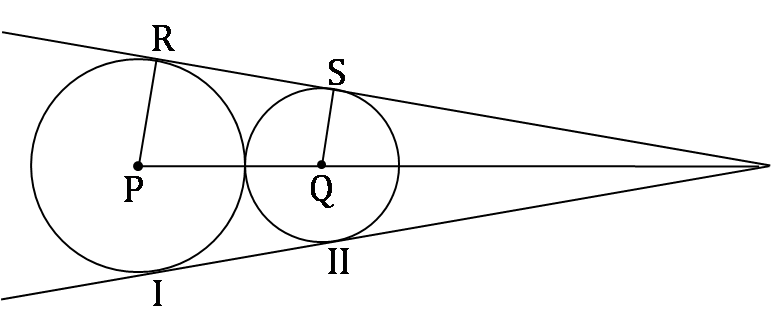
What is the ratio of the length of PQ to that of QO?
Passage / Data
Answer the following question based on the information given below.
In the adjoining figure, I and II are circles with centres P and Q respectively. The two circles touch each other and have a common tangent that touches them at points R and S respectively. This common tangent meets the line joining P and Q at O. The diameters of I and II are in the ratio 4 : 3. It is also known that the length of PO is 28 cm.
What is the radius of the circle II?
Passage / Data
Answer the following question based on the information given below.
In the adjoining figure, I and II are circles with centres P and Q respectively. The two circles touch each other and have a common tangent that touches them at points R and S respectively. This common tangent meets the line joining P and Q at O. The diameters of I and II are in the ratio 4 : 3. It is also known that the length of PO is 28 cm.
The length of SO is ________.
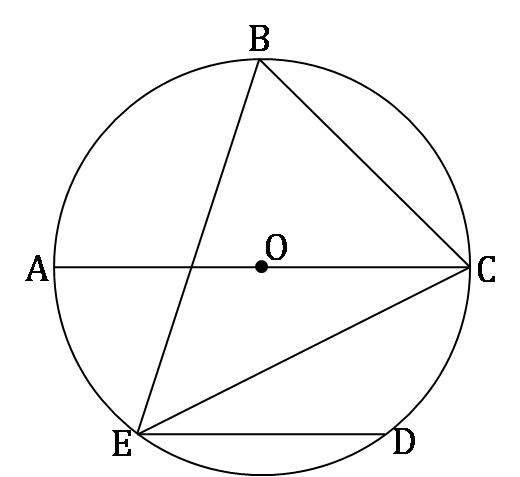
In the adjoining figure, chord ED is parallel to the diameter AC of the circle. If ∠CBE = 65°, then what is the value of ∠DEC?
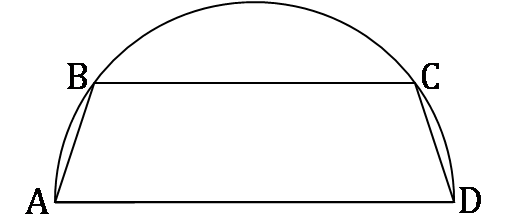
On a semicircle with diameter AD, chord BC is parallel to the diameter. Further, each of the chords AB and CD has length 2, while AD has length 8. What is the length of BC?
Passage / Data
Answer the following question based on the information given below.
f1(x) = x 0 ≤ x ≤ 1
= 1 x ≥ 1
= 0 otherwise
f2(x) = f1(–x) for all x
f3(x) = –f2(x) for all x
f4(x) = f3(–x) for all x
How many of the following products are necessarily zero for every x
f1(x)f2(x), f2(x)f3(x), f2(x)f4(x)?
Passage / Data
Answer the following question based on the information given below.
f1(x) = x 0 ≤ x ≤ 1
= 1 x ≥ 1
= 0 otherwise
f2(x) = f1(–x) for all x
f3(x) = –f2(x) for all x
f4(x) = f3(–x) for all x
Which of the following is necessarily true?
Passage / Data
Answer the following question based on the information given below.
In an examination, there are 100 questions divided into three groups A, B and C such that each group contains at least one question. Each question in group A carries 1 mark, each question in group B carries 2 marks and each question in group C carries 3 marks. It is known that the questions in group A together carry at least 60% of the total marks.
If group B contains 23 questions, then how many questions are there in group C?
Passage / Data
Answer the following question based on the information given below.
In an examination, there are 100 questions divided into three groups A, B and C such that each group contains at least one question. Each question in group A carries 1 mark, each question in group B carries 2 marks and each question in group C carries 3 marks. It is known that the questions in group A together carry at least 60% of the total marks.
If group C contains 8 questions and group B carries at least 20% of the total marks, which of the following best describes the number of questions in group B?
A sprinter starts running on a circular path of radius r metres. Her average speed (in metres/minute) is πr during the first 30 seconds, πr/2 during next one minute, πr/4 during next 2 minutes, πr/8 during next 4 minutes, and so on. What is the ratio of the time taken for the nth round to that for the previous round?
Consider the sequence of numbers a1, a2, a3, ... to infinity where a1 = 81.33 and a2 = –19 and aj = aj–1 – aj–2 for j ≥ 3. What is the sum of the first 6002 terms of this sequence?
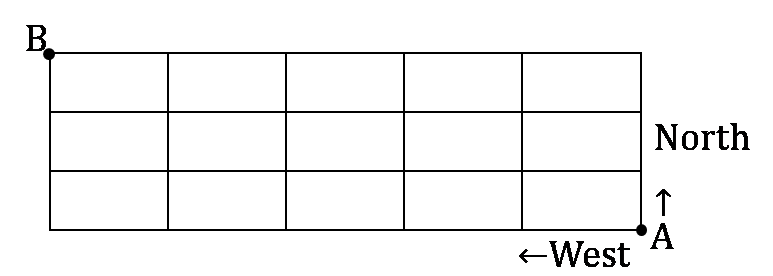
In the adjoining figure, the lines represent one-way roads allowing travel only northwards or only westwards. Along how many distinct routes can a car reach point B from point A?
Let C be a circle with centre P0 and AB be a diameter of C. Suppose P1 is the mid-point of the line segment P0B, P2 is the mid-point of the line segment P1B and so on. Let C1, C2, C3, ... be circles with diameters P0P1, P1P2, P2P3 ... respectively. Suppose the circles C1,C2, C3, ... are all shaded. The ratio of the area of the unshaded portion of C to that of the original circle C is:
Let u = (log2 x)2 – 6 log2 x + 12 where x is a real number. Then the equation xu = 256, has
A new flag is to be designed with six vertical stripes using some or all of the colours yellow, green, blue and red. Then, the number of ways this can be done such that no two adjacent stripes have the same colour is:
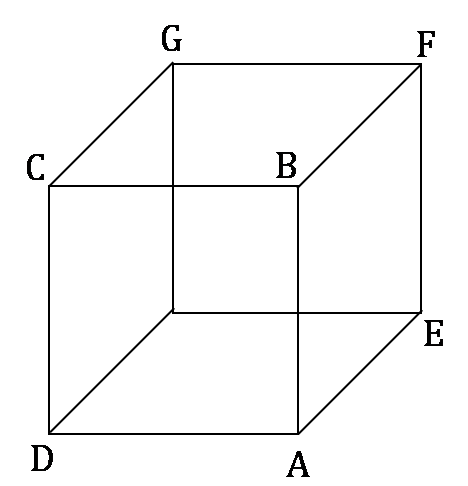
If the lengths of diagonals DF, AG and CE of the cube shown in the adjoining figure are equal to the three sides of a triangle, then the radius of the circle circumscribing that triangle will be _______.
A circle with radius 2 is placed against a right angle. Another smaller circle is also placed as shown in the adjoining figure. What is the radius of the smaller circle?

Each question is followed by two statements, A and B. Answer each question using the following instructions
Choose 1 if the question can be answered by using one of the statements alone but not by using the other statement alone.
Choose 2 if the question can be answered by using either of the statements alone.
Choose 3 if the question can be answered by using both statements together but not by either statement alone.
Choose 4 if the question cannot be answered on the basis of the two statements.
Ravi spent less than Rs.75 to buy one kilogram each of potato, onion, and gourd. Which one of the three vegetables bought was the costliest?
A. 2 kg potato and 1 kg gourd cost less than 1 kg potato and 2 kg gourd.
B. 1 kg potato and 2 kg onion together cost the same as 1 kg onion and 2 kg gourd.
Each question is followed by two statements, A and B. Answer each question using the following instructions
Choose 1 if the question can be answered by using one of the statements alone but not by using the other statement alone.
Choose 2 if the question can be answered by using either of the statements alone.
Choose 3 if the question can be answered by using both statements together but not by either statement alone.
Choose 4 if the question cannot be answered on the basis of the two statements.
Tarak is standing 2 steps to the left of a red mark and 3 steps to the right of a blue mark. He tosses a coin. If it comes up heads, he moves one step to the right; otherwise he moves one step to the left. He keeps doing this until he reaches one of the two marks, and then he stops. At which mark does he stop?
A. He stops after 21 coin tosses.
B. He obtains three more tails than heads.
Each question is followed by two statements, A and B. Answer each question using the following instructions
Choose 1 if the question can be answered by using one of the statements alone but not by using the other statement alone.
Choose 2 if the question can be answered by using either of the statements alone.
Choose 3 if the question can be answered by using both statements together but not by either statement alone.
Choose 4 if the question cannot be answered on the basis of the two statements.
Nandini paid for an article using currency notes of denominations Re. l, Rs. 2, Rs. 5, and Rs. 10 using at least one note of each denomination. The total number of five and ten rupee notes used was one more than the total number of one and two rupee notes used. What was the price of the article?
A. Nandini used a total of 13 currency notes.
B. The price of the article was a multiple of Rs. 10.
Each question is followed by two statements, A and B. Answer each question using the following instructions
Choose 1 if the question can be answered by using one of the statements alone but not by using the other statement alone.
Choose 2 if the question can be answered by using either of the statements alone.
Choose 3 if the question can be answered by using both statements together but not by either statement alone.
Choose 4 if the question cannot be answered on the basis of the two statements.
Four candidates for an award obtain distinct scores in a test. Each of the four casts a vote to choose the winner of the award. The candidate who gets the largest number of votes wins the award. In case of a tie in the voting process, the candidate with the highest score wins the award. Who wins the award?
A. The candidates with the top three scores each vote for the top scorer amongst the other three.
B. The candidate with the lowest score votes for the player with the second highest score.
Each question is followed by two statements, A and B. Answer each question using the following instructions
Choose 1 if the question can be answered by using one of the statements alone but not by using the other statement alone.
Choose 2 if the question can be answered by using either of the statements alone.
Choose 3 if the question can be answered by using both statements together but not by either statement alone.
Choose 4 if the question cannot be answered on the basis of the two statements.
In a class of 30 students, Rashmi secured the third rank among the girls, while her brother Kumar studying in the same class secured the sixth rank in the whole class. Between the two, who had a better overall rank?
A. Kumar was among the top 25% of the boys merit list in the class in which 60% were boys.
B. There were three boys among the top five rank holders, and three girls among the top ten rank holders.
Each question is followed by two statements, A and B. Answer each question using the following instructions
Choose 1 if the question can be answered by using one of the statements alone but not by using the other statement alone.
Choose 2 if the question can be answered by using either of the statements alone.
Choose 3 if the question can be answered by using both statements together but not by either statement alone.
Choose 4 if the question cannot be answered on the basis of the two statements.
Zakib spends 30% of his income on his children’s education, 20% on recreation and 10% on healthcare. The corresponding percentages for Supriyo are 40%, 25%, and 13%. Who spends more on children’s education?
A. Zakib spends more on recreation than Supriyo.
B. Supriyo spends more on healthcare than Zakib.