CAT 2000 — DILR
All 36 DILR questions from CAT 2000, with the answer key and detailed solutions. Practise free — check answers as you go, or tap Show solution.
CAT 2000 · DILR
Persons X, Y, Z and Q live in red, green, yellow or blue coloured houses placed in a sequence on a street. Z lives in a yellow house. The green house is adjacent to the blue house. X does not live adjacent to Z. The yellow house is in between the green and red houses. The colour of the house X lives in is
My bag can carry no more than ten books. I must carry at least one book each of management, mathematics, physics and fiction. Also, for every management book I carry I must carry two or more fiction books, and for every mathematics book I carry I must carry two or more physics books. I earn 4, 3, 2 and 1 points for each management, mathematics, physics and fiction book, respectively, I carry in my bag. I want to maximise the points I can earn by carrying the most appropriate combination of books in my bag. The maximum points that I can earn are
Five persons with names P, M, U, T and X live separately in any one of the following a palace, a hut, a fort, a house or a hotel. Each one likes two different colours from among the following blue, black, red, yellow and green. U likes red and blue. T likes black. The person living in a palace does not like black or blue. P likes blue and red. M likes yellow. X lives in a hotel. M lives in a
There are ten animals-two each of lion, panther, bison, bear, and deer in a zoo. The enclosures in the zoo are named X, Y, Z, P and Q and each enclosure is allotted to one of the following attendants Jack, Mohan, Shalini, Suman and Rita. Two animals of different species are housed in each enclosure. A lion and a deer cannot be together. A panther cannot be with either a deer or a bison. Suman attends to animals from among bison, deer, bear and panther only. Mohan attends to a lion and a panther. Jack does not attend to deer, lion or bison. X, Y and Z are allotted to Mohan, Jack and Rita respectively. X and Q enclosures have one animal of the same species. Z and P have the same pair of animals. The animals attended by Shalini are
Eighty kilograms (kg) of store material is to be transported to a location 10 km away. Any number of couriers can be used to transport the material can be packed in any number of units of 10, 20 or 40 kg. Courier charges are Rs. 10 per hour. Couriers travel at the speed of 10 km/hr if they are not carrying any load, at 5 km/hr if carrying 10 kg, at 2 km/hr if carrying 20 kg and at 1 km/hr if carrying 40 kg. A courier cannot carry more than 40 kg of load. The minimum cost at which 80 kg of store material can be transported will be
Passage / Data
Answer the following question based on the information given below.
Information Technology Industry in India (Figure are in million US dollars)
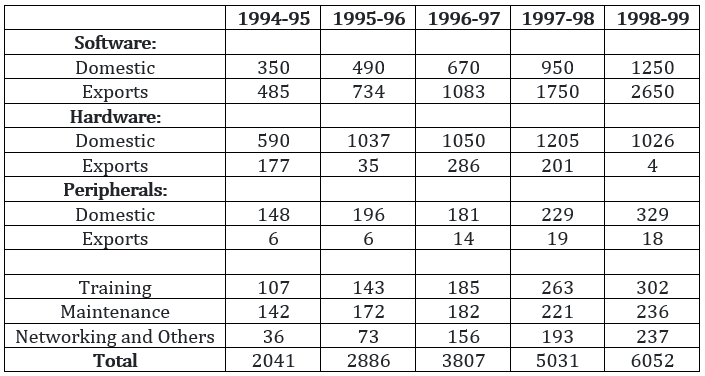
The total annual exports lay between 35 and 40 percent of the total annual business of the IT industry, in years
Passage / Data
Answer the following question based on the information given below.
Information Technology Industry in India (Figure are in million US dollars)
The highest percentage growth in the total IT business, relative to the previous year was achieved in
Passage / Data
Answer the following question based on the information given below.
Information Technology Industry in India (Figure are in million US dollars)
Which one of the following statements is correct?
Passage / Data
Answer the following question based on the information given below.
Information Technology Industry in India (Figure are in million US dollars)
For the IT hardware business activity, which one of the following is not true?
Passage / Data
Answer the following question based on the information given below.
Information Technology Industry in India (Figure are in million US dollars)
For the two IT business activities, hardware and peripherals, which one of the following is true?
Passage / Data
Answer the following question based on the information given below.
Factory Sector by Type of Ownership.
All figures in the table are in percent of the total for the corresponding column.
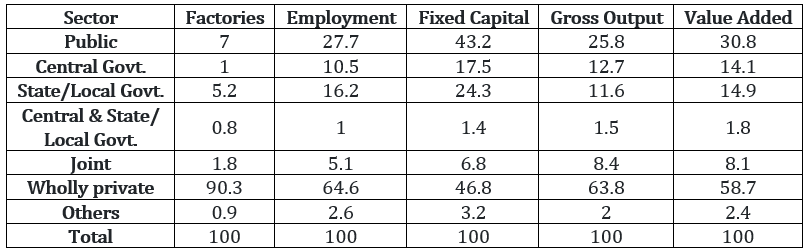
Suppose the average employment level is 60 per factory. The average employment in “wholly private” factories is approximately
Passage / Data
Answer the following question based on the information given below.
Factory Sector by Type of Ownership.
All figures in the table are in percent of the total for the corresponding column.
Among the firms in different sectors, value added per employee is highest in
Passage / Data
Answer the following question based on the information given below.
Factory Sector by Type of Ownership.
All figures in the table are in percent of the total for the corresponding column.
Capital productivity is defined as the gross output value per rupee of fixed capital. The three sectors with the higher capital productivity, arranged in descending order are
Passage / Data
Answer the following question based on the information given below.
Factory Sector by Type of Ownership.
All figures in the table are in percent of the total for the corresponding column.
A sector is considered “pareto efficient” if its value added per employee and its value added per rupee of fixed capital is higher than those of all other sectors. Based on the table data, the pareto efficient sector is
Passage / Data
Answer the following question based on the information given below.
Factory Sector by Type of Ownership.
All figures in the table are in percent of the total for the corresponding column.
The total value added in all sectors is estimated at Rs. 140,000 crores. Suppose that the number of firms in the joint sector is 2700. The average value added per factory, in Rs. crores, in the central government is
Passage / Data
FEI for a country in a year, is the ratio (expressed as a percentage) of its foreign equity inflows to its GDP. The following figure displays the FEIs for select Asian countries for the years 1997 and 1998.
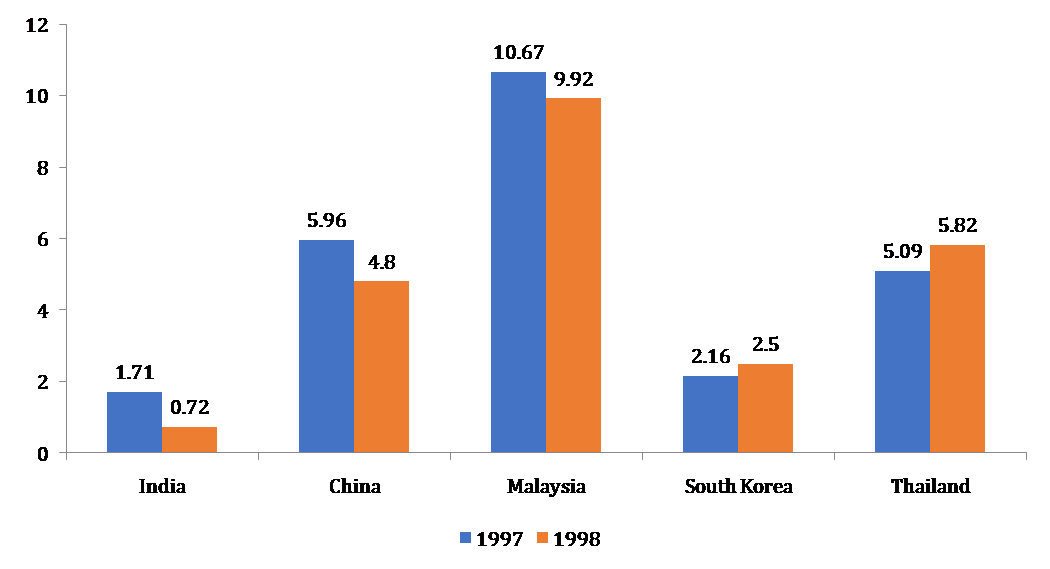
The country with the largest change in FEI in 1998 relative to its FEI in 1997, is
Passage / Data
FEI for a country in a year, is the ratio (expressed as a percentage) of its foreign equity inflows to its GDP. The following figure displays the FEIs for select Asian countries for the years 1997 and 1998.
Based on the data provided, it can be concluded that
Passage / Data
FEI for a country in a year, is the ratio (expressed as a percentage) of its foreign equity inflows to its GDP. The following figure displays the FEIs for select Asian countries for the years 1997 and 1998.
It is known that China’s GDP in 1998 was 7% higher than its value in 1997, while India's GDP grew by 2% during the same period. The GDP of South Korea, on the other hand, fell by 5%. Which of the following statements is/are true?
- Foreign equity inflows to China were higher in 1998 than in 1997.
- Foreign equity inflows to China were lower in 1998 than in 1997.
- Foreign equity inflows to India were higher in 1998 than in 1997.
- Foreign equity inflows to South Korea decreased in 1998 relative to 1997.
- Foreign equity inflows to South Korea increased in 1998 relative to 1997.
Passage / Data
FEI for a country in a year, is the ratio (expressed as a percentage) of its foreign equity inflows to its GDP. The following figure displays the FEIs for select Asian countries for the years 1997 and 1998.
China’s foreign equity inflows in 1998 were 10 times that into India. It can be concluded that
Passage / Data
Answer the following question based on the information given below.
The table shows trends in external transactions of Indian corporate sector during the period 1993-94 to 1997-98. In addition, following definitions hold good.
Salesi , Importsi, and Exportsi respectively denote the sales, imports and exports in year i.
Deficit in year i, Deficiti = Importsi – Exportsi.
Deficit Intensity in year i, DIi = Deficiti / Salesi.
Growth rate of deficit intensity in year i, GDIi = (DIi – DIi-1)/DIi-1
Further, note that all imports are classified as either raw material or capital goods.
Trends in External Transactions of Indian Corporate Sector (All figures in %)
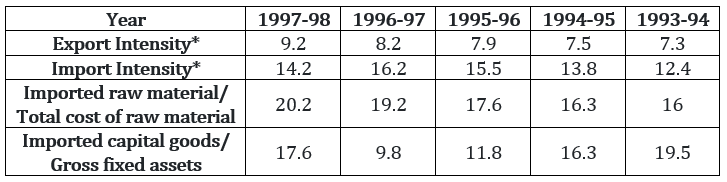
The highest growth rate in deficit intensity was recorded in
Passage / Data
Answer the following question based on the information given below.
The table shows trends in external transactions of Indian corporate sector during the period 1993-94 to 1997-98. In addition, following definitions hold good.
Salesi , Importsi, and Exportsi respectively denote the sales, imports and exports in year i.
Deficit in year i, Deficiti = Importsi – Exportsi.
Deficit Intensity in year i, DIi = Deficiti / Salesi.
Growth rate of deficit intensity in year i, GDIi = (DIi – DIi-1)/DIi-1
Further, note that all imports are classified as either raw material or capital goods.
Trends in External Transactions of Indian Corporate Sector (All figures in %)
The value of the highest growth rate in deficit intensity is approximately
Passage / Data
Answer the following question based on the information given below.
The table shows trends in external transactions of Indian corporate sector during the period 1993-94 to 1997-98. In addition, following definitions hold good.
Salesi , Importsi, and Exportsi respectively denote the sales, imports and exports in year i.
Deficit in year i, Deficiti = Importsi – Exportsi.
Deficit Intensity in year i, DIi = Deficiti / Salesi.
Growth rate of deficit intensity in year i, GDIi = (DIi – DIi-1)/DIi-1
Further, note that all imports are classified as either raw material or capital goods.
Trends in External Transactions of Indian Corporate Sector (All figures in %)
In 1997-98 the total cost of raw materials is estimated as 50% of sales of that year. The turn over of Gross fixed assets, defined as the ratio of sales to Gross fixed assets, in 1997-98 is, approximately
Passage / Data
Answer the following question based on the information given below.
The table shows trends in external transactions of Indian corporate sector during the period 1993-94 to 1997-98. In addition, following definitions hold good.
Salesi , Importsi, and Exportsi respectively denote the sales, imports and exports in year i.
Deficit in year i, Deficiti = Importsi – Exportsi.
Deficit Intensity in year i, DIi = Deficiti / Salesi.
Growth rate of deficit intensity in year i, GDIi = (DIi – DIi-1)/DIi-1
Further, note that all imports are classified as either raw material or capital goods.
Trends in External Transactions of Indian Corporate Sector (All figures in %)
Which of the following statements can be inferred to be true from the given data?
Passage / Data
Answer the following question based on the information given below.
The figures below present annual growth rate, expressed as the % change relative to the previous year, in four sectors of the economy of the Republic of Reposia during the 9 year period from 1990 to 1998. Assume that the index of production for each of the four sectors is set at 100 in 1989. Further, the four sectors manufacturing, mining and quarrying, electricity, and chemicals, respectively, constituted 20%. 15%. 10% and 15% of total industrial production in 1989.
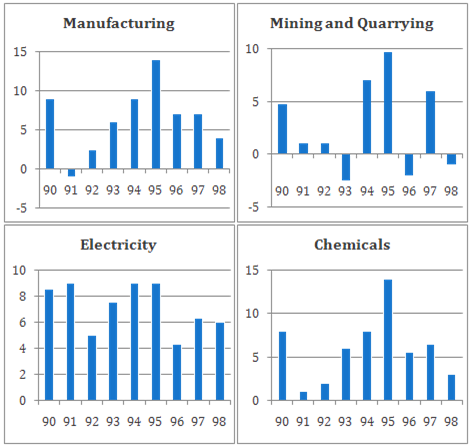
Which is the sector with the highest growth during the period 1989 and 1998?
Passage / Data
Answer the following question based on the information given below.
The figures below present annual growth rate, expressed as the % change relative to the previous year, in four sectors of the economy of the Republic of Reposia during the 9 year period from 1990 to 1998. Assume that the index of production for each of the four sectors is set at 100 in 1989. Further, the four sectors manufacturing, mining and quarrying, electricity, and chemicals, respectively, constituted 20%. 15%. 10% and 15% of total industrial production in 1989.
The overall growth rate in 1991 of the four sectors together is approximately
Passage / Data
Answer the following question based on the information given below.
The figures below present annual growth rate, expressed as the % change relative to the previous year, in four sectors of the economy of the Republic of Reposia during the 9 year period from 1990 to 1998. Assume that the index of production for each of the four sectors is set at 100 in 1989. Further, the four sectors manufacturing, mining and quarrying, electricity, and chemicals, respectively, constituted 20%. 15%. 10% and 15% of total industrial production in 1989.
When was the highest level of production in the manufacturing sector achieved during the nine year period 1990-1998?
Passage / Data
Answer the following question based on the information given below.
The figures below present annual growth rate, expressed as the % change relative to the previous year, in four sectors of the economy of the Republic of Reposia during the 9 year period from 1990 to 1998. Assume that the index of production for each of the four sectors is set at 100 in 1989. Further, the four sectors manufacturing, mining and quarrying, electricity, and chemicals, respectively, constituted 20%. 15%. 10% and 15% of total industrial production in 1989.
When was the lowest level of production of the mining and quarrying sector achieved during the nine year period 1990-1998?
Passage / Data
Answer the following question based on the information given below.
The figures below present annual growth rate, expressed as the % change relative to the previous year, in four sectors of the economy of the Republic of Reposia during the 9 year period from 1990 to 1998. Assume that the index of production for each of the four sectors is set at 100 in 1989. Further, the four sectors manufacturing, mining and quarrying, electricity, and chemicals, respectively, constituted 20%. 15%. 10% and 15% of total industrial production in 1989.
The percentage increase of production in the four sectors, namely, manufacturing, mining & quarrying, electricity and chemicals, taken together, in 1994, relative to 1989, is approximately
Passage / Data
Answer the following question based on the information given below.
The figures below present annual growth rate, expressed as the % change relative to the previous year, in four sectors of the economy of the Republic of Reposia during the 9 year period from 1990 to 1998. Assume that the index of production for each of the four sectors is set at 100 in 1989. Further, the four sectors manufacturing, mining and quarrying, electricity, and chemicals, respectively, constituted 20%. 15%. 10% and 15% of total industrial production in 1989.
It is known that the index of total industrial production in 1994 was 50 percent more that in 1989. Then, the percentage increase in production between 1989 and 1994 in sectors other than the four listed above is
Passage / Data
Answer the following question based on the information given below.
ABC Ltd. produces widgets for which the demand is unlimited and they can sell all of their production. The graph below describes the monthly variable costs incurred by the company as a function of the quantity produced. In addition, operating the plant for one shift results in a fixed monthly cost of Rs. 800. Fixed monthly costs for second shift operation are estimated at Rs. 1200. Each shift operation provides capacity for producing 30 widgets per month.
Note : Average unit cost, AC = Total monthly costs/monthly production, and
Marginal cost, MC is the rate of change in total cost for unit change in quantity produced.
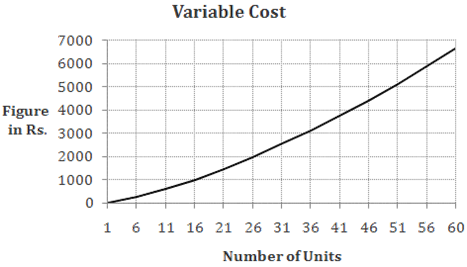
Total production in July is 40 units. What is the approximate average unit cost for July?
Passage / Data
Answer the following question based on the information given below.
ABC Ltd. produces widgets for which the demand is unlimited and they can sell all of their production. The graph below describes the monthly variable costs incurred by the company as a function of the quantity produced. In addition, operating the plant for one shift results in a fixed monthly cost of Rs. 800. Fixed monthly costs for second shift operation are estimated at Rs. 1200. Each shift operation provides capacity for producing 30 widgets per month.
Note : Average unit cost, AC = Total monthly costs/monthly production, and
Marginal cost, MC is the rate of change in total cost for unit change in quantity produced.
ABC Ltd. is considering increasing the production level. What is the approximate marginal cost of increasing production from its July level of 40 units?
Passage / Data
Answer the following question based on the information given below.
ABC Ltd. produces widgets for which the demand is unlimited and they can sell all of their production. The graph below describes the monthly variable costs incurred by the company as a function of the quantity produced. In addition, operating the plant for one shift results in a fixed monthly cost of Rs. 800. Fixed monthly costs for second shift operation are estimated at Rs. 1200. Each shift operation provides capacity for producing 30 widgets per month.
Note : Average unit cost, AC = Total monthly costs/monthly production, and
Marginal cost, MC is the rate of change in total cost for unit change in quantity produced.
From the data provided it can be inferred that, for production levels in the range of 0 to 60 units.
Passage / Data
Answer the following question based on the information given below.
ABC Ltd. produces widgets for which the demand is unlimited and they can sell all of their production. The graph below describes the monthly variable costs incurred by the company as a function of the quantity produced. In addition, operating the plant for one shift results in a fixed monthly cost of Rs. 800. Fixed monthly costs for second shift operation are estimated at Rs. 1200. Each shift operation provides capacity for producing 30 widgets per month.
Note : Average unit cost, AC = Total monthly costs/monthly production, and
Marginal cost, MC is the rate of change in total cost for unit change in quantity produced.
Suppose that each widget sells for Rs 150. What is the profit earned by ABC Ltd. in July? (Profit is defined as the excess of sales revenue over total cost.)
Passage / Data
Answer the following question based on the information given below.
ABC Ltd. produces widgets for which the demand is unlimited and they can sell all of their production. The graph below describes the monthly variable costs incurred by the company as a function of the quantity produced. In addition, operating the plant for one shift results in a fixed monthly cost of Rs. 800. Fixed monthly costs for second shift operation are estimated at Rs. 1200. Each shift operation provides capacity for producing 30 widgets per month.
Note : Average unit cost, AC = Total monthly costs/monthly production, and
Marginal cost, MC is the rate of change in total cost for unit change in quantity produced.
Assume that the unit price is Rs. 150 and profit is defined as the excess of sales revenue over total costs. What is the monthly production level of ABC Ltd. at which the profit is highest?
Passage / Data
Answer the following question based on the information given below.
ABC Ltd. produces widgets for which the demand is unlimited and they can sell all of their production. The graph below describes the monthly variable costs incurred by the company as a function of the quantity produced. In addition, operating the plant for one shift results in a fixed monthly cost of Rs. 800. Fixed monthly costs for second shift operation are estimated at Rs. 1200. Each shift operation provides capacity for producing 30 widgets per month.
Note : Average unit cost, AC = Total monthly costs/monthly production, and
Marginal cost, MC is the rate of change in total cost for unit change in quantity produced.
For monthly production level in the range of 0 to 30 units
Passage / Data
Answer the following question based on the information given below.
ABC Ltd. produces widgets for which the demand is unlimited and they can sell all of their production. The graph below describes the monthly variable costs incurred by the company as a function of the quantity produced. In addition, operating the plant for one shift results in a fixed monthly cost of Rs. 800. Fixed monthly costs for second shift operation are estimated at Rs. 1200. Each shift operation provides capacity for producing 30 widgets per month.
Note : Average unit cost, AC = Total monthly costs/monthly production, and
Marginal cost, MC is the rate of change in total cost for unit change in quantity produced.
Choose 1; if the question can be answered by using one of the statements alone, but cannot be answered using the other statement alone.
Choose 2; if the question can be answered by using either statement alone.
Choose 3; if the question can be answered by using both statements together, but cannot be answered using either statement alone.
Choose 4; if the question cannot be answered even by using both statements together.
For any two real numbers
a ⊕ b = 1 if both a and b are positive or both a and b are negative.
= –1 if one of the two numbers a and b is positive and the other negative.
What is (2 ⊕ 0) ⊕ (–5 ⊕ –6)?
- a ⊕ b is zero if a is zero.
- a ⊕ b = b ⊕ a