CAT 2001 — DILR
All 44 DILR questions from CAT 2001, with the answer key and detailed solutions. Practise free — check answers as you go, or tap Show solution.
CAT 2001 · DILR
Passage / Data
Answer the following question based on the information given below.
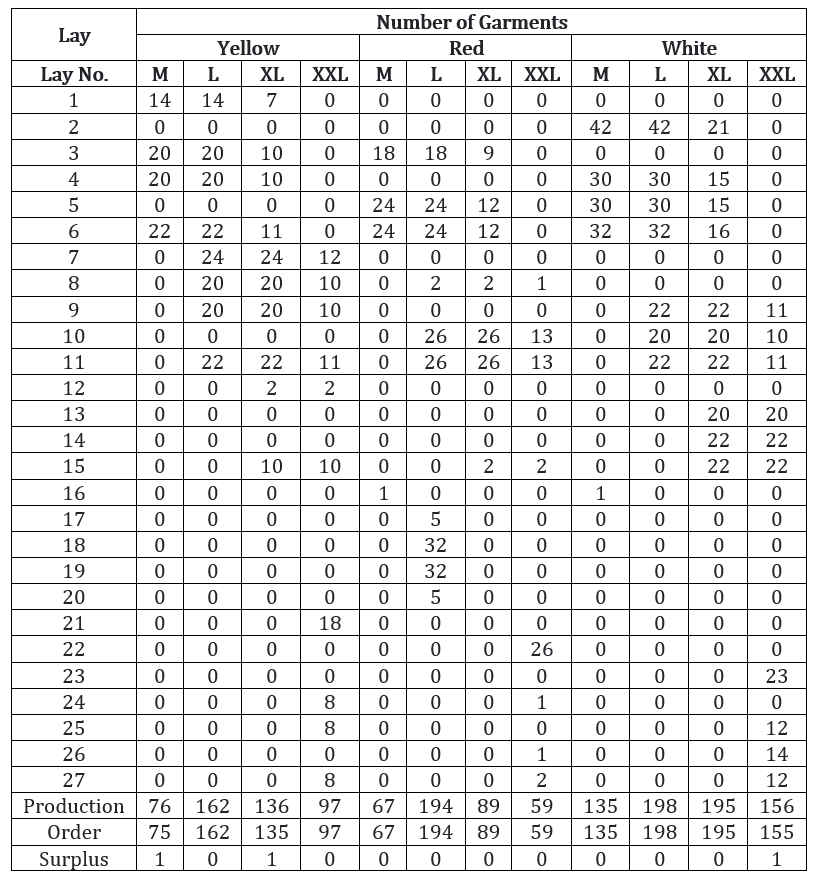
The following is a table describing garments manufactured based upon the colour and size each lay. There are four sizes: M-Medium, L-Large, XL-Extra Large and XXL-Extra Extra Large. There are three colours: Yellow, Red and White.
How many lays are used to produce Yellow-coloured fabrics?
Passage / Data
Answer the following question based on the information given below.
The following is a table describing garments manufactured based upon the colour and size each lay. There are four sizes: M-Medium, L-Large, XL-Extra Large and XXL-Extra Extra Large. There are three colours: Yellow, Red and White.
How many lays are used to produce Extra-Extra Large fabrics?
Passage / Data
Answer the following question based on the information given below.
The following is a table describing garments manufactured based upon the colour and size each lay. There are four sizes: M-Medium, L-Large, XL-Extra Large and XXL-Extra Extra Large. There are three colours: Yellow, Red and White.
How many lays are used to produce Extra-Extra Large Yellow or Extra-Extra Large White fabrics?
Passage / Data
Answer the following question based on the information given below.
The following is a table describing garments manufactured based upon the colour and size each lay. There are four sizes: M-Medium, L-Large, XL-Extra Large and XXL-Extra Extra Large. There are three colours: Yellow, Red and White.
How many varieties of fabrics, which exceed the order have been produced?
Passage / Data
Answer the following question based on the information given below.
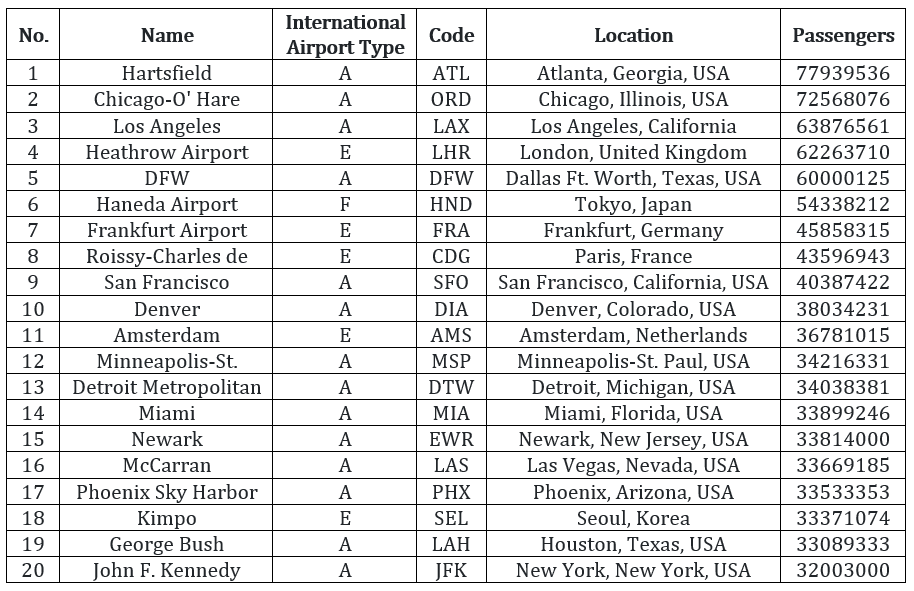
Answer these questions based on the table given below concerning the twenty busiest international airports in the world.
How many international airports of type 'A' account for more than 40 million passengers?
Passage / Data
Answer the following question based on the information given below.
Answer these questions based on the table given below concerning the twenty busiest international airports in the world.
What percentage of top ten busiest airports is in the United States of America?
Passage / Data
Answer the following question based on the information given below.
Answer these questions based on the table given below concerning the twenty busiest international airports in the world.
Of the five busiest airports, roughly what percentage of passengers is handled by Heathrow airport?
Passage / Data
Answer the following question based on the information given below.
Answer these questions based on the table given below concerning the twenty busiest international airports in the world.
How many international airports not located in the USA handle more than 30 million passengers?
Passage / Data
Answer the following question based on the information given below.
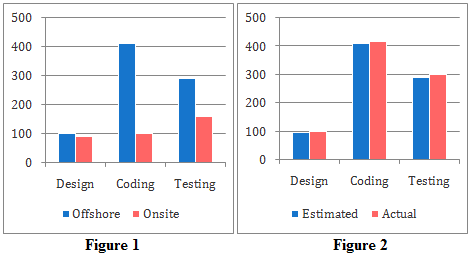
Figure 1 shows the amount of work distribution, in man-hours, for a software between offshore and onsite activities. Figure 2 shows the estimated and actual work effort involved in the different offshore activities in the same company during the same period. [Note: Onsite refers to work performed at the customer's premise and offshore refers to work performed at the developer's premise.]
Which of the work requires as many man-hours as that spent in coding?
Passage / Data
Answer the following question based on the information given below.
Figure 1 shows the amount of work distribution, in man-hours, for a software between offshore and onsite activities. Figure 2 shows the estimated and actual work effort involved in the different offshore activities in the same company during the same period. [Note: Onsite refers to work performed at the customer's premise and offshore refers to work performed at the developer's premise.]
Roughly what percentage of the total work is carried out onsite?
Passage / Data
Answer the following question based on the information given below.
Figure 1 shows the amount of work distribution, in man-hours, for a software between offshore and onsite activities. Figure 2 shows the estimated and actual work effort involved in the different offshore activities in the same company during the same period. [Note: Onsite refers to work performed at the customer's premise and offshore refers to work performed at the developer's premise.]
The total effort in man-hours spent onsite is nearest to which of the following?
Passage / Data
Answer the following question based on the information given below.
Figure 1 shows the amount of work distribution, in man-hours, for a software between offshore and onsite activities. Figure 2 shows the estimated and actual work effort involved in the different offshore activities in the same company during the same period. [Note: Onsite refers to work performed at the customer's premise and offshore refers to work performed at the developer's premise.]
If the total working hours were 100, which of the following tasks will account for approximately 50 hours?
Passage / Data
Answer the following question based on the information given below.
Figure 1 shows the amount of work distribution, in man-hours, for a software between offshore and onsite activities. Figure 2 shows the estimated and actual work effort involved in the different offshore activities in the same company during the same period. [Note: Onsite refers to work performed at the customer's premise and offshore refers to work performed at the developer's premise.]
If 50 percent of the offshore work were to be carried out onsite, with the distribution of effort between the tasks remaining the same, the proportion of testing carried out offshore would be
Passage / Data
Answer the following question based on the information given below.
Figure 1 shows the amount of work distribution, in man-hours, for a software between offshore and onsite activities. Figure 2 shows the estimated and actual work effort involved in the different offshore activities in the same company during the same period. [Note: Onsite refers to work performed at the customer's premise and offshore refers to work performed at the developer's premise.]
If 50 percent of the offshore work were to be carried out onsite, with the distribution of effort between the tasks remaining the same, which of the following is true of all work carried out onsite?
Passage / Data
Answer the following question based on the information given below.
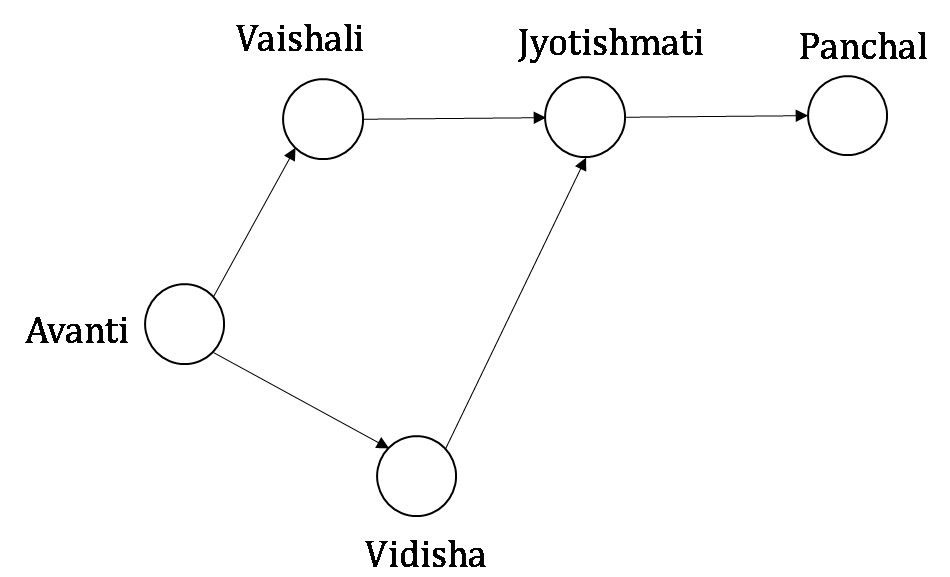
The following sketch shows the pipelines carrying material from one location to another. Each location has a demand for material. The demand at Vaishali is 400, at Jyotishmati is 400, at Panchal is 700, and at Vidisha is 200. Each arrow indicates the direction of material flow through the pipeline. The flow from Vaishali to Jyotishmati is 300. The quantity of material flow is such that the demands at all these locations are exactly met. The capacity of each pipeline is 1000.
The quantity moved from Avanti to Vidisha is
Passage / Data
Answer the following question based on the information given below.
The following sketch shows the pipelines carrying material from one location to another. Each location has a demand for material. The demand at Vaishali is 400, at Jyotishmati is 400, at Panchal is 700, and at Vidisha is 200. Each arrow indicates the direction of material flow through the pipeline. The flow from Vaishali to Jyotishmati is 300. The quantity of material flow is such that the demands at all these locations are exactly met. The capacity of each pipeline is 1000.
The free capacity available at the Avanti-Vaishali pipeline is
Passage / Data
Answer the following question based on the information given below.
The following sketch shows the pipelines carrying material from one location to another. Each location has a demand for material. The demand at Vaishali is 400, at Jyotishmati is 400, at Panchal is 700, and at Vidisha is 200. Each arrow indicates the direction of material flow through the pipeline. The flow from Vaishali to Jyotishmati is 300. The quantity of material flow is such that the demands at all these locations are exactly met. The capacity of each pipeline is 1000.
What is the free capacity available in the Avanti-Vidisha pipeline?
Passage / Data
Answer the following question based on the information given below.
There are six companies, 1 through 6. All of these companies use six operations, A through F. The following graph shows the distribution of efforts put in by each company in these six operations.
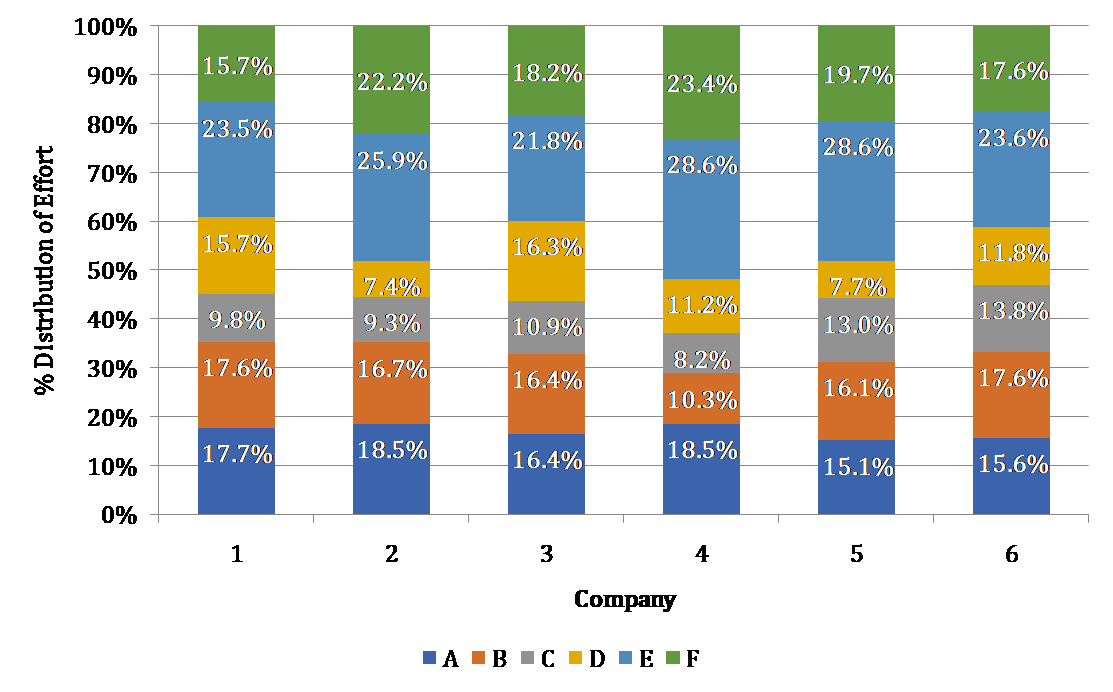
Suppose effort allocation is interchanged between operation B and C, then C and D, and then D and E. If companies are then ranked in ascending order of effort in E, what will be the rank of company 3?
Passage / Data
Answer the following question based on the information given below.
There are six companies, 1 through 6. All of these companies use six operations, A through F. The following graph shows the distribution of efforts put in by each company in these six operations.
A new technology is introduced in company 4 such that the total efforts for operations B through F get evenly distributed among these. What is the change in the percentage of effort in operation E?
Passage / Data
Answer the following question based on the information given below.
There are six companies, 1 through 6. All of these companies use six operations, A through F. The following graph shows the distribution of efforts put in by each company in these six operations.
Suppose the companies find that they can remove operations B, C and D and redistribute the effort released equally among the remaining operations. Then, which operation will show the maximum across all companies and all operations?
Passage / Data
Answer the following question based on the information given below.
The questions are based on the pie charts given below. Chart 1 shows the distribution of twelve million tons of crude oil transported through different modes over a specific period of time. Chart 2 shows the distribution of the cost of transporting this crude oil. The total cost was Rs. 30 million.
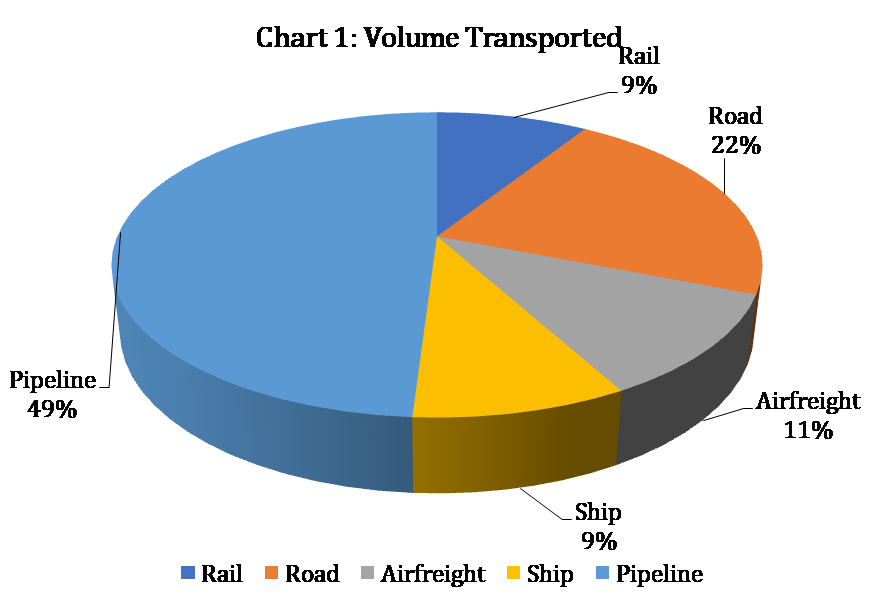
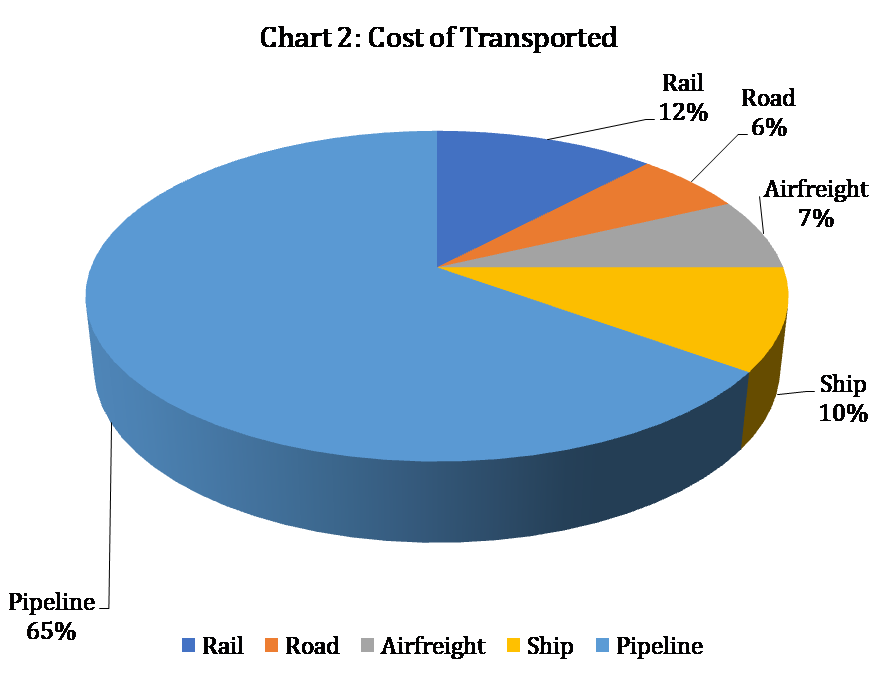
The cost in rupees per ton of oil moved by rail and road happens to be roughly
Passage / Data
Answer the following question based on the information given below.
The questions are based on the pie charts given below. Chart 1 shows the distribution of twelve million tons of crude oil transported through different modes over a specific period of time. Chart 2 shows the distribution of the cost of transporting this crude oil. The total cost was Rs. 30 million.
From the charts given, it appears that the cheapest mode of transport is
Passage / Data
Answer the following question based on the information given below.
The questions are based on the pie charts given below. Chart 1 shows the distribution of twelve million tons of crude oil transported through different modes over a specific period of time. Chart 2 shows the distribution of the cost of transporting this crude oil. The total cost was Rs. 30 million.
If the costs per ton of transport by ship, air and road are represented by P, Q and R respectively, which of the following is true?
Passage / Data
Answer the following question based on the information given below.
The questions are based on the pie charts given below. Chart 1 shows the distribution of twelve million tons of crude oil transported through different modes over a specific period of time. Chart 2 shows the distribution of the cost of transporting this crude oil. The total cost was Rs. 30 million.
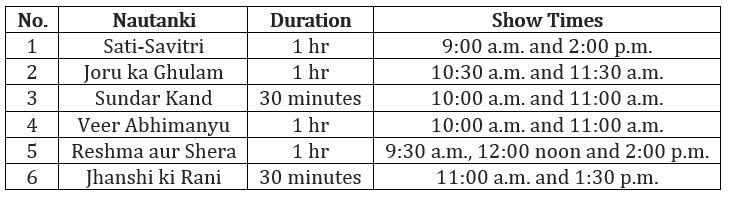
At a village mela, the following six nautankis (plays) are scheduled as shown in the table below. You wish to see all the six nautankis. Further, you wish to ensure that you get a lunch break from 12:30 p.m. to 1:30 p.m. In which of the following way can you do this?
Passage / Data
Answer the following question based on the information given below.
The questions are based on the pie charts given below. Chart 1 shows the distribution of twelve million tons of crude oil transported through different modes over a specific period of time. Chart 2 shows the distribution of the cost of transporting this crude oil. The total cost was Rs. 30 million.
Mrs. Ranga has three children and has difficulty remembering their ages and the months of their birth. The clues below may help her remember.
A. The boy, who was born in June, is 7 years old.
B. One of the children is 4 years old, but it is not Anshuman.
C. Vaibhav is older than Suprita.
D. One of the children was born in September, but it was not Vaibhav.
E. Suprita's birthday is in April.
F. The youngest child is only 2 years old.
Based on the above clues, which one of the following statements is true?
Passage / Data
Answer the following question based on the information given below.
The questions are based on the pie charts given below. Chart 1 shows the distribution of twelve million tons of crude oil transported through different modes over a specific period of time. Chart 2 shows the distribution of the cost of transporting this crude oil. The total cost was Rs. 30 million.
The Banerjees, the Sharmas, and the Pattabhiramans each have a tradition of eating Sunday lunch as a family. Each family serves a special meal at a certain time of day. Each family has a particular set of chinaware used only for this meal. Use the clues below to answer the following question.
A. The Sharma family eats at noon.
B. The family that serves fried brinjal uses blue chinaware.
C. The Banerjee family eats at 2 o'clock.
DThe family that serves sambar does not use red chinaware.
E. The family that eats at 1 o'clock serves fried brinjal.
F. The Pattabhiraman family does not use white chinaware.
G. The family that eats last likes makkai-ki-roti.
Which one of the following statements is true?
Passage / Data
Answer the following question based on the information given below.
The questions are based on the pie charts given below. Chart 1 shows the distribution of twelve million tons of crude oil transported through different modes over a specific period of time. Chart 2 shows the distribution of the cost of transporting this crude oil. The total cost was Rs. 30 million.
While Balbir had his back turned, a dog ran into his butcher shop, snatched a piece of meat off the counter and ran out. Balbir was mad when he realised what had happened. He asked three other shopkeepers, who had seen the dog, to describe it. The shopkeepers really didn't want to help Balbir. So each of them made a statement which contained one truth and one lie.
A. Shopkeeper Number 1 said: "The dog had black hair and a long tail."
B. Shopkeeper Number 2 said: "The dog has a short tail and wore a collar."
C. Shopkeeper Number 3 said: "The dog had white hair and no collar."
Based on the above statements, which of the following could be a correct description?
Passage / Data
Answer the following question based on the information given below.
Elle is three times older than Yogesh. Zaheer is half the age of Wahida. Yogesh is older than Zaheer.
Which of the following can be inferred?
Passage / Data
Answer the following question based on the information given below.
Elle is three times older than Yogesh. Zaheer is half the age of Wahida. Yogesh is older than Zaheer.
Which of the following information will be sufficient to estimate Elle's age?
Passage / Data
Answer the following question based on the information given below.
A group of three or four has to be selected from seven persons. Among are two women: Fiza and Kavita, and five men: Ram, Shyam, David, Peter and Rahim. Ram would not like to be in the group if Shyam is also selected. Shyam and Rahim want to be selected together in the group. Kavita would like to be in the group only if David is also there. David, if selected, would not like Peter in the group. Ram would like to be in the group only if Peter is also there. David insists that Fiza be selected in case he is there in the group.
Which of the following is a feasible group of three?
Passage / Data
Answer the following question based on the information given below.
A group of three or four has to be selected from seven persons. Among are two women: Fiza and Kavita, and five men: Ram, Shyam, David, Peter and Rahim. Ram would not like to be in the group if Shyam is also selected. Shyam and Rahim want to be selected together in the group. Kavita would like to be in the group only if David is also there. David, if selected, would not like Peter in the group. Ram would like to be in the group only if Peter is also there. David insists that Fiza be selected in case he is there in the group.
Which of the following is a feasible group of four?
Passage / Data
Answer the following question based on the information given below.
A group of three or four has to be selected from seven persons. Among are two women: Fiza and Kavita, and five men: Ram, Shyam, David, Peter and Rahim. Ram would not like to be in the group if Shyam is also selected. Shyam and Rahim want to be selected together in the group. Kavita would like to be in the group only if David is also there. David, if selected, would not like Peter in the group. Ram would like to be in the group only if Peter is also there. David insists that Fiza be selected in case he is there in the group.
Which of the following statements is true?
Passage / Data
Answer the following question based on the information given below.
A group of three or four has to be selected from seven persons. Among are two women: Fiza and Kavita, and five men: Ram, Shyam, David, Peter and Rahim. Ram would not like to be in the group if Shyam is also selected. Shyam and Rahim want to be selected together in the group. Kavita would like to be in the group only if David is also there. David, if selected, would not like Peter in the group. Ram would like to be in the group only if Peter is also there. David insists that Fiza be selected in case he is there in the group.
On her walk through the park, Hansa collected 50 coloured leaves, all either maple or oak. She sorted them by category when she got home, and found the following:
A. The number of red oak leaves with spots is even and positive.
B. The number of red oak leaves without any spot equals the number of red maple leaves without spots.
C. All non-red oak leaves have spots, and there are five times as many of them as there are red spotted oak leaves.
D. There are no spotted maple leaves that are not red.
E. There are exactly 6 red spotted maple leaves.
F. There are exactly 22 maple leaves that are neither spotted nor red.
How many oak leaves did she collect?
Passage / Data
Answer the following question based on the information given below.
A group of three or four has to be selected from seven persons. Among are two women: Fiza and Kavita, and five men: Ram, Shyam, David, Peter and Rahim. Ram would not like to be in the group if Shyam is also selected. Shyam and Rahim want to be selected together in the group. Kavita would like to be in the group only if David is also there. David, if selected, would not like Peter in the group. Ram would like to be in the group only if Peter is also there. David insists that Fiza be selected in case he is there in the group.
Eight people carrying food baskets are going for a picnic on motorcycles. Their names A, B, C, D, E, F, G, and H. They have four motorcycles, M1, M2, M3 and M4 among them. They also have four food baskets O, P, Q and R of different sizes and shapes and each can be carried only on motorcycles M1, M2, M3, or M4, respectively. No more than two persons can travel on a motorcycle and no more than one basket can be carried on a motorcycle. There are two husband-wife pairs in this group of eight people and each pair will ride on a motorcycle together. C cannot travel with A or B. E cannot travel with B or F. G cannot travel with F or H or D. The husband-wife pairs must carry baskets O and P. Q is with A and P is with D. F travels on M1 and E travels on M2 motorcycles. G is with Q, and B cannot go with R. Who is travelling with H?
Passage / Data
Answer the following question based on the information given below.
A group of three or four has to be selected from seven persons. Among are two women: Fiza and Kavita, and five men: Ram, Shyam, David, Peter and Rahim. Ram would not like to be in the group if Shyam is also selected. Shyam and Rahim want to be selected together in the group. Kavita would like to be in the group only if David is also there. David, if selected, would not like Peter in the group. Ram would like to be in the group only if Peter is also there. David insists that Fiza be selected in case he is there in the group.
In a family gathering there are two males who are grandfathers and four males who are fathers. In the same gathering there are two females who are grandmothers and four females who are mothers. There is at least one grandson or a granddaughter present in this gathering. There are two husband-wife pairs in this group. These can either be a grandfather and a grandmother, or a father and a mother. The single grandfather (who wife is not present) has two grandsons and a son present. The single grandmother (whose husband is not present) has two granddaughters and a daughter present. A grandfather or a grandmother present with their spouses does not have any grandson or granddaughter present. What is the minimum number of people present in this gathering?
Passage / Data
Answer the following question based on the information given below.
A group of three or four has to be selected from seven persons. Among are two women: Fiza and Kavita, and five men: Ram, Shyam, David, Peter and Rahim. Ram would not like to be in the group if Shyam is also selected. Shyam and Rahim want to be selected together in the group. Kavita would like to be in the group only if David is also there. David, if selected, would not like Peter in the group. Ram would like to be in the group only if Peter is also there. David insists that Fiza be selected in case he is there in the group.
I have a total of Rs. 1,000. Item A costs Rs. 110, item B costs Rs. 90, item C costs Rs. 70, item D costs Rs. 40 and item E costs Rs. 45. For every item D that I purchase, I must also buy two of item B. For every item A, I must buy one of item C. For every item E, I must also buy two of item D and one of item B. For every item purchased I earn 1000 points and for every rupee not spent I earn a penalty of 1500 points. My objective is to maximise to points I earn. What is the number of items that I must purchase to maximise my points?
Passage / Data
Answer the following question based on the information given below.
A group of three or four has to be selected from seven persons. Among are two women: Fiza and Kavita, and five men: Ram, Shyam, David, Peter and Rahim. Ram would not like to be in the group if Shyam is also selected. Shyam and Rahim want to be selected together in the group. Kavita would like to be in the group only if David is also there. David, if selected, would not like Peter in the group. Ram would like to be in the group only if Peter is also there. David insists that Fiza be selected in case he is there in the group.
Four friends Ashok, Bashir, Chirag and Deepak are out shopping. Ashok has less money than three times the amount that Bashir has. Chirag has more money than Bashir. Deepak has an amount equal to the difference of amounts with Bashir and Chirag. Ashok has three times the money with Deepak. They each have to buy at least one shirt, or one shawl, or one sweater, or one jacket that are priced Rs. 200, Rs. 400, Rs. 600, and Rs. 1,000 a piece, respectively. Chirag borrows Rs. 300 from Ashok and buys a jacket. Bashir buys a sweater after borrowing Rs. 100 from Ashok and is left with no money. Ashok buys three shirts. What is the costliest item the Deepak could buy with his own money?
Passage / Data
Answer the following question based on the information given below.
A group of three or four has to be selected from seven persons. Among are two women: Fiza and Kavita, and five men: Ram, Shyam, David, Peter and Rahim. Ram would not like to be in the group if Shyam is also selected. Shyam and Rahim want to be selected together in the group. Kavita would like to be in the group only if David is also there. David, if selected, would not like Peter in the group. Ram would like to be in the group only if Peter is also there. David insists that Fiza be selected in case he is there in the group.
In a "keep-fit" gymnasium class there are fifteen females enrolled in a weight-loss program. They all have been grouped in any one of the five weight-groups W1, W2, W3, W4, or W5. One instructor is assigned to one weight-group only. Sonali, Shalini, Shubhra, and Shahira belong to the same weight-group. Sonali and Rupa are in one weight-group, Rupali and Renuka are also in one weight-group. Rupa, Radha, Renuka, Ruchika and Ritu belong to different weight-groups. Somya cannot be with Ritu, and Tara cannot be with Radha. Komal cannot be with Radha, Somya, or Ritu. Shahira is in W1 and Somya is in W4 with Ruchika. Sweta and Jyotika cannot be with Rupali, but are in a weight-group with total membership of four. No weight-group can have more than five or less than one member. Amita, Babita, Chandrika, Deepika, and Elina are instructors of weight-groups with membership sizes 5, 4, 3, 2 and 1, respectively. Who is the instructor of Radha?
Passage / Data
Answer the following question based on the information given below.
A group of three or four has to be selected from seven persons. Among are two women: Fiza and Kavita, and five men: Ram, Shyam, David, Peter and Rahim. Ram would not like to be in the group if Shyam is also selected. Shyam and Rahim want to be selected together in the group. Kavita would like to be in the group only if David is also there. David, if selected, would not like Peter in the group. Ram would like to be in the group only if Peter is also there. David insists that Fiza be selected in case he is there in the group.
A king has unflinching loyalty from eight of his ministers M1 to M8, but he has to select only four to make a cabinet committee. He decides to choose these four such that each selected person shares a liking with at least one of the other three selected. The selected persons must also hate one of the likings of any of the other three persons selected.
A. M1 likes fishing and smoking, but hates gambling.
B. M2 likes smoking and drinking, but hates fishing.
C. M3 likes gambling, but hates smoking.
D. M4 likes mountaineering, but hates drinking.
E. M5 likes drinking, but hates smoking and mountaineering.
F. M6 likes fishing, but hates smoking and mountaineering.
G. M7 likes gambling and mountaineering, but hates fishing.
H. M8 likes smoking and gambling, but hates mountaineering.
Who are the four people selected by the king?
Passage / Data
Answer the following question based on the information given below.
A and B are two sets (e.g. A = mothers, B = women). The elements that could belong to both the sets (e.g. women who are mothers) is given by the set C = A.B. The elements which could belong to either A or B, or both, is indicated by the set D = A ∪ B. A set that does not contain any elements is known as a null set, represented by Ï (for example, if none of the women in the set B is a mother, they C = A.B is a null set, or C = Ï).
Let 'V' signify the set of all vertebrates; 'M' the set of all mammals; 'D' dogs; 'F' fish; 'A' Alsatian and 'P', a dog named Pluto.
Given that X = M.D is such that X = D, which of the following is true?
Passage / Data
Answer the following question based on the information given below.
A and B are two sets (e.g. A = mothers, B = women). The elements that could belong to both the sets (e.g. women who are mothers) is given by the set C = A.B. The elements which could belong to either A or B, or both, is indicated by the set D = A ∪ B. A set that does not contain any elements is known as a null set, represented by Ï (for example, if none of the women in the set B is a mother, they C = A.B is a null set, or C = Ï).
Let 'V' signify the set of all vertebrates; 'M' the set of all mammals; 'D' dogs; 'F' fish; 'A' Alsatian and 'P', a dog named Pluto.
If Y = F. (D.V), is not a null set, it implies that
Passage / Data
Answer the following question based on the information given below.
A and B are two sets (e.g. A = mothers, B = women). The elements that could belong to both the sets (e.g. women who are mothers) is given by the set C = A.B. The elements which could belong to either A or B, or both, is indicated by the set D = A ∪ B. A set that does not contain any elements is known as a null set, represented by Ï (for example, if none of the women in the set B is a mother, they C = A.B is a null set, or C = Ï).
Let 'V' signify the set of all vertebrates; 'M' the set of all mammals; 'D' dogs; 'F' fish; 'A' Alsatian and 'P', a dog named Pluto.
If Z = (P.D) ∪ M, then
Passage / Data
Answer the following question based on the information given below.
A and B are two sets (e.g. A = mothers, B = women). The elements that could belong to both the sets (e.g. women who are mothers) is given by the set C = A.B. The elements which could belong to either A or B, or both, is indicated by the set D = A ∪ B. A set that does not contain any elements is known as a null set, represented by Ï (for example, if none of the women in the set B is a mother, they C = A.B is a null set, or C = Ï).
Let 'V' signify the set of all vertebrates; 'M' the set of all mammals; 'D' dogs; 'F' fish; 'A' Alsatian and 'P', a dog named Pluto.
If P.A = Ï and P ∪ A = D, then which of the following is true?
Passage / Data
Answer the following question based on the information given below.
A and B are two sets (e.g. A = mothers, B = women). The elements that could belong to both the sets (e.g. women who are mothers) is given by the set C = A.B. The elements which could belong to either A or B, or both, is indicated by the set D = A ∪ B. A set that does not contain any elements is known as a null set, represented by Ï (for example, if none of the women in the set B is a mother, they C = A.B is a null set, or C = Ï).
Let 'V' signify the set of all vertebrates; 'M' the set of all mammals; 'D' dogs; 'F' fish; 'A' Alsatian and 'P', a dog named Pluto.
If 09/12/2001 happens to be Sunday, then 09/12/1971 would have been a