Basics — CAT Previous-Year Questions
11 previous-year questions on Basics from CAT, with full solutions. Practise free — check answers as you go; sign in to save your progress.
Basics · CAT PYQs
In the XY-plane, the area, in sq. units, of the region defined by the inequalities
y ≥ x + 4 and -4 ≤ x2 + y2 + 4(x - y) ≤ 0 is
Let C be the circle x2 + y2 + 4x - 6y - 3 = 0 and L be the locus of the point of intersection of a pair of tangents to C with the angle between the two tangents equal to 60 degree. Then, the point at which L touches the line x = 6 is?
Let ABCD be a parallelogram such that the coordinates of its three vertices A, B, C are (1, 1), (3, 4) and (−2, 8), respectively. Then, the coordinates of the vertex D are
The points (2, 1) and (-3, -4) are opposite vertices of a parallelogram. If the other two vertices lie on the line x + 9y + c = 0, then c is
Let S be the set of all points (x, y) in the x-y plane such that |x| + |y| ≤ 2 and |x| ≥ 1. Then, the area, in square units, of the region represented by S equals
The area of the closed region bounded by the equation | x | + | y | = 2 in the two-dimensional plane is
The points (2, 5) and (6, 3) are two end points of a diagonal of a rectangle. If the other diagonal has the equation y = 3x + c, then c is
The area bounded by the three curves |x + y| = 1, |x| = 1, and |y| = 1, is equal to
Passage / Data
Directions: Answer the questions based on the following information.
A robot moves on a graph sheet with X and Y-axis. The robot is moved by feeding it with a sequence of instructions. The different instructions that can be used in moving it, and their meanings are:
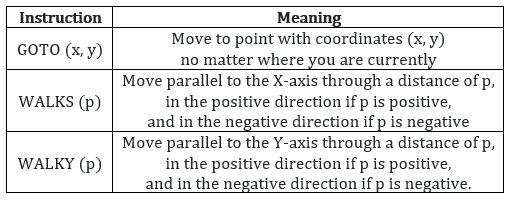
The robot reaches point (6, 6) when a sequence of three instructions is executed, the first of which is a GOTO(x,y) instruction, the second is WALKX(2) and the third is WALKY(4). What are the value of x and y?
Passage / Data
Directions: Answer the questions based on the following information.
A robot moves on a graph sheet with X and Y-axis. The robot is moved by feeding it with a sequence of instructions. The different instructions that can be used in moving it, and their meanings are:
The robot is initially at (x, y), x > 0 and y < 0. The minimum number of instructions needed to be executed to bring it to the origin (0, 0) if you are prohibited from using the GOTO instruction is
What is the distance between the points A(3, 8) and B(–2, –7)?