Quadrilaterals & Polygons — XAT Previous-Year Questions
9 previous-year questions on Quadrilaterals & Polygons from XAT, with full solutions. Practise free — check answers as you go; sign in to save your progress.
Quadrilaterals & Polygons · XAT PYQs
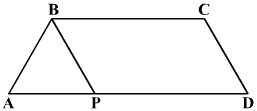
ABCD is a trapezoid where BC is parallel to AD and perpendicular to AB. Kindly note that BC < AD. P is a point on AD such that CPD is an equilateral triangle. Q is a point on BC such that AQ is parallel to PC. If the area of the triangle CPD is 4√3, find the area of the triangle ABQ.
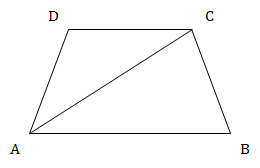
In the trapezium ABCD the sides AB and CD are parallel. The value of is
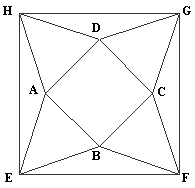
In the picture below, EFGH, ABCD are squares, and ABE, BCF, CDG, DAH are equilateral triangles. What is the ratio of the area of the square EFGH to that of ABCD?
If the diagonals of a rhombus of side 15 cm are in the ratio 3:4, find the area of the rhombus.
AB, CD and EF are three parallel lines, in that order. Let d1 and d2 be the distances from CD to AB and EF respectively. d1 and d2 are integers, where d1 : d2 = 2 : 1. P is a point on AB, Q and S are points on CD and R is a point on EF. If the area of the quadrilateral PQRS is 30 square units, what is the value of QR when value of SR is the least?
Passage / Data
Answer the next 4 questions based on the following information:
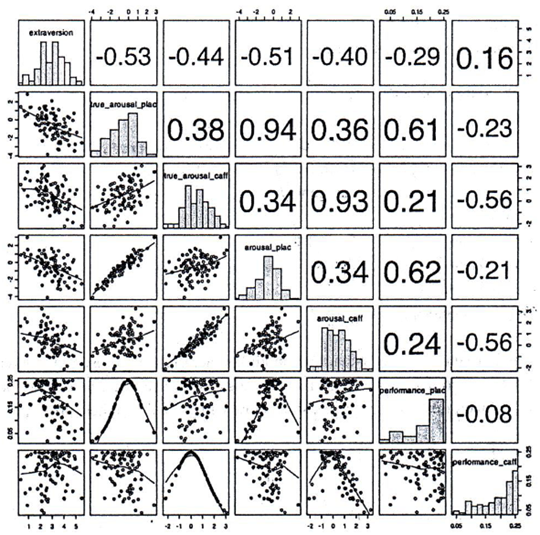
The grid below captures relationships among seven personality dimensions: "extraversion", "true_arousal_plac", "true_arousal_caff”, "arousal_plac", "arousal_caff”, "performance_plac", and "performance caff”. The diagonal represents histograms of the seven dimensions. Left of the diagonal represents scatterplots between the dimensions while the right of the diagonal represents quantitative relationships between the dimensions. The lines in the scatterplots are closest approximation of the points. The value of the relationships to the right of the diagonal can vary from -1 to +1, with -1 being the extreme linear negative relation and +1 extreme linear positive relation. (Axes of the graph are conventionally drawn).
ABCD is a rectangle. P, Q and R are the midpoint of BC, CD and DA. The point S lies on the line QR in such a way that SR: QS = 1:3. The ratio of the area of triangle APS to area of rectangle ABCD is
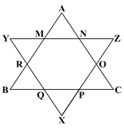
∆ABC and ∆XYZ are equilateral triangles of 54 cm sides. All smaller triangles like ∆ANM, ∆OCP, ∆QPX etc. are also equilateral triangles. Find the area of the shape MNOPQRM.
ABCD is a quadrilateral such that AD = 9 cm, BC = 13 cm and ⎿DAB = ⎿BCD = 90°. P and Q are two points on AB and CD respectively, such that DQ : BP = 1 : 2 and DQ is an integer. How many values can DQ take, for which the maximum possible area of the quadrilateral PBQD is 150 sq.cm?
The parallel sides of a trapezoid ABCD are in the ratio of 4 : 5. ABCD is divided into an isosceles triangle ABP and a parallelogram PBCD (as shown below). ABCD has a perimeter equal to 1120 meters and PBCD has a perimeter equal to 1000 meters. Find Sin ∠ABC, given 2∠DAB = ∠BCD.