Data Sufficiency — CAT Previous-Year Questions
75 previous-year questions on Data Sufficiency from CAT, with full solutions. Practise free — check answers as you go; sign in to save your progress.
Data Sufficiency · CAT PYQs
Passage / Data
Each question is followed by two statements, A and B. Answer each question using the following instructions:
Mark option (1) if the question can be answered by using statement A alone but not by using statement B alone.
Mark option (2) if the question can be answered by using statement B alone but not by using statement A alone.
Mark option (3) if the question can be answered by using either statement alone.
Mark option (4) if the question can be answered by using both the statements together but not by either of the statements alone.
Mark option (5) if the question cannot be answered on the basis of the two statements.
In a single elimination tournament, any player is eliminated with a single loss. The tournament is played in multiple rounds subject to the following rules:
a. If the number of players, say n, in any round is even, then the players are grouped in to n/2 pairs. The players in each pair play a match against each other and the winner moves on to the next round.
b. If the number of players, say n, in any round is odd, then one of them is given a bye, that is, he automatically moves on to the next round. The remaining (n − 1) players are grouped into (n − 1)/2 pairs. The players in each pair play a match against each other and the winner moves on to the next round. No player gets more than one bye in the entire tournament.
Thus, if n is even, then n/2 players move on to the next round while if n is odd, then (n + 1)/2 players move on to the next round. The process is continued till the final round, which obviously is played between two players. The winner in the final round is the champion of the tournament.
What is the number of matches played by the champion?
A: The entry list for the tournament consists of 83 players.
B: The champion received one bye.
Passage / Data
Each question is followed by two statements, A and B. Answer each question using the following instructions:
Mark option (1) if the question can be answered by using statement A alone but not by using statement B alone.
Mark option (2) if the question can be answered by using statement B alone but not by using statement A alone.
Mark option (3) if the question can be answered by using either statement alone.
Mark option (4) if the question can be answered by using both the statements together but not by either of the statements alone.
Mark option (5) if the question cannot be answered on the basis of the two statements.
In a single elimination tournament, any player is eliminated with a single loss. The tournament is played in multiple rounds subject to the following rules:
a. If the number of players, say n, in any round is even, then the players are grouped in to n/2 pairs. The players in each pair play a match against each other and the winner moves on to the next round.
b. If the number of players, say n, in any round is odd, then one of them is given a bye, that is, he automatically moves on to the next round. The remaining (n − 1) players are grouped into (n − 1)/2 pairs. The players in each pair play a match against each other and the winner moves on to the next round. No player gets more than one bye in the entire tournament.
Thus, if n is even, then n/2 players move on to the next round while if n is odd, then (n + 1)/2 players move on to the next round. The process is continued till the final round, which obviously is played between two players. The winner in the final round is the champion of the tournament.
If the number of players, say n, in the first round was between 65 and 128, then what is the exact value of n?
A. Exactly one player received a bye in the entire tournament.
B. One player received a bye while moving on to the fourth round from the third round
Each question is followed by two statements, I and II. Answer each question using the following instructions:
Mark (1) if the question can be answered by using statement I alone but not by using statement II alone.
Mark (2) if the question can be answered by using statement II alone but not by using statement I alone.
Mark (3) if the question can be answered by using either of the statements alone.
Mark (4) if the question can be answered by using both the statements together but not by either of the statements alone.
Mark (5) if the question cannot be answered by using any of the statements.
In a particular school, sixty students were athletes. Ten among them were also among the top academic performers. How many top academic performers were in the school?
I. Sixty per cent of the top academic performers were not athletes.
II. All the top academic performers were not necessarily athletes.
Each question is followed by two statements, I and II. Answer each question using the following instructions:
Mark (1) if the question can be answered by using statement I alone but not by using statement II alone.
Mark (2) if the question can be answered by using statement II alone but not by using statement I alone.
Mark (3) if the question can be answered by using either of the statements alone.
Mark (4) if the question can be answered by using both the statements together but not by either of the statements alone.
Mark (5) if the question cannot be answered by using any of the statements.
Five students Atul, Bala, Chetan, Dev and Ernesto were the only ones who participated in a quiz contest. They were ranked based on their scores in the contest. Dev got a higher rank as compared to Ernesto, while Bala got a higher rank as compared to Chetan. Chetan’s rank was lower than the median. Who among the five got the highest rank?
I. Atul was the last rank holder.
II. Bala was not among the top two rank holders.
Each question is followed by two statements, A and B. Answer each question using the following instructions
Choose 1 if the question can be answered by using one of the statements alone but not by using the other statement alone.
Choose 2 if the question can be answered by using either of the statements alone.
Choose 3 if the question can be answered by using both statements together but not by either statement alone.
Choose 4 if the question cannot be answered on the basis of the two statements.
Four candidates for an award obtain distinct scores in a test. Each of the four casts a vote to choose the winner of the award. The candidate who gets the largest number of votes wins the award. In case of a tie in the voting process, the candidate with the highest score wins the award. Who wins the award?
A. The candidates with the top three scores each vote for the top scorer amongst the other three.
B. The candidate with the lowest score votes for the player with the second highest score.
Each question is followed by two statements, A and B. Answer each question using the following instructions
Choose 1 if the question can be answered by using one of the statements alone but not by using the other statement alone.
Choose 2 if the question can be answered by using either of the statements alone.
Choose 3 if the question can be answered by using both statements together but not by either statement alone.
Choose 4 if the question cannot be answered on the basis of the two statements.
In a class of 30 students, Rashmi secured the third rank among the girls, while her brother Kumar studying in the same class secured the sixth rank in the whole class. Between the two, who had a better overall rank?
A. Kumar was among the top 25% of the boys merit list in the class in which 60% were boys.
B. There were three boys among the top five rank holders, and three girls among the top ten rank holders.
Each question is followed by two statements A and B. Answer each question using the following instructions:
Answer (1) if the question can be solved by any one of the statements, but not the other one.
Answer (2) if the question can be solved by using either of the two statements.
Answer (3) if the question can be solved by using both the statements together and not by any one of them.
Answer (4) if the question cannot be solved with the help of the given data and more data is required.
In a hockey match, the Indian team was behind by 2 goals with 5 minutes remaining. Did they win the match?
A. Deepak Thakur, the Indian striker scored 3 goals in the last 5 minutes of the match.
B. Korea scored a total of 3 goals in the match.
Each question given below is followed by five statements numbered I, II, III, IV and V. The answer choice given below each question consists of one or more statements. You have to choose the choice which gives more relevant / useful information in answering the question correctly. Read all the statements together with the question and choose your answer
For what reason Purohit did not get the offer of employment?
Statement:
I. Purohit passed the interview.
II. Purohit's friend passed the medical test who passed the interview along with Purohit.
III. Purohit's father did not want him to take the job.
IV. Purohit has another employment offer from another company.
V. Purohit did not clear the mandatory medical test.
Each question given below is followed by five statements numbered I, II, III, IV and V. The answer choice given below each question consists of one or more statements. You have to choose the choice which gives more relevant / useful information in answering the question correctly. Read all the statements together with the question and choose your answer
What were the possible reasons due to which DESCO incurred losses for the last two years?
Statement:
I. The company's shares are not registered in the stock exchange.
II. The company does not export its products.
III. The company has an inefficient labour force.
IV. The price of its product has fallen in the last two years due to competitive market.
V. Entry of similar foreign goods at a cheaper rate.
Each question given below is followed by five statements numbered I, II, III, IV and V. The answer choice given below each question consists of one or more statements. You have to choose the choice which gives more relevant / useful information in answering the question correctly. Read all the statements together with the question and choose your answer
On which day of the week did Sunil get his letter of promotion?
Statement:
I. Sunil purchased a new shirt on Friday
II. Sunil was given a party that Saturday.
III. Sunil was given the letter of promotion on the day before he purchased the shirt.
IV. Tuesday being his birthday, Sunil gave a party to all his friends.
V. Sunil's friend was promoted on Friday.
Each question given below is followed by five statements numbered I, II, III, IV and V. The answer choice given below each question consists of one or more statements. You have to choose the choice which gives more relevant / useful information in answering the question correctly. Read all the statements together with the question and choose your answer
Who among A, B, C, D and E is the heaviest?
Statement:
I. B and C are heavier than A and D.
II. C is heavier than D.
III. C is heavier than A and lighter than B.
IV. E is heavier than B
V. D is lighter than E.
Choose 1; if the question can be answered by using one of the statements alone, but cannot be answered using the other statement alone.
Choose 2; if the question can be answered by using either statement alone.
Choose 3; if the question can be answered by using both statements together, but cannot be answered using either statement alone.
Choose 4; if the question cannot be answered even by using both statements together.
Consider three real numbers, X, Y and Z. Is Z the smallest of these numbers?
- X is greater than at least one of Y and Z.
- Y is greater than at least one of X and Z.
Directions: Each question is followed by two statements I and II. Mark:
1. if the question can be answered by any one of the statements alone, but cannot be answered by using the other statement alone.
2. if the question can be answered by using either statement alone.
3. if the question can be answered by using both the statements together, but cannot be answered by using either statement alone.
4. if the question cannot be answered even by using both the statements together.
Find a pair of real numbers x and y that satisfy the following two equations simultaneously. It is known that the values of a, b, c, d, e and f are non-zero.
ax + by = c
dx + ey = f
I. a = kd and b = ke, c = kf, k ≠ 0
II. a = b = 1, d = e = 2, f ≠ 2c
Directions: Each question is followed by two statements I and II. Mark:
1. if the question can be answered by any one of the statements alone, but cannot be answered by using the other statement alone.
2. if the question can be answered by using either statement alone.
3. if the question can be answered by using both the statements together, but cannot be answered by using either statement alone.
4. if the question cannot be answered even by using both the statements together.
How many students among A, B, C and D have passed the examination?
I. The following is a true statement: A and B passed the examination.
II. The following is a false statement: At least one among C and D has passed the examination.
Directions: Each question is followed by two statements I and II. Mark:
1. if the question can be answered by any one of the statements alone, but cannot be answered by using the other statement alone.
2. if the question can be answered by using either statement alone.
3. if the question can be answered by using both the statements together, but cannot be answered by using either statement alone.
4. if the question cannot be answered even by using both the statements together.
What is the distance x between two cities A and B in integral number of kilometres?
I. x satisfies the equation
II. x ≤ 10 km
Directions: Each question is followed by two statements I and II. Mark:
1. if the question can be answered by any one of the statements alone, but cannot be answered by using the other statement alone.
2. if the question can be answered by using either statement alone.
3. if the question can be answered by using both the statements together, but cannot be answered by using either statement alone.
4. if the question cannot be answered even by using both the statements together.
Mr Mendel grew 100 flowering plants from black seeds and white seeds, each seed giving rise to one plant. A plant gives flowers of only one colour. From a black seed comes a plant giving red or blue flowers. From a white seed comes a plant giving red or white flowers. How many black seeds were used by Mr Mendel?
I. The number of plants with white flowers was 10.
II. The number of plants with red flowers was 70.
Direction: Each question is followed by two statements, I and II. Answer the questions based on the statements and mark the answer as
1. if the question can be answered with the help of any one statement alone but not by the other statement.
2. if the question can be answered with the help of either of the statements taken individually.
3. if the question can be answered with the help of both statements together.
4. if the question cannot be answered even with the help of both statements together.
Find 2⊗3, where 2 ⊗ 3 need not be equal to 3 ⊗ 2 .
I. 1⊗ 2 = 3
II. a ⊗ b = where a and b are positive.
Direction: Each question is followed by two statements, I and II. Answer the questions based on the statements and mark the answer as
1. if the question can be answered with the help of any one statement alone but not by the other statement.
2. if the question can be answered with the help of either of the statements taken individually.
3. if the question can be answered with the help of both statements together.
4. if the question cannot be answered even with the help of both statements together.
There are four envelopes — E1, E2, E3 and E4— in which one was supposed to put letters L1, L2, L3 and L4 meant for persons C1, C2, C3 and C4 respectively, but by mistake the letters got jumbled up and went in wrong envelopes. Now if C2 is allowed to open an envelope at random, then how will he identify the envelope containing the letter for him?
I. L2 has been put in E1.
II. The letter belonging to C3 has gone in the correct envelope.
Direction: Each question is followed by two statements, I and II. Answer the questions based on the statements and mark the answer as
1. if the question can be answered with the help of any one statement alone but not by the other statement.
2. if the question can be answered with the help of either of the statements taken individually.
3. if the question can be answered with the help of both statements together.
4. if the question cannot be answered even with the help of both statements together.
There are four racks numbered 1, 2, 3, 4 and four books numbered 1, 2, 3, 4. If an even rack has to contain an odd-numbered book and an odd rack contains an even-numbered book, then what is the position of book 4?
I. Second book has been put in third rack.
II. Third book has been put in second rack.
Direction: Each question is followed by two statements, I and II. Answer the questions based on the statements and mark the answer as
1. if the question can be answered with the help of any one statement alone but not by the other statement.
2. if the question can be answered with the help of either of the statements taken individually.
3. if the question can be answered with the help of both statements together.
4. if the question cannot be answered even with the help of both statements together.
Find the value of X in terms of ‘a’.
I. Arithmetic mean of X and Y is ’a’ while the geometric mean is also ‘a’.
II. = R; X - Y = D.
Direction: Each of these items has a question followed by two statements, I and II. Mark the answer
1. if the question can be answered with the help of one statement alone.
2. if the question can be answered with the help of any one statement independently.
3. if the question can be answered with the help of both statements together.
4. if the question cannot be answered even with the help of both statements together.
What is the value of a3 + b3 ?
I. a2 + b2 = 22
II. ab = 3
Direction: Each of these items has a question followed by two statements, I and II. Mark the answer
1. if the question can be answered with the help of one statement alone.
2. if the question can be answered with the help of any one statement independently.
3. if the question can be answered with the help of both statements together.
4. if the question cannot be answered even with the help of both statements together.
Is the number completely divisible by 99?
I. The number is divisible by 9 and 11 simultaneously.
II. If the digits of the number are reversed, the number is divisible by 9 and 11.
Direction: Each of these items has a question followed by two statements, I and II. Mark the answer
1. if the question can be answered with the help of one statement alone.
2. if the question can be answered with the help of any one statement independently.
3. if the question can be answered with the help of both statements together.
4. if the question cannot be answered even with the help of both statements together.
A person is walking from Mali to Pali, which lies to its north-east. What is the distance between Mali and Pali?
I. When the person has covered the distance, he is 3 km east and 1 km north of Mali.
II. When the person has covered the distance, he is 6 km east and 2 km north of Mali.
Direction: Each of these items has a question followed by two statements, I and II. Mark the answer
1. if the question can be answered with the help of one statement alone.
2. if the question can be answered with the help of any one statement independently.
3. if the question can be answered with the help of both statements together.
4. if the question cannot be answered even with the help of both statements together.
What is the value of x and y?
I. 3x + 2y = 45
II. 10.5x + 7y = 157.5
Direction: Each of these items has a question followed by two statements, I and II. Mark the answer
1. if the question can be answered with the help of one statement alone.
2. if the question can be answered with the help of any one statement independently.
3. if the question can be answered with the help of both statements together.
4. if the question cannot be answered even with the help of both statements together.
Three friends P, Q and R are wearing hats, either black or white. Each person can see the hats of the other two persons. What is the colour of P's hat?
I. P says that he can see one black hat and one white hat.
II. Q says that he can see one white hat and one black hat.
Direction: Each of these items has a question followed by two statements, I and II. Mark the answer
1. if the question can be answered with the help of one statement alone.
2. if the question can be answered with the help of any one statement independently.
3. if the question can be answered with the help of both statements together.
4. if the question cannot be answered even with the help of both statements together.
What is the speed of the car?
I. The speed of a car is 10 (km/hr) more than that of a motorcycle.
II. The motorcycle takes 2 hr more than the car to cover 100 km.
Direction: Each of these items has a question followed by two statements, I and II. Mark the answer
1. if the question can be answered with the help of one statement alone.
2. if the question can be answered with the help of any one statement independently.
3. if the question can be answered with the help of both statements together.
4. if the question cannot be answered even with the help of both statements together.
What is the ratio of the volume of the given right circular cone to the one obtained from it?
I. The smaller cone is obtained by passing a plane parallel to the base and dividing the original height in the ratio 1 : 2.
II. The height and the base of the new cone are one-third those of the original cone.
Direction: Each of these items has a question followed by two statements, I and II. Mark the answer
1. if the question can be answered with the help of one statement alone.
2. if the question can be answered with the help of any one statement independently.
3. if the question can be answered with the help of both statements together.
4. if the question cannot be answered even with the help of both statements together.
What is the area bounded by the two lines and the coordinate axes in the first quadrant?
I. The lines intersect at a point which also lies on the lines 3x – 4y = 1 and 7x – 8y = 5.
II. The lines are perpendicular, and one of them intersects the Y-axis at an intercept of 4.
Direction: Each of these items has a question followed by two statements, I and II. Mark the answer
1. if the question can be answered with the help of one statement alone.
2. if the question can be answered with the help of any one statement independently.
3. if the question can be answered with the help of both statements together.
4. if the question cannot be answered even with the help of both statements together.
What is the cost price of the chair?
I. The chair and the table are sold at profits of 15% and 20% respectively.
II. If the cost price of the chair is increased by 10% and that of the table is increased by 20%, the profit reduces by Rs. 20.
Direction: Each of these items has a question followed by two statements, I and II. Mark the answer
1. if the question can be answered with the help of one statement alone.
2. if the question can be answered with the help of any one statement independently.
3. if the question can be answered with the help of both statements together.
4. if the question cannot be answered even with the help of both statements together.
After what time will the two persons Tez and Gati meet while moving around the circular track? Both of them start at the same point and at the same time.
I. Tez moves at a constant speed of 5 m/s, while Gati starts at a speed of 2 m/s and increases his speed by 0.5 m/s at the end of every second thereafter.
II. Gati can complete one entire lap in exactly 10 s.
Direction: Each question is followed by two statements, I and II. Mark the answer as
1. if the question cannot be answered even with the help of both the statements taken together.
2. if the question can be answered by any one of the two statements.
3. if each statement alone is sufficient to answer the question, but not the other one (e.g. statement I alone is required to answer the question, but not statement II and vice versa).
4. if both statements I and II together are needed to answer the question.
A tractor travelled a distance 5 m. What is the radius of the rear wheel?
I. The front wheel rotates ‘N’ times more than the rear wheel over this distance.
II. The circumference of the rear wheel is ‘t’ times that of the front wheel.
Direction: Each question is followed by two statements, I and II. Mark the answer as
1. if the question cannot be answered even with the help of both the statements taken together.
2. if the question can be answered by any one of the two statements.
3. if each statement alone is sufficient to answer the question, but not the other one (e.g. statement I alone is required to answer the question, but not statement II and vice versa).
4. if both statements I and II together are needed to answer the question.
What is the ratio of the two liquids A and B in the mixture finally, if these two liquids kept in three vessels are mixed together? (The containers are of equal volume.)
I. The ratio of liquid A to liquid B in the first and second vessel is 3 : 5, 2 : 3 respectively.
II. The ratio of liquid A to liquid B in vessel 3 is 4 : 3.
Direction: Each question is followed by two statements, I and II. Mark the answer as
1. if the question cannot be answered even with the help of both the statements taken together.
2. if the question can be answered by any one of the two statements.
3. if each statement alone is sufficient to answer the question, but not the other one (e.g. statement I alone is required to answer the question, but not statement II and vice versa).
4. if both statements I and II together are needed to answer the question.
If a, b and c are integers, is (a – b + c) > (a + b – c)?
I. b is negative.
II. c is positive.
Direction: Each question is followed by two statements, I and II. Mark the answer as
1. if the question cannot be answered even with the help of both the statements taken together.
2. if the question can be answered by any one of the two statements.
3. if each statement alone is sufficient to answer the question, but not the other one (e.g. statement I alone is required to answer the question, but not statement II and vice versa).
4. if both statements I and II together are needed to answer the question.
If α and β are the roots of the equation (ax2 + bx + c = 0), then what is the value of (α2 + β2)?
I. α + ß = -
II. 2αß =
Direction: Each question is followed by two statements, I and II. Mark the answer as
1. if the question cannot be answered even with the help of both the statements taken together.
2. if the question can be answered by any one of the two statements.
3. if each statement alone is sufficient to answer the question, but not the other one (e.g. statement I alone is required to answer the question, but not statement II and vice versa).
4. if both statements I and II together are needed to answer the question.
What is the cost price of the article?
I. After selling the article, a loss of 25% on cost price is incurred.
II. The selling price is three-fourths of the cost price.
Direction: Each question is followed by two statements, I and II. Mark the answer as
1. if the question cannot be answered even with the help of both the statements taken together.
2. if the question can be answered by any one of the two statements.
3. if each statement alone is sufficient to answer the question, but not the other one (e.g. statement I alone is required to answer the question, but not statement II and vice versa).
4. if both statements I and II together are needed to answer the question.
What is the selling price of the article?
I. The profit on sales is 20%.
II. The profit on each unit is 25% and the cost price is Rs. 250.
Direction: Each question is followed by two statements, I and II. Mark the answer as
1. if the question cannot be answered even with the help of both the statements taken together.
2. if the question can be answered by any one of the two statements.
3. if each statement alone is sufficient to answer the question, but not the other one (e.g. statement I alone is required to answer the question, but not statement II and vice versa).
4. if both statements I and II together are needed to answer the question.
How many different triangles can be formed?
I. There are 16 coplanar, straight lines.
II. No two lines are parallel.
Direction: Each question is followed by two statements, I and II. Mark the answer as
1. if the question cannot be answered even with the help of both the statements taken together.
2. if the question can be answered by any one of the two statements.
3. if each statement alone is sufficient to answer the question, but not the other one (e.g. statement I alone is required to answer the question, but not statement II and vice versa).
4. if both statements I and II together are needed to answer the question.
What is the total worth of Lakhiram's assets?
I. A compound interest at 10% on his assets, followed by a tax of 4% on the interest, fetches him Rs. 1,500 this year.
II. The interest is compounded once every four months.
Direction: Each question is followed by two statements, I and II. Mark the answer as
1. if the question cannot be answered even with the help of both the statements taken together.
2. if the question can be answered by any one of the two statements.
3. if each statement alone is sufficient to answer the question, but not the other one (e.g. statement I alone is required to answer the question, but not statement II and vice versa).
4. if both statements I and II together are needed to answer the question.
How old is Sachin in 1997?
I. Sachin is 11 years younger than Anil whose age will be a prime number in 1998.
II. Anil's age was a prime number in 1996.
Direction: Each question is followed by two statements, I and II. Mark the answer as
1. if the question cannot be answered even with the help of both the statements taken together.
2. if the question can be answered by any one of the two statements.
3. if each statement alone is sufficient to answer the question, but not the other one (e.g. statement I alone is required to answer the question, but not statement II and vice versa).
4. if both statements I and II together are needed to answer the question.
What is the number of type-2 widgets produced, if the total number of widgets produced is 20,000?
I. If the production of type-1 widgets increases by 10% and that of type-2 decreases by 6%, the total production remains the same.
II. The ratio in which type-1 and type-2 widgets are produced is 2 : 1.
Direction: Each of these questions is followed by two statements, I and II. Mark the answer as
1. if the question can be answered with the help of statement I alone.
2. if the question can be answered with the help of statement II alone.
3. if both statement I and statement II are needed to answer the question.
4. if the question cannot be answered even with the help of both the statements.
If x, y and z are real numbers, is z – x even or odd?
I. xyz is odd.
II. xy + yz + zx is even.
Direction: Each of these questions is followed by two statements, I and II. Mark the answer as
1. if the question can be answered with the help of statement I alone.
2. if the question can be answered with the help of statement II alone.
3. if both statement I and statement II are needed to answer the question.
4. if the question cannot be answered even with the help of both the statements.
What is the value of x, if x and y are consecutive positive even integers?
I. (x – y)2 = 4
II. (x + y)2 < 100
Direction: Each of these questions is followed by two statements, I and II. Mark the answer as
1. if the question can be answered with the help of statement I alone.
2. if the question can be answered with the help of statement II alone.
3. if both statement I and statement II are needed to answer the question.
4. if the question cannot be answered even with the help of both the statements.
What is the profit percentage?
I. The cost price is 80% of the selling price.
II. The profit is Rs.50.
Direction: Each of these questions is followed by two statements, I and II. Mark the answer as
1. if the question can be answered with the help of statement I alone.
2. if the question can be answered with the help of statement II alone.
3. if both statement I and statement II are needed to answer the question.
4. if the question cannot be answered even with the help of both the statements.
What is the area of the triangle?
I. Two sides are 41 cm each.
II. The altitude to the third side is 9 cm long.
Direction: Each of these questions is followed by two statements, I and II. Mark the answer as
1. if the question can be answered with the help of statement I alone.
2. if the question can be answered with the help of statement II alone.
3. if both statement I and statement II are needed to answer the question.
4. if the question cannot be answered even with the help of both the statements.
What is the price of bananas?
I. With Rs.84, I can buy 14 bananas and 35 oranges.
II. If price of bananas is reduced by 50%, then we can buy 48 bananas in Rs.12.
Direction: Each of these questions is followed by two statements, I and II. Mark the answer as
1. if the question can be answered with the help of statement I alone.
2. if the question can be answered with the help of statement II alone.
3. if both statement I and statement II are needed to answer the question.
4. if the question cannot be answered even with the help of both the statements.
What is the first term of an arithmetic progression of positive integers?
I. Sum of the squares of the first and the second term is 116.
II. The fifth term is divisible by 7.
Direction: Each of these questions is followed by two statements, I and II. Mark the answer as
1. if the question can be answered with the help of statement I alone.
2. if the question can be answered with the help of statement II alone.
3. if both statement I and statement II are needed to answer the question.
4. if the question cannot be answered even with the help of both the statements.
What is the length of rectangle ABCD?
I. Area of the rectangle is 48 square units.
II. Length of the diagonal is 10 units.
Direction: Each of these questions is followed by two statements, I and II. Mark the answer as
1. if the question can be answered with the help of statement I alone.
2. if the question can be answered with the help of statement II alone.
3. if both statement I and statement II are needed to answer the question.
4. if the question cannot be answered even with the help of both the statements.
What is the number x?
I. The LCM of x and 18 is 36.
II. The HCF of x and 18 is 2.
Direction: Each of these questions is followed by two statements, I and II. Mark the answer as
1. if the question can be answered with the help of statement I alone.
2. if the question can be answered with the help of statement II alone.
3. if both statement I and statement II are needed to answer the question.
4. if the question cannot be answered even with the help of both the statements.
Is x + y – z + t even?
I. x + y + t is even.
II. t and z are odd.
Passage / Data
Each of these items has a question followed by two statements. As the answer,
Mark (a), If the question can be answered with the help of statement I alone,
Mark (b), If the question can be answered with the help of statement II, alone,
Mark (c), If both, statement I and statement II are needed to answer the question, and
Mark (d), If the question cannot be answered even with the help of both the statements.
Is the distance from the office to home less than the distance from the cinema hall to home?
I. The time taken to travel from home to office is as much as the time taken from home to the cinema hall, both distance being covered without stopping.
II. The road from the cinema hall to home is bad and speed reduces, as compared to that on the road from home to the office.
Passage / Data
Each of these items has a question followed by two statements. As the answer,
Mark (a), If the question can be answered with the help of statement I alone,
Mark (b), If the question can be answered with the help of statement II, alone,
Mark (c), If both, statement I and statement II are needed to answer the question, and
Mark (d), If the question cannot be answered even with the help of both the statements.
A and B work at digging a ditch alternately for a day each. If A can dig a ditch in ‘a’ days and B can dig that ditch in ‘b’ days, will work get done faster if A begins the work?
I. n is a positive integer such that n = 1
II. b > a
Passage / Data
Each of these items has a question followed by two statements. As the answer,
Mark (a), If the question can be answered with the help of statement I alone,
Mark (b), If the question can be answered with the help of statement II, alone,
Mark (c), If both, statement I and statement II are needed to answer the question, and
Mark (d), If the question cannot be answered even with the help of both the statements.
If twenty sweets are distributed among some boys and girls such that each girl gets two sweets and each boy gets three sweets, what is the number of boys and girls?
I. The number of girls is not more than five.
II. If each girl gets 3 sweets and each boy gets 2 sweets, the number of sweets required for the children will still be the same.
Passage / Data
Each of these items has a question followed by two statements. As the answer,
Mark (a), If the question can be answered with the help of statement I alone,
Mark (b), If the question can be answered with the help of statement II, alone,
Mark (c), If both, statement I and statement II are needed to answer the question, and
Mark (d), If the question cannot be answered even with the help of both the statements.
If the selling price were to be increased by 10%, the sales would reduce by 10%. In what ratio would profits change?
I. The cost price remains constant.
II. The cost price increased 10%.
Passage / Data
Each of these items has a question followed by two statements. As the answer,
Mark (a), If the question can be answered with the help of statement I alone,
Mark (b), If the question can be answered with the help of statement II, alone,
Mark (c), If both, statement I and statement II are needed to answer the question, and
Mark (d), If the question cannot be answered even with the help of both the statements.
What is the average weight of the 3 new team members who are recently included into the team?
I. The average weight of the team increases by 20 kg.
II. The 3 new men substitute earlier members whose weights are 64 kg, 75 kg and 66 kg.
Passage / Data
Each of these items has a question followed by two statements. As the answer,
Mark (a), If the question can be answered with the help of statement I alone,
Mark (b), If the question can be answered with the help of statement II, alone,
Mark (c), If both, statement I and statement II are needed to answer the question, and
Mark (d), If the question cannot be answered even with the help of both the statements.
Is segment PQ greater than segment RS?
I. PB > RE,BQ = ES.
II. B is a point on PQ, E is a point on RS.
Passage / Data
Each of these items has a question followed by two statements. As the answer,
Mark (a), If the question can be answered with the help of statement I alone,
Mark (b), If the question can be answered with the help of statement II, alone,
Mark (c), If both, statement I and statement II are needed to answer the question, and
Mark (d), If the question cannot be answered even with the help of both the statements.
Three boys had a few coffee Bite toffees with them. The number of toffees with the second were four more than those with the first and the number of toffees with the third were four more than those with the second. How many toffees were there in all?
I. The number of toffees with each of them is a multiple of 2.
II. The first boy ate up four toffees from what he had and the second boy ate up six toffees from
what had and the third boy gave them two toffees each from what he had and the number of toffees remaining with each of them formed a geometric progression.
Passage / Data
Each of these items has a question followed by two statements. As the answer,
Mark (a), If the question can be answered with the help of statement I alone,
Mark (b), If the question can be answered with the help of statement II, alone,
Mark (c), If both, statement I and statement II are needed to answer the question, and
Mark (d), If the question cannot be answered even with the help of both the statements.
Little Beau Peep lost her sheep. She couldn’t remember how many were there. She knew she would have 400 more next year, than the number of sheep she had last year. How many sheep were there?
I. The number of sheep last year was 20% more than the year before that and this simple rate of increase continues to be the same for the next 10 years.
II. The increase is compounded annually.
Passage / Data
Each of these items has a question followed by two statements. As the answer,
Mark (a), If the question can be answered with the help of statement I alone,
Mark (b), If the question can be answered with the help of statement II, alone,
Mark (c), If both, statement I and statement II are needed to answer the question, and
Mark (d), If the question cannot be answered even with the help of both the statements.
What will be the total cost of creating a 1- foot border of tiles along the inside edges of a room?
I. The room is 48 feet in length and 50 fet in breadth.
II. Every tile costs Rs. 10.
Passage / Data
Each of these items has a question followed by two statements. As the answer,
Mark (a), If the question can be answered with the help of statement I alone,
Mark (b), If the question can be answered with the help of statement II, alone,
Mark (c), If both, statement I and statement II are needed to answer the question, and
Mark (d), If the question cannot be answered even with the help of both the statements.
Ten boys go to a neighbouring orchard. Each boy steals a few mangoes. What is the total number of mangoes they steal?
I. The first boy steals 4 mangoes and the fourth boy steals 16 mangoes and the eight boy 32 mangoes and the tenth boy steals 40 mangoes.
II. The first boy stole the minimum number of mangoes and the tenth boy stole the maximum number of mangoes.
Each of these questions is followed by two statements. As the answer,
Mark (a), If the question can be answered with the help of statement I alone,
Mark (b), If the question can be answered with the help of statement II, alone,
Mark (c), If both, statement I and statement II are needed to answer the question, and
Mark (d), If the question cannot be answered even with the help of both the statements.
Given that X and Y are non-negative. What is the value of X?
I. 2X + 2Y ≤ 40
II. X − 2Y ≥ 20
Each of these questions is followed by two statements. As the answer,
Mark (a), If the question can be answered with the help of statement I alone,
Mark (b), If the question can be answered with the help of statement II, alone,
Mark (c), If both, statement I and statement II are needed to answer the question, and
Mark (d), If the question cannot be answered even with the help of both the statements.
What are the values of 3 integers a, b, and c?
I. ab = 8
II. bc = 9
Each of these questions is followed by two statements. As the answer,
Mark (a), If the question can be answered with the help of statement I alone,
Mark (b), If the question can be answered with the help of statement II, alone,
Mark (c), If both, statement I and statement II are needed to answer the question, and
Mark (d), If the question cannot be answered even with the help of both the statements.
Is the average of the largest and the smallest of four given numbers greater than the average of the four numbers?
I. The difference between the largest and the second largest numbers is greater than the difference
between the second smallest and the smallest numbers.
II. The difference between the largest and the second largest numbers is less than the difference
between the second largest and the second smallest numbers.
Each of these questions is followed by two statements. As the answer,
Mark (a), If the question can be answered with the help of statement I alone,
Mark (b), If the question can be answered with the help of statement II, alone,
Mark (c), If both, statement I and statement II are needed to answer the question, and
Mark (d), If the question cannot be answered even with the help of both the statements.
What are the ages of the three brothers?
I. The product of their ages is 21.
II. The sum of their ages is not divisible by 3.
Each of these questions is followed by two statements. As the answer,
Mark (a), If the question can be answered with the help of statement I alone,
Mark (b), If the question can be answered with the help of statement II, alone,
Mark (c), If both, statement I and statement II are needed to answer the question, and
Mark (d), If the question cannot be answered even with the help of both the statements.
Two types of widgets, namely type A and type B, are produced on a machine. The number of machine hours available per week is 80. How many widgets of type A must be produced?
I. One unit of type A widget requires 2 machine hours and one unit of type B widget requires 4 machine hours.
II. The widget dealer wants supply of at least 10 units of type A widget per week and he would not accept less than 15 units of type B widget.
Each of these questions is followed by two statements. As the answer,
Mark (a), If the question can be answered with the help of statement I alone,
Mark (b), If the question can be answered with the help of statement II, alone,
Mark (c), If both, statement I and statement II are needed to answer the question, and
Mark (d), If the question cannot be answered even with the help of both the statements.
What is the area of a regular hexagon?
I. The length of the boundary line of the hexagon is 36 cm.
II. The area of the hexagon is 6 times the area of an equilateral triangle formed on one of the sides.
Each of these questions is followed by two statements. As the answer,
Mark (a), If the question can be answered with the help of statement I alone,
Mark (b), If the question can be answered with the help of statement II, alone,
Mark (c), If both, statement I and statement II are needed to answer the question, and
Mark (d), If the question cannot be answered even with the help of both the statements.
What is the price of mangoes per kg?
I. Ten kg of mangoes and two dozens of oranges cost Rs.252.
II. Two kg of mangoes could be bought in exchange for one dozen oranges.
Each of these items has a question followed by two statements. As the answer,
Type 1, If the question can be answered with the help of statement I alone,
Type 2, If the question can be answered with the help of statement II alone,
Type 3, If both the statement I and statement II are needed to answer the question, and
Type 4, If the question cannot be answered even with the help of both the statements.
Is it more profitable for Company M to produce Q?
- Product R is sold at a price four times that of Q.
- One unit of Q requires 2 units of labour, while one unit of R requires 5 units of labour. There is no other constraint on production.
Each of these items has a question followed by two statements. As the answer,
Type 1, If the question can be answered with the help of statement I alone,
Type 2, If the question can be answered with the help of statement II alone,
Type 3, If both the statement I and statement II are needed to answer the question, and
Type 4, If the question cannot be answered even with the help of both the statements.
What is the value of prime number x?
- x2 + x is a two digit number greater than 50.
- x3 is a three digit number.
Each of these items has a question followed by two statements. As the answer,
Type 1, If the question can be answered with the help of statement I alone,
Type 2, If the question can be answered with the help of statement II alone,
Type 3, If both the statement I and statement II are needed to answer the question, and
Type 4, If the question cannot be answered even with the help of both the statements.
The average of three unequal quotations for a particular share is Rs.110. If all are quoted in integral values of rupee, does the highest quotation exceed Rs.129?
- The lowest quotation is Rs.100.
- One of the quotations is Rs.115.
Each of these items has a question followed by two statements. As the answer,
Type 1, If the question can be answered with the help of statement I alone,
Type 2, If the question can be answered with the help of statement II alone,
Type 3, If both the statement I and statement II are needed to answer the question, and
Type 4, If the question cannot be answered even with the help of both the statements.
How many people (from the group surveyed) read both Indian Express and Times of India?
- Out of total of 200 readers, 100 read Indian Express, 120 read Times of India and 50 read Hindu.
- Out of a total of 200 readers, 100 read Indian Express, 120 read Times of India and 50 read neither
Each of these items has a question followed by two statements. As the answer,
Type 1, If the question can be answered with the help of statement I alone,
Type 2, If the question can be answered with the help of statement II alone,
Type 3, If both the statement I and statement II are needed to answer the question, and
Type 4, If the question cannot be answered even with the help of both the statements.
X says to Y, “I am 3 times as old as you were 3 years ago”. How old is X?
- Y’s age 17 years from now will be same as X’s present age.
- X’s age nine years from now is 3 times Y’s present age.
Each of these items has a question followed by two statements. As the answer,
Type 1, If the question can be answered with the help of statement I alone,
Type 2, If the question can be answered with the help of statement II alone,
Type 3, If both the statement I and statement II are needed to answer the question, and
Type 4, If the question cannot be answered even with the help of both the statements.
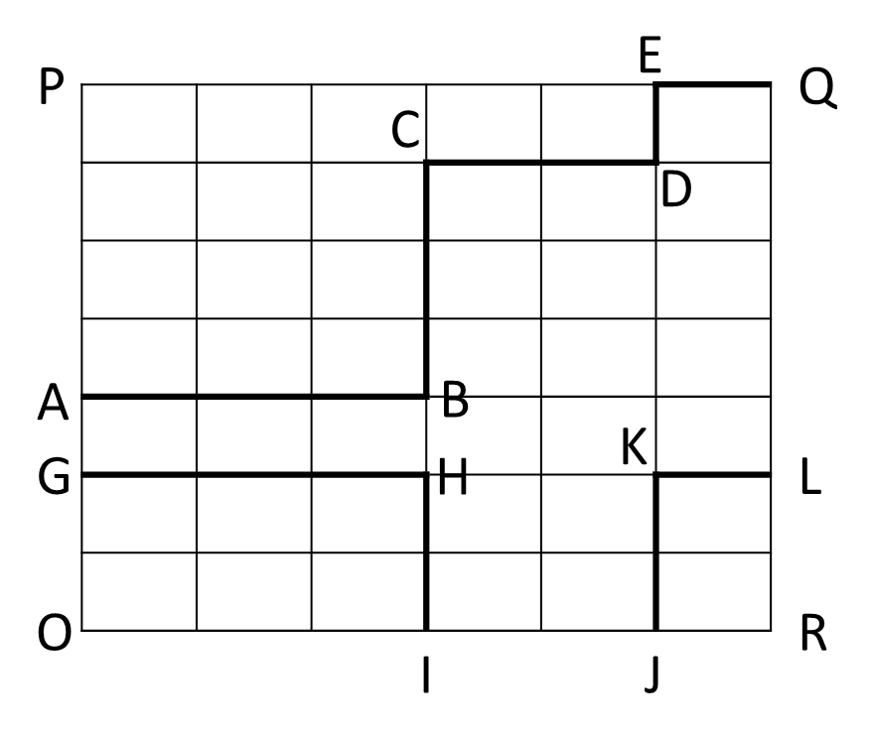
What is the area under the line GHI – JKL in the given quadrilateral OPQR, knowing that all the small spaces are squares of the same area?
- Length ABCDEQ is greater than or equal to 60.
- Area OPQR is less than or equal to 1512.
Each of these items has a question followed by two statements. As the answer,
Type 1, If the question can be answered with the help of statement I alone,
Type 2, If the question can be answered with the help of statement II alone,
Type 3, If both the statement I and statement II are needed to answer the question, and
Type 4, If the question cannot be answered even with the help of both the statements.
What is the radius of the circle?
- Ratio of its area to circumference is > 7.
- Diameter of the circle is ≤ 32.
Each of these items has a question followed by two statements. As the answer,
Type 1, If the question can be answered with the help of statement I alone,
Type 2, If the question can be answered with the help of statement II alone,
Type 3, If both the statement I and statement II are needed to answer the question, and
Type 4, If the question cannot be answered even with the help of both the statements.
What is the time difference between New York and London?
- The departure time at New York is exactly 9:00 a.m. local time and the arrival time at London is at 10:00 a.m. local time.
- The flight time is 5 hours.
Each of these items has a question followed by two statements. As the answer,
Type 1, If the question can be answered with the help of statement I alone,
Type 2, If the question can be answered with the help of statement II alone,
Type 3, If both the statement I and statement II are needed to answer the question, and
Type 4, If the question cannot be answered even with the help of both the statements.
Mr. Murthy takes the morning train to his office from station A to station B, and his colleague Mr.Rahman joins him on the way. There are three stations C, D and E on the way not necessarily in that sequence. What is the sequence of stations?
- Mr. Rahman boards the train at D.
- Mr. Thomas, who travels between C & D has two segments of journey in common with Mr. Murthy but none with Mr. Rahman.