Distribution — CAT Previous-Year Questions
115 previous-year questions on Distribution from CAT, with full solutions. Practise free — check answers as you go; sign in to save your progress.
Distribution · CAT PYQs
Passage / Data
Answer the following questions based on the information given below.
Eight gymnastics players numbered 1 through 8 underwent a training camp where they were coached by three coaches - Xena, Yuki, and Zara. Each coach trained at least two players. Yuki trained only even numbered players, while Zara trained only odd numbered players. After the camp, the coaches evaluated the players and gave integer ratings to the respective players trained by them on a scale of 1 to 7, with 1 being the lowest rating and 7 the highest.
The following additional information is known.
1. Xena trained more players than Yuki.
2. Player-1 and Player-4 were trained by the same coach, while the coaches who trained Player-2, Player-3 and Player-5 were all different.
3. Player-5 and Player-7 were trained by the same coach and got the same rating. All other players got a unique rating.
4. The average of the ratings of all the players was 4.
5. Player-2 got the highest rating.
6. The average of the ratings of the players trained by Yuki was twice that of the players trained by Xena and two more than that of the players trained by Zara.
7. Player-4's rating was double of Player-8's and less than Player-5's.
What best can be concluded about the number of players coached by Zara?
Passage / Data
Answer the following questions based on the information given below.
Eight gymnastics players numbered 1 through 8 underwent a training camp where they were coached by three coaches - Xena, Yuki, and Zara. Each coach trained at least two players. Yuki trained only even numbered players, while Zara trained only odd numbered players. After the camp, the coaches evaluated the players and gave integer ratings to the respective players trained by them on a scale of 1 to 7, with 1 being the lowest rating and 7 the highest.
The following additional information is known.
1. Xena trained more players than Yuki.
2. Player-1 and Player-4 were trained by the same coach, while the coaches who trained Player-2, Player-3 and Player-5 were all different.
3. Player-5 and Player-7 were trained by the same coach and got the same rating. All other players got a unique rating.
4. The average of the ratings of all the players was 4.
5. Player-2 got the highest rating.
6. The average of the ratings of the players trained by Yuki was twice that of the players trained by Xena and two more than that of the players trained by Zara.
7. Player-4's rating was double of Player-8's and less than Player-5's.
What was the rating of Player-7?
Passage / Data
Answer the following questions based on the information given below.
Eight gymnastics players numbered 1 through 8 underwent a training camp where they were coached by three coaches - Xena, Yuki, and Zara. Each coach trained at least two players. Yuki trained only even numbered players, while Zara trained only odd numbered players. After the camp, the coaches evaluated the players and gave integer ratings to the respective players trained by them on a scale of 1 to 7, with 1 being the lowest rating and 7 the highest.
The following additional information is known.
1. Xena trained more players than Yuki.
2. Player-1 and Player-4 were trained by the same coach, while the coaches who trained Player-2, Player-3 and Player-5 were all different.
3. Player-5 and Player-7 were trained by the same coach and got the same rating. All other players got a unique rating.
4. The average of the ratings of all the players was 4.
5. Player-2 got the highest rating.
6. The average of the ratings of the players trained by Yuki was twice that of the players trained by Xena and two more than that of the players trained by Zara.
7. Player-4's rating was double of Player-8's and less than Player-5's.
What was the rating of Player-6?
Passage / Data
Answer the following questions based on the information given below.
Eight gymnastics players numbered 1 through 8 underwent a training camp where they were coached by three coaches - Xena, Yuki, and Zara. Each coach trained at least two players. Yuki trained only even numbered players, while Zara trained only odd numbered players. After the camp, the coaches evaluated the players and gave integer ratings to the respective players trained by them on a scale of 1 to 7, with 1 being the lowest rating and 7 the highest.
The following additional information is known.
1. Xena trained more players than Yuki.
2. Player-1 and Player-4 were trained by the same coach, while the coaches who trained Player-2, Player-3 and Player-5 were all different.
3. Player-5 and Player-7 were trained by the same coach and got the same rating. All other players got a unique rating.
4. The average of the ratings of all the players was 4.
5. Player-2 got the highest rating.
6. The average of the ratings of the players trained by Yuki was twice that of the players trained by Xena and two more than that of the players trained by Zara.
7. Player-4's rating was double of Player-8's and less than Player-5's.
For how many players the ratings can be determined with certainty?
Passage / Data
Answer the following questions based on the information given below.
Eight gymnastics players numbered 1 through 8 underwent a training camp where they were coached by three coaches - Xena, Yuki, and Zara. Each coach trained at least two players. Yuki trained only even numbered players, while Zara trained only odd numbered players. After the camp, the coaches evaluated the players and gave integer ratings to the respective players trained by them on a scale of 1 to 7, with 1 being the lowest rating and 7 the highest.
The following additional information is known.
1. Xena trained more players than Yuki.
2. Player-1 and Player-4 were trained by the same coach, while the coaches who trained Player-2, Player-3 and Player-5 were all different.
3. Player-5 and Player-7 were trained by the same coach and got the same rating. All other players got a unique rating.
4. The average of the ratings of all the players was 4.
5. Player-2 got the highest rating.
6. The average of the ratings of the players trained by Yuki was twice that of the players trained by Xena and two more than that of the players trained by Zara.
7. Player-4's rating was double of Player-8's and less than Player-5's.
Who all were the players trained by Xena?
Passage / Data
Answer the following questions based on the information given below:
An air conditioner (AC) company has four dealers – D1, D2, D3 and D4 in a city. It is evaluating sales performances of these dealers. The company sells two variants of ACs – Window and Split. Both these variants can be either Inverter type or Non-inverter type. It is known that of the total number of ACs sold in the city, 25% were of Window variant, while the rest were of Split variant. Among the Inverter ACs sold, 20% were of Window variant.
The following information is also known:
1. Every dealer sold at least two window ACs.
2. D1 sold 13 inverter ACs, while D3 sold 5 Non-inverter ACs.
3. A total of six Window Non-inverter ACs and 36 Split Inverter ACs were sold in the city.
4. The number of Split ACs sold by D1 was twice the number of Window ACs sold by it.
5. D3 and D4 sold an equal number of Window ACs and this number was one-third of the number of similar ACs sold by D2.
6. D2 and D3 were the only ones who sold Window Non-inverter ACs. The number of these ACs sold by D2 was twice the number of these ACs sold by D3.
7. D3 and D4 sold an equal number of Split Inverter ACs. This number was half the number of similar ACs sold by D2.
How many Split Inverter ACs did D2 sell?
Passage / Data
Answer the following questions based on the information given below:
An air conditioner (AC) company has four dealers – D1, D2, D3 and D4 in a city. It is evaluating sales performances of these dealers. The company sells two variants of ACs – Window and Split. Both these variants can be either Inverter type or Non-inverter type. It is known that of the total number of ACs sold in the city, 25% were of Window variant, while the rest were of Split variant. Among the Inverter ACs sold, 20% were of Window variant.
The following information is also known:
1. Every dealer sold at least two window ACs.
2. D1 sold 13 inverter ACs, while D3 sold 5 Non-inverter ACs.
3. A total of six Window Non-inverter ACs and 36 Split Inverter ACs were sold in the city.
4. The number of Split ACs sold by D1 was twice the number of Window ACs sold by it.
5. D3 and D4 sold an equal number of Window ACs and this number was one-third of the number of similar ACs sold by D2.
6. D2 and D3 were the only ones who sold Window Non-inverter ACs. The number of these ACs sold by D2 was twice the number of these ACs sold by D3.
7. D3 and D4 sold an equal number of Split Inverter ACs. This number was half the number of similar ACs sold by D2.
What percentage of ACs sold were of Non-inverter type?
Passage / Data
Answer the following questions based on the information given below:
An air conditioner (AC) company has four dealers – D1, D2, D3 and D4 in a city. It is evaluating sales performances of these dealers. The company sells two variants of ACs – Window and Split. Both these variants can be either Inverter type or Non-inverter type. It is known that of the total number of ACs sold in the city, 25% were of Window variant, while the rest were of Split variant. Among the Inverter ACs sold, 20% were of Window variant.
The following information is also known:
1. Every dealer sold at least two window ACs.
2. D1 sold 13 inverter ACs, while D3 sold 5 Non-inverter ACs.
3. A total of six Window Non-inverter ACs and 36 Split Inverter ACs were sold in the city.
4. The number of Split ACs sold by D1 was twice the number of Window ACs sold by it.
5. D3 and D4 sold an equal number of Window ACs and this number was one-third of the number of similar ACs sold by D2.
6. D2 and D3 were the only ones who sold Window Non-inverter ACs. The number of these ACs sold by D2 was twice the number of these ACs sold by D3.
7. D3 and D4 sold an equal number of Split Inverter ACs. This number was half the number of similar ACs sold by D2.
What was the total number of ACs sold by D2 and D4?
Passage / Data
Answer the following questions based on the information given below:
An air conditioner (AC) company has four dealers – D1, D2, D3 and D4 in a city. It is evaluating sales performances of these dealers. The company sells two variants of ACs – Window and Split. Both these variants can be either Inverter type or Non-inverter type. It is known that of the total number of ACs sold in the city, 25% were of Window variant, while the rest were of Split variant. Among the Inverter ACs sold, 20% were of Window variant.
The following information is also known:
1. Every dealer sold at least two window ACs.
2. D1 sold 13 inverter ACs, while D3 sold 5 Non-inverter ACs.
3. A total of six Window Non-inverter ACs and 36 Split Inverter ACs were sold in the city.
4. The number of Split ACs sold by D1 was twice the number of Window ACs sold by it.
5. D3 and D4 sold an equal number of Window ACs and this number was one-third of the number of similar ACs sold by D2.
6. D2 and D3 were the only ones who sold Window Non-inverter ACs. The number of these ACs sold by D2 was twice the number of these ACs sold by D3.
7. D3 and D4 sold an equal number of Split Inverter ACs. This number was half the number of similar ACs sold by D2.
Which of the following statements is necessarily false?
Passage / Data
Answer the following questions based on the information given below:
An air conditioner (AC) company has four dealers – D1, D2, D3 and D4 in a city. It is evaluating sales performances of these dealers. The company sells two variants of ACs – Window and Split. Both these variants can be either Inverter type or Non-inverter type. It is known that of the total number of ACs sold in the city, 25% were of Window variant, while the rest were of Split variant. Among the Inverter ACs sold, 20% were of Window variant.
The following information is also known:
1. Every dealer sold at least two window ACs.
2. D1 sold 13 inverter ACs, while D3 sold 5 Non-inverter ACs.
3. A total of six Window Non-inverter ACs and 36 Split Inverter ACs were sold in the city.
4. The number of Split ACs sold by D1 was twice the number of Window ACs sold by it.
5. D3 and D4 sold an equal number of Window ACs and this number was one-third of the number of similar ACs sold by D2.
6. D2 and D3 were the only ones who sold Window Non-inverter ACs. The number of these ACs sold by D2 was twice the number of these ACs sold by D3.
7. D3 and D4 sold an equal number of Split Inverter ACs. This number was half the number of similar ACs sold by D2.
If D3 and D4 sold an equal number of ACs, then what was the number of Non-inverter ACs sold by D2?
Passage / Data
Answer the next 5 questions based on the information given below:
A few salesmen are employed to sell a product called TRICCEK among households in various housing complexes. On each day, a salesman is assigned to visit one housing complex. Once a salesman enters a housing complex, he can meet any number of households in the time available. However, if a household makes a complaint against the salesman, then he must leave the housing complex immediately and cannot meet any other household on that day. A household may buy any number of TRICCEK items or may not buy any item. The salesman needs to record the total number of TRICCEK items sold as well as the number of households met in each day. The success rate of a salesman for a day is defined as the ratio of the number of items sold to the number of households met on that day. Some details about the performances of three salesmen - Tohri, Hokli and Lahur, on two particular days are given below.
1. Over the two days, all three of them met the same total number of households, and each of them sold a total of 100 items.
2. On both days, Lahur met the same number of households and sold the same number of items.
3. Hokli could not sell any item on the second day because the first household he met on that day complained against him.
4. Tohri met 30 more households on the second day than on the first day.
5. Tohri’s success rate was twice that of Lahur’s on the first day, and it was 75% of Lahur’s on the second day.
What was the total number of households met by Tohri, Hokli and Lahur on the first day?
Passage / Data
Answer the next 5 questions based on the information given below:
A few salesmen are employed to sell a product called TRICCEK among households in various housing complexes. On each day, a salesman is assigned to visit one housing complex. Once a salesman enters a housing complex, he can meet any number of households in the time available. However, if a household makes a complaint against the salesman, then he must leave the housing complex immediately and cannot meet any other household on that day. A household may buy any number of TRICCEK items or may not buy any item. The salesman needs to record the total number of TRICCEK items sold as well as the number of households met in each day. The success rate of a salesman for a day is defined as the ratio of the number of items sold to the number of households met on that day. Some details about the performances of three salesmen - Tohri, Hokli and Lahur, on two particular days are given below.
1. Over the two days, all three of them met the same total number of households, and each of them sold a total of 100 items.
2. On both days, Lahur met the same number of households and sold the same number of items.
3. Hokli could not sell any item on the second day because the first household he met on that day complained against him.
4. Tohri met 30 more households on the second day than on the first day.
5. Tohri’s success rate was twice that of Lahur’s on the first day, and it was 75% of Lahur’s on the second day.
How many TRICCEK items were sold by Tohri on the first day?
Passage / Data
Answer the next 5 questions based on the information given below:
A few salesmen are employed to sell a product called TRICCEK among households in various housing complexes. On each day, a salesman is assigned to visit one housing complex. Once a salesman enters a housing complex, he can meet any number of households in the time available. However, if a household makes a complaint against the salesman, then he must leave the housing complex immediately and cannot meet any other household on that day. A household may buy any number of TRICCEK items or may not buy any item. The salesman needs to record the total number of TRICCEK items sold as well as the number of households met in each day. The success rate of a salesman for a day is defined as the ratio of the number of items sold to the number of households met on that day. Some details about the performances of three salesmen - Tohri, Hokli and Lahur, on two particular days are given below.
1. Over the two days, all three of them met the same total number of households, and each of them sold a total of 100 items.
2. On both days, Lahur met the same number of households and sold the same number of items.
3. Hokli could not sell any item on the second day because the first household he met on that day complained against him.
4. Tohri met 30 more households on the second day than on the first day.
5. Tohri’s success rate was twice that of Lahur’s on the first day, and it was 75% of Lahur’s on the second day.
How many households did Lahur meet on the second day?
Passage / Data
Answer the next 5 questions based on the information given below:
A few salesmen are employed to sell a product called TRICCEK among households in various housing complexes. On each day, a salesman is assigned to visit one housing complex. Once a salesman enters a housing complex, he can meet any number of households in the time available. However, if a household makes a complaint against the salesman, then he must leave the housing complex immediately and cannot meet any other household on that day. A household may buy any number of TRICCEK items or may not buy any item. The salesman needs to record the total number of TRICCEK items sold as well as the number of households met in each day. The success rate of a salesman for a day is defined as the ratio of the number of items sold to the number of households met on that day. Some details about the performances of three salesmen - Tohri, Hokli and Lahur, on two particular days are given below.
1. Over the two days, all three of them met the same total number of households, and each of them sold a total of 100 items.
2. On both days, Lahur met the same number of households and sold the same number of items.
3. Hokli could not sell any item on the second day because the first household he met on that day complained against him.
4. Tohri met 30 more households on the second day than on the first day.
5. Tohri’s success rate was twice that of Lahur’s on the first day, and it was 75% of Lahur’s on the second day.
How many households did Tohri meet on the first day?
Passage / Data
Answer the next 5 questions based on the information given below:
A few salesmen are employed to sell a product called TRICCEK among households in various housing complexes. On each day, a salesman is assigned to visit one housing complex. Once a salesman enters a housing complex, he can meet any number of households in the time available. However, if a household makes a complaint against the salesman, then he must leave the housing complex immediately and cannot meet any other household on that day. A household may buy any number of TRICCEK items or may not buy any item. The salesman needs to record the total number of TRICCEK items sold as well as the number of households met in each day. The success rate of a salesman for a day is defined as the ratio of the number of items sold to the number of households met on that day. Some details about the performances of three salesmen - Tohri, Hokli and Lahur, on two particular days are given below.
1. Over the two days, all three of them met the same total number of households, and each of them sold a total of 100 items.
2. On both days, Lahur met the same number of households and sold the same number of items.
3. Hokli could not sell any item on the second day because the first household he met on that day complained against him.
4. Tohri met 30 more households on the second day than on the first day.
5. Tohri’s success rate was twice that of Lahur’s on the first day, and it was 75% of Lahur’s on the second day.
Which of the following statements is FALSE?
Passage / Data
Answer the next 4 questions based on the information given
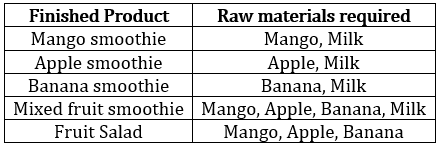
Ganga, Kaveri, and Narmada are three women who buy four raw materials (Mango, Apple, Banana and Milk) and sell five finished products (Mango smoothie, Apple smoothie, Banana smoothie, Mixed fruit smoothie and Fruit salad). Table-1 gives information about the raw materials required to produce the five finished products. One unit of a finished product requires one unit of each of the raw materials mentioned in the second column of the table.
Table - 1
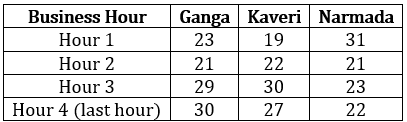
One unit of milk, mango, apple, and banana cost ₹5, ₹3, ₹2, and ₹1 respectively. Each unit of a finished product is sold for a profit equal to two times the number of raw materials used to make that product. For example, apple smoothie is made with two raw materials (apple and milk) and will be sold for a profit of ₹4 per unit. Leftover raw materials are sold during the last business hour of the day for a loss of ₹1 per unit. The amount, in rupees, received from sales (revenue) for each woman in each of the four business hours of the day is given in Table-2.
Table - 2
The following additional facts are known.
- No one except possibly Ganga sold any Mango smoothie.
- Each woman sold either zero or one unit of any single finished product in any hour.
- Each woman had exactly one unit each of two different raw materials as leftovers.
- No one had any banana leftover.
What BEST can be concluded about the number of units of fruit salad sold in the first hour?
Passage / Data
Answer the next 4 questions based on the information given
Ganga, Kaveri, and Narmada are three women who buy four raw materials (Mango, Apple, Banana and Milk) and sell five finished products (Mango smoothie, Apple smoothie, Banana smoothie, Mixed fruit smoothie and Fruit salad). Table-1 gives information about the raw materials required to produce the five finished products. One unit of a finished product requires one unit of each of the raw materials mentioned in the second column of the table.
Table - 1
One unit of milk, mango, apple, and banana cost ₹5, ₹3, ₹2, and ₹1 respectively. Each unit of a finished product is sold for a profit equal to two times the number of raw materials used to make that product. For example, apple smoothie is made with two raw materials (apple and milk) and will be sold for a profit of ₹4 per unit. Leftover raw materials are sold during the last business hour of the day for a loss of ₹1 per unit. The amount, in rupees, received from sales (revenue) for each woman in each of the four business hours of the day is given in Table-2.
Table - 2
The following additional facts are known.
- No one except possibly Ganga sold any Mango smoothie.
- Each woman sold either zero or one unit of any single finished product in any hour.
- Each woman had exactly one unit each of two different raw materials as leftovers.
- No one had any banana leftover.
Which of the following is NECESSARILY true?
Passage / Data
Answer the next 4 questions based on the information given
Ganga, Kaveri, and Narmada are three women who buy four raw materials (Mango, Apple, Banana and Milk) and sell five finished products (Mango smoothie, Apple smoothie, Banana smoothie, Mixed fruit smoothie and Fruit salad). Table-1 gives information about the raw materials required to produce the five finished products. One unit of a finished product requires one unit of each of the raw materials mentioned in the second column of the table.
Table - 1
One unit of milk, mango, apple, and banana cost ₹5, ₹3, ₹2, and ₹1 respectively. Each unit of a finished product is sold for a profit equal to two times the number of raw materials used to make that product. For example, apple smoothie is made with two raw materials (apple and milk) and will be sold for a profit of ₹4 per unit. Leftover raw materials are sold during the last business hour of the day for a loss of ₹1 per unit. The amount, in rupees, received from sales (revenue) for each woman in each of the four business hours of the day is given in Table-2.
Table - 2
The following additional facts are known.
- No one except possibly Ganga sold any Mango smoothie.
- Each woman sold either zero or one unit of any single finished product in any hour.
- Each woman had exactly one unit each of two different raw materials as leftovers.
- No one had any banana leftover.
What BEST can be concluded about the total number of units of milk the three women had in the beginning?
Passage / Data
Answer the next 4 questions based on the information given
Ganga, Kaveri, and Narmada are three women who buy four raw materials (Mango, Apple, Banana and Milk) and sell five finished products (Mango smoothie, Apple smoothie, Banana smoothie, Mixed fruit smoothie and Fruit salad). Table-1 gives information about the raw materials required to produce the five finished products. One unit of a finished product requires one unit of each of the raw materials mentioned in the second column of the table.
Table - 1
One unit of milk, mango, apple, and banana cost ₹5, ₹3, ₹2, and ₹1 respectively. Each unit of a finished product is sold for a profit equal to two times the number of raw materials used to make that product. For example, apple smoothie is made with two raw materials (apple and milk) and will be sold for a profit of ₹4 per unit. Leftover raw materials are sold during the last business hour of the day for a loss of ₹1 per unit. The amount, in rupees, received from sales (revenue) for each woman in each of the four business hours of the day is given in Table-2.
Table - 2
The following additional facts are known.
- No one except possibly Ganga sold any Mango smoothie.
- Each woman sold either zero or one unit of any single finished product in any hour.
- Each woman had exactly one unit each of two different raw materials as leftovers.
- No one had any banana leftover.
If it is known that three leftover units of mangoes were sold during the last business hour of the day, how many apple smoothies were sold during the day?
Passage / Data
Answer the next 6 questions based on the information given
A journal plans to publish 18 research papers, written by eight authors (A, B, C, D, E, F, G, and H) in four issues of the journal scheduled in January, April, July and October. Each of the research papers was written by exactly one of the eight authors. Five papers were scheduled in each of the first two issues, while four were scheduled in each of the last two issues. Every author wrote at least one paper and at most three papers. The total number of papers written by A, D, G and H was double the total number of papers written by the other four authors. Four of the authors were from India and two each were from Japan and China. Each author belonged to exactly one of the three areas — Manufacturing, Automation and Logistics. Four of the authors were from the Logistics area and two were from the Automation area. As per the journal policy, none of the authors could have more than one paper in any issue of the journal.
The following facts are also known.
- F, an Indian author from the Logistics area, wrote only one paper. It was scheduled in the October issue.
- A was from the Automation area and did not have a paper scheduled in the October issue.
- None of the Indian authors were from the Manufacturing area and none of the Japanese or Chinese authors were from the Automation area.
- A and H were from different countries, but had their papers scheduled in exactly the same issues.
- C and E, both Chinese authors from different areas, had the same number of papers scheduled. Further, E had papers scheduled in consecutive issues of the journal but C did not.
- B, from the Logistics area, had a paper scheduled in the April issue of the journal.
- B and G belonged to the same country. None of their papers were scheduled in the same issue of the journal.
- D, a Japanese author from the Manufacturing area, did not have a paper scheduled in the July issue.
- C and H belonged to different areas.
What is the correct sequence of number of papers written by B, C, E and G, respectively?
Passage / Data
Answer the next 6 questions based on the information given
A journal plans to publish 18 research papers, written by eight authors (A, B, C, D, E, F, G, and H) in four issues of the journal scheduled in January, April, July and October. Each of the research papers was written by exactly one of the eight authors. Five papers were scheduled in each of the first two issues, while four were scheduled in each of the last two issues. Every author wrote at least one paper and at most three papers. The total number of papers written by A, D, G and H was double the total number of papers written by the other four authors. Four of the authors were from India and two each were from Japan and China. Each author belonged to exactly one of the three areas — Manufacturing, Automation and Logistics. Four of the authors were from the Logistics area and two were from the Automation area. As per the journal policy, none of the authors could have more than one paper in any issue of the journal.
The following facts are also known.
- F, an Indian author from the Logistics area, wrote only one paper. It was scheduled in the October issue.
- A was from the Automation area and did not have a paper scheduled in the October issue.
- None of the Indian authors were from the Manufacturing area and none of the Japanese or Chinese authors were from the Automation area.
- A and H were from different countries, but had their papers scheduled in exactly the same issues.
- C and E, both Chinese authors from different areas, had the same number of papers scheduled. Further, E had papers scheduled in consecutive issues of the journal but C did not.
- B, from the Logistics area, had a paper scheduled in the April issue of the journal.
- B and G belonged to the same country. None of their papers were scheduled in the same issue of the journal.
- D, a Japanese author from the Manufacturing area, did not have a paper scheduled in the July issue.
- C and H belonged to different areas.
How many papers were written by Indian authors?
Passage / Data
Answer the next 6 questions based on the information given
A journal plans to publish 18 research papers, written by eight authors (A, B, C, D, E, F, G, and H) in four issues of the journal scheduled in January, April, July and October. Each of the research papers was written by exactly one of the eight authors. Five papers were scheduled in each of the first two issues, while four were scheduled in each of the last two issues. Every author wrote at least one paper and at most three papers. The total number of papers written by A, D, G and H was double the total number of papers written by the other four authors. Four of the authors were from India and two each were from Japan and China. Each author belonged to exactly one of the three areas — Manufacturing, Automation and Logistics. Four of the authors were from the Logistics area and two were from the Automation area. As per the journal policy, none of the authors could have more than one paper in any issue of the journal.
The following facts are also known.
- F, an Indian author from the Logistics area, wrote only one paper. It was scheduled in the October issue.
- A was from the Automation area and did not have a paper scheduled in the October issue.
- None of the Indian authors were from the Manufacturing area and none of the Japanese or Chinese authors were from the Automation area.
- A and H were from different countries, but had their papers scheduled in exactly the same issues.
- C and E, both Chinese authors from different areas, had the same number of papers scheduled. Further, E had papers scheduled in consecutive issues of the journal but C did not.
- B, from the Logistics area, had a paper scheduled in the April issue of the journal.
- B and G belonged to the same country. None of their papers were scheduled in the same issue of the journal.
- D, a Japanese author from the Manufacturing area, did not have a paper scheduled in the July issue.
- C and H belonged to different areas.
Which of the following statement(s) MUST be true?
Statement A: Every issue had at least one paper by author(s) from each country.
Statement B: Every issue had at most two papers by author(s) from each area.
Passage / Data
Answer the next 6 questions based on the information given
A journal plans to publish 18 research papers, written by eight authors (A, B, C, D, E, F, G, and H) in four issues of the journal scheduled in January, April, July and October. Each of the research papers was written by exactly one of the eight authors. Five papers were scheduled in each of the first two issues, while four were scheduled in each of the last two issues. Every author wrote at least one paper and at most three papers. The total number of papers written by A, D, G and H was double the total number of papers written by the other four authors. Four of the authors were from India and two each were from Japan and China. Each author belonged to exactly one of the three areas — Manufacturing, Automation and Logistics. Four of the authors were from the Logistics area and two were from the Automation area. As per the journal policy, none of the authors could have more than one paper in any issue of the journal.
The following facts are also known.
- F, an Indian author from the Logistics area, wrote only one paper. It was scheduled in the October issue.
- A was from the Automation area and did not have a paper scheduled in the October issue.
- None of the Indian authors were from the Manufacturing area and none of the Japanese or Chinese authors were from the Automation area.
- A and H were from different countries, but had their papers scheduled in exactly the same issues.
- C and E, both Chinese authors from different areas, had the same number of papers scheduled. Further, E had papers scheduled in consecutive issues of the journal but C did not.
- B, from the Logistics area, had a paper scheduled in the April issue of the journal.
- B and G belonged to the same country. None of their papers were scheduled in the same issue of the journal.
- D, a Japanese author from the Manufacturing area, did not have a paper scheduled in the July issue.
- C and H belonged to different areas.
Which of the following statements is FALSE?
Passage / Data
Answer the next 6 questions based on the information given
A journal plans to publish 18 research papers, written by eight authors (A, B, C, D, E, F, G, and H) in four issues of the journal scheduled in January, April, July and October. Each of the research papers was written by exactly one of the eight authors. Five papers were scheduled in each of the first two issues, while four were scheduled in each of the last two issues. Every author wrote at least one paper and at most three papers. The total number of papers written by A, D, G and H was double the total number of papers written by the other four authors. Four of the authors were from India and two each were from Japan and China. Each author belonged to exactly one of the three areas — Manufacturing, Automation and Logistics. Four of the authors were from the Logistics area and two were from the Automation area. As per the journal policy, none of the authors could have more than one paper in any issue of the journal.
The following facts are also known.
- F, an Indian author from the Logistics area, wrote only one paper. It was scheduled in the October issue.
- A was from the Automation area and did not have a paper scheduled in the October issue.
- None of the Indian authors were from the Manufacturing area and none of the Japanese or Chinese authors were from the Automation area.
- A and H were from different countries, but had their papers scheduled in exactly the same issues.
- C and E, both Chinese authors from different areas, had the same number of papers scheduled. Further, E had papers scheduled in consecutive issues of the journal but C did not.
- B, from the Logistics area, had a paper scheduled in the April issue of the journal.
- B and G belonged to the same country. None of their papers were scheduled in the same issue of the journal.
- D, a Japanese author from the Manufacturing area, did not have a paper scheduled in the July issue.
- C and H belonged to different areas.
Which of the following statements is FALSE?
Passage / Data
Answer the next 6 questions based on the information given
A journal plans to publish 18 research papers, written by eight authors (A, B, C, D, E, F, G, and H) in four issues of the journal scheduled in January, April, July and October. Each of the research papers was written by exactly one of the eight authors. Five papers were scheduled in each of the first two issues, while four were scheduled in each of the last two issues. Every author wrote at least one paper and at most three papers. The total number of papers written by A, D, G and H was double the total number of papers written by the other four authors. Four of the authors were from India and two each were from Japan and China. Each author belonged to exactly one of the three areas — Manufacturing, Automation and Logistics. Four of the authors were from the Logistics area and two were from the Automation area. As per the journal policy, none of the authors could have more than one paper in any issue of the journal.
The following facts are also known.
- F, an Indian author from the Logistics area, wrote only one paper. It was scheduled in the October issue.
- A was from the Automation area and did not have a paper scheduled in the October issue.
- None of the Indian authors were from the Manufacturing area and none of the Japanese or Chinese authors were from the Automation area.
- A and H were from different countries, but had their papers scheduled in exactly the same issues.
- C and E, both Chinese authors from different areas, had the same number of papers scheduled. Further, E had papers scheduled in consecutive issues of the journal but C did not.
- B, from the Logistics area, had a paper scheduled in the April issue of the journal.
- B and G belonged to the same country. None of their papers were scheduled in the same issue of the journal.
- D, a Japanese author from the Manufacturing area, did not have a paper scheduled in the July issue.
- C and H belonged to different areas.
Which of the following is the correct sequence of number of papers by authors from Automation, Manufacturing and Logistics areas, respectively?
Passage / Data
Answer the next 6 questions based on the information given
Ravi works in an online food-delivery company. After each delivery, customers rate Ravi on each of four parameters – Behaviour, Packaging, Hygiene, and Timeliness, on a scale from 1 to 9. If the total of the four rating points is 25 or more, then Ravi gets a bonus of ₹20 for that delivery. Additionally, a customer may or may not give Ravi a tip. If the customer gives a tip, it
is either ₹30 or ₹50.
One day, Ravi made four deliveries - one to each of Atal, Bihari, Chirag and Deepak, and received a total of ₹120 in bonus and tips. He did not get both a bonus and a tip from the same customer.
The following additional facts are also known.
- In Timeliness, Ravi received a total of 21 points, and three of the customers gave him the same rating points in this parameter. Atal gave higher rating points than Bihari and Chirag in this parameter.
- Ravi received distinct rating points in Packaging from the four customers adding up to 29 points. Similarly, Ravi received distinct rating points in Hygiene from the four customers adding up to 26 points.
- Chirag gave the same rating points for Packaging and Hygiene.
- Among the four customers, Bihari gave the highest rating points in Packaging, and Chirag gave the highest rating points in Hygiene.
- Everyone rated Ravi between 5 and 7 in Behaviour. Unique maximum and minimum ratings in this parameter were given by Atal and Deepak respectively.
- If the customers are ranked based on ratings given by them in individual parameters, then Atal’s rank based on Packaging is the same as that based on Hygiene. This is also true for Deepak.
What was the minimum rating that Ravi received from any customer in any parameter?
Passage / Data
Answer the next 6 questions based on the information given
Ravi works in an online food-delivery company. After each delivery, customers rate Ravi on each of four parameters – Behaviour, Packaging, Hygiene, and Timeliness, on a scale from 1 to 9. If the total of the four rating points is 25 or more, then Ravi gets a bonus of ₹20 for that delivery. Additionally, a customer may or may not give Ravi a tip. If the customer gives a tip, it
is either ₹30 or ₹50.
One day, Ravi made four deliveries - one to each of Atal, Bihari, Chirag and Deepak, and received a total of ₹120 in bonus and tips. He did not get both a bonus and a tip from the same customer.
The following additional facts are also known.
- In Timeliness, Ravi received a total of 21 points, and three of the customers gave him the same rating points in this parameter. Atal gave higher rating points than Bihari and Chirag in this parameter.
- Ravi received distinct rating points in Packaging from the four customers adding up to 29 points. Similarly, Ravi received distinct rating points in Hygiene from the four customers adding up to 26 points.
- Chirag gave the same rating points for Packaging and Hygiene.
- Among the four customers, Bihari gave the highest rating points in Packaging, and Chirag gave the highest rating points in Hygiene.
- Everyone rated Ravi between 5 and 7 in Behaviour. Unique maximum and minimum ratings in this parameter were given by Atal and Deepak respectively.
- If the customers are ranked based on ratings given by them in individual parameters, then Atal’s rank based on Packaging is the same as that based on Hygiene. This is also true for Deepak.
The COMPLETE list of customers who gave the maximum total rating points to Ravi is
Passage / Data
Answer the next 6 questions based on the information given
Ravi works in an online food-delivery company. After each delivery, customers rate Ravi on each of four parameters – Behaviour, Packaging, Hygiene, and Timeliness, on a scale from 1 to 9. If the total of the four rating points is 25 or more, then Ravi gets a bonus of ₹20 for that delivery. Additionally, a customer may or may not give Ravi a tip. If the customer gives a tip, it
is either ₹30 or ₹50.
One day, Ravi made four deliveries - one to each of Atal, Bihari, Chirag and Deepak, and received a total of ₹120 in bonus and tips. He did not get both a bonus and a tip from the same customer.
The following additional facts are also known.
- In Timeliness, Ravi received a total of 21 points, and three of the customers gave him the same rating points in this parameter. Atal gave higher rating points than Bihari and Chirag in this parameter.
- Ravi received distinct rating points in Packaging from the four customers adding up to 29 points. Similarly, Ravi received distinct rating points in Hygiene from the four customers adding up to 26 points.
- Chirag gave the same rating points for Packaging and Hygiene.
- Among the four customers, Bihari gave the highest rating points in Packaging, and Chirag gave the highest rating points in Hygiene.
- Everyone rated Ravi between 5 and 7 in Behaviour. Unique maximum and minimum ratings in this parameter were given by Atal and Deepak respectively.
- If the customers are ranked based on ratings given by them in individual parameters, then Atal’s rank based on Packaging is the same as that based on Hygiene. This is also true for Deepak.
What rating did Atal give on Timeliness?
Passage / Data
Answer the next 6 questions based on the information given
Ravi works in an online food-delivery company. After each delivery, customers rate Ravi on each of four parameters – Behaviour, Packaging, Hygiene, and Timeliness, on a scale from 1 to 9. If the total of the four rating points is 25 or more, then Ravi gets a bonus of ₹20 for that delivery. Additionally, a customer may or may not give Ravi a tip. If the customer gives a tip, it
is either ₹30 or ₹50.
One day, Ravi made four deliveries - one to each of Atal, Bihari, Chirag and Deepak, and received a total of ₹120 in bonus and tips. He did not get both a bonus and a tip from the same customer.
The following additional facts are also known.
- In Timeliness, Ravi received a total of 21 points, and three of the customers gave him the same rating points in this parameter. Atal gave higher rating points than Bihari and Chirag in this parameter.
- Ravi received distinct rating points in Packaging from the four customers adding up to 29 points. Similarly, Ravi received distinct rating points in Hygiene from the four customers adding up to 26 points.
- Chirag gave the same rating points for Packaging and Hygiene.
- Among the four customers, Bihari gave the highest rating points in Packaging, and Chirag gave the highest rating points in Hygiene.
- Everyone rated Ravi between 5 and 7 in Behaviour. Unique maximum and minimum ratings in this parameter were given by Atal and Deepak respectively.
- If the customers are ranked based on ratings given by them in individual parameters, then Atal’s rank based on Packaging is the same as that based on Hygiene. This is also true for Deepak.
What BEST can be concluded about the tip amount given by Deepak?
Passage / Data
Answer the next 6 questions based on the information given
Ravi works in an online food-delivery company. After each delivery, customers rate Ravi on each of four parameters – Behaviour, Packaging, Hygiene, and Timeliness, on a scale from 1 to 9. If the total of the four rating points is 25 or more, then Ravi gets a bonus of ₹20 for that delivery. Additionally, a customer may or may not give Ravi a tip. If the customer gives a tip, it
is either ₹30 or ₹50.
One day, Ravi made four deliveries - one to each of Atal, Bihari, Chirag and Deepak, and received a total of ₹120 in bonus and tips. He did not get both a bonus and a tip from the same customer.
The following additional facts are also known.
- In Timeliness, Ravi received a total of 21 points, and three of the customers gave him the same rating points in this parameter. Atal gave higher rating points than Bihari and Chirag in this parameter.
- Ravi received distinct rating points in Packaging from the four customers adding up to 29 points. Similarly, Ravi received distinct rating points in Hygiene from the four customers adding up to 26 points.
- Chirag gave the same rating points for Packaging and Hygiene.
- Among the four customers, Bihari gave the highest rating points in Packaging, and Chirag gave the highest rating points in Hygiene.
- Everyone rated Ravi between 5 and 7 in Behaviour. Unique maximum and minimum ratings in this parameter were given by Atal and Deepak respectively.
- If the customers are ranked based on ratings given by them in individual parameters, then Atal’s rank based on Packaging is the same as that based on Hygiene. This is also true for Deepak.
In which parameter did Atal give the maximum rating points to Ravi?
Passage / Data
Answer the next 6 questions based on the information given
Ravi works in an online food-delivery company. After each delivery, customers rate Ravi on each of four parameters – Behaviour, Packaging, Hygiene, and Timeliness, on a scale from 1 to 9. If the total of the four rating points is 25 or more, then Ravi gets a bonus of ₹20 for that delivery. Additionally, a customer may or may not give Ravi a tip. If the customer gives a tip, it
is either ₹30 or ₹50.
One day, Ravi made four deliveries - one to each of Atal, Bihari, Chirag and Deepak, and received a total of ₹120 in bonus and tips. He did not get both a bonus and a tip from the same customer.
The following additional facts are also known.
- In Timeliness, Ravi received a total of 21 points, and three of the customers gave him the same rating points in this parameter. Atal gave higher rating points than Bihari and Chirag in this parameter.
- Ravi received distinct rating points in Packaging from the four customers adding up to 29 points. Similarly, Ravi received distinct rating points in Hygiene from the four customers adding up to 26 points.
- Chirag gave the same rating points for Packaging and Hygiene.
- Among the four customers, Bihari gave the highest rating points in Packaging, and Chirag gave the highest rating points in Hygiene.
- Everyone rated Ravi between 5 and 7 in Behaviour. Unique maximum and minimum ratings in this parameter were given by Atal and Deepak respectively.
- If the customers are ranked based on ratings given by them in individual parameters, then Atal’s rank based on Packaging is the same as that based on Hygiene. This is also true for Deepak.
What rating did Deepak give on Packaging?
Passage / Data
Answer the following questions based on the information given below.
Four institutes, A, B, C, and D, had contracts with four vendors W, X, Y, and Z during the ten calendar years from 2010 to 2019. The contracts were either multi-year contracts running for several consecutive years or single-year contracts. No institute had more than one contract with the same vendor. However, in a calendar year, an institute may have had contracts with multiple vendors, and a vendor may have had contracts with multiple institutes. It is known that over the decade, the institutes each got into two contracts with two of these vendors, and each vendor got into two contracts with two of these institutes.
The following facts are also known about these contracts.
- Vendor Z had at least one contract in every year.
- Vendor X had one or more contracts in every year up to 2015, but no contract in any year after that.
- Vendor Y had contracts in 2010 and 2019. Vendor W had contracts only in 2012.
- There were five contracts in 2012.
- There were exactly four multi-year contracts. Institute B had a 7-year contract, D had a 4-year contract, and A and C had one 3-year contract each. The other four contracts were single-year contracts.
- Institute C had one or more contracts in 2012 but did not have any contract in 2011.
- Institutes B and D each had exactly one contract in 2012. Institute D did not have any contract in 2010.
In which of the following years were there two or more contracts?
Passage / Data
Answer the following questions based on the information given below.
Four institutes, A, B, C, and D, had contracts with four vendors W, X, Y, and Z during the ten calendar years from 2010 to 2019. The contracts were either multi-year contracts running for several consecutive years or single-year contracts. No institute had more than one contract with the same vendor. However, in a calendar year, an institute may have had contracts with multiple vendors, and a vendor may have had contracts with multiple institutes. It is known that over the decade, the institutes each got into two contracts with two of these vendors, and each vendor got into two contracts with two of these institutes.
The following facts are also known about these contracts.
- Vendor Z had at least one contract in every year.
- Vendor X had one or more contracts in every year up to 2015, but no contract in any year after that.
- Vendor Y had contracts in 2010 and 2019. Vendor W had contracts only in 2012.
- There were five contracts in 2012.
- There were exactly four multi-year contracts. Institute B had a 7-year contract, D had a 4-year contract, and A and C had one 3-year contract each. The other four contracts were single-year contracts.
- Institute C had one or more contracts in 2012 but did not have any contract in 2011.
- Institutes B and D each had exactly one contract in 2012. Institute D did not have any contract in 2010.
Which of the following is true?
Passage / Data
Answer the following questions based on the information given below.
Four institutes, A, B, C, and D, had contracts with four vendors W, X, Y, and Z during the ten calendar years from 2010 to 2019. The contracts were either multi-year contracts running for several consecutive years or single-year contracts. No institute had more than one contract with the same vendor. However, in a calendar year, an institute may have had contracts with multiple vendors, and a vendor may have had contracts with multiple institutes. It is known that over the decade, the institutes each got into two contracts with two of these vendors, and each vendor got into two contracts with two of these institutes.
The following facts are also known about these contracts.
- Vendor Z had at least one contract in every year.
- Vendor X had one or more contracts in every year up to 2015, but no contract in any year after that.
- Vendor Y had contracts in 2010 and 2019. Vendor W had contracts only in 2012.
- There were five contracts in 2012.
- There were exactly four multi-year contracts. Institute B had a 7-year contract, D had a 4-year contract, and A and C had one 3-year contract each. The other four contracts were single-year contracts.
- Institute C had one or more contracts in 2012 but did not have any contract in 2011.
- Institutes B and D each had exactly one contract in 2012. Institute D did not have any contract in 2010.
In how many years during this period was there only one contract?
Passage / Data
Answer the following questions based on the information given below.
Four institutes, A, B, C, and D, had contracts with four vendors W, X, Y, and Z during the ten calendar years from 2010 to 2019. The contracts were either multi-year contracts running for several consecutive years or single-year contracts. No institute had more than one contract with the same vendor. However, in a calendar year, an institute may have had contracts with multiple vendors, and a vendor may have had contracts with multiple institutes. It is known that over the decade, the institutes each got into two contracts with two of these vendors, and each vendor got into two contracts with two of these institutes.
The following facts are also known about these contracts.
- Vendor Z had at least one contract in every year.
- Vendor X had one or more contracts in every year up to 2015, but no contract in any year after that.
- Vendor Y had contracts in 2010 and 2019. Vendor W had contracts only in 2012.
- There were five contracts in 2012.
- There were exactly four multi-year contracts. Institute B had a 7-year contract, D had a 4-year contract, and A and C had one 3-year contract each. The other four contracts were single-year contracts.
- Institute C had one or more contracts in 2012 but did not have any contract in 2011.
- Institutes B and D each had exactly one contract in 2012. Institute D did not have any contract in 2010.
What BEST can be concluded about the number of contracts in 2010?
Passage / Data
Answer the following questions based on the information given below.
Four institutes, A, B, C, and D, had contracts with four vendors W, X, Y, and Z during the ten calendar years from 2010 to 2019. The contracts were either multi-year contracts running for several consecutive years or single-year contracts. No institute had more than one contract with the same vendor. However, in a calendar year, an institute may have had contracts with multiple vendors, and a vendor may have had contracts with multiple institutes. It is known that over the decade, the institutes each got into two contracts with two of these vendors, and each vendor got into two contracts with two of these institutes.
The following facts are also known about these contracts.
- Vendor Z had at least one contract in every year.
- Vendor X had one or more contracts in every year up to 2015, but no contract in any year after that.
- Vendor Y had contracts in 2010 and 2019. Vendor W had contracts only in 2012.
- There were five contracts in 2012.
- There were exactly four multi-year contracts. Institute B had a 7-year contract, D had a 4-year contract, and A and C had one 3-year contract each. The other four contracts were single-year contracts.
- Institute C had one or more contracts in 2012 but did not have any contract in 2011.
- Institutes B and D each had exactly one contract in 2012. Institute D did not have any contract in 2010.
Which institutes had multiple contracts during the same year?
Passage / Data
Answer the following questions based on the information given below.
Four institutes, A, B, C, and D, had contracts with four vendors W, X, Y, and Z during the ten calendar years from 2010 to 2019. The contracts were either multi-year contracts running for several consecutive years or single-year contracts. No institute had more than one contract with the same vendor. However, in a calendar year, an institute may have had contracts with multiple vendors, and a vendor may have had contracts with multiple institutes. It is known that over the decade, the institutes each got into two contracts with two of these vendors, and each vendor got into two contracts with two of these institutes.
The following facts are also known about these contracts.
- Vendor Z had at least one contract in every year.
- Vendor X had one or more contracts in every year up to 2015, but no contract in any year after that.
- Vendor Y had contracts in 2010 and 2019. Vendor W had contracts only in 2012.
- There were five contracts in 2012.
- There were exactly four multi-year contracts. Institute B had a 7-year contract, D had a 4-year contract, and A and C had one 3-year contract each. The other four contracts were single-year contracts.
- Institute C had one or more contracts in 2012 but did not have any contract in 2011.
- Institutes B and D each had exactly one contract in 2012. Institute D did not have any contract in 2010.
Which institutes and vendors had more than one contracts in any year?
Passage / Data
Answer the next 4 questions based on the information given below.
The Humanities department of a college is planning to organize eight seminars, one for each of the eight doctoral students - A, B, C, D, E, F, G and H. Four of them are from Economics, three from Sociology and one from Anthropology department. Each student is guided by one among P, Q, R, S and T. Two students are guided by each of P, R and T, while one student is guided by each of Q and S. Each student is guided by a guide belonging to their department.
Each seminar is to be scheduled in one of four consecutive 30-minute slots starting at 9:00 am, 9:30 am, 10:00 am and 10:30 am on the same day. More than one seminars can be scheduled in a slot, provided the guide is free. Only three rooms are available and hence at the most three seminars can be scheduled in a slot. Students who are guided by the same guide must be scheduled in consecutive slots.
The following additional facts are also known.
- Seminars by students from Economics are scheduled in each of the four slots.
- A’s is the only seminar that is scheduled at 10:00 am. A is guided by R.
- F is an Anthropology student whose seminar is scheduled at 10:30 am.
- The seminar of a Sociology student is scheduled at 9:00 am.
- B and G are both Sociology students, whose seminars are scheduled in the same slot. The seminar of an Economics student, who is guided by T, is also scheduled in the same slot.
- P, who is guiding both B and C, has students scheduled in the first two slots.
- A and G are scheduled in two consecutive slots.
Which one of the following statements is true?
Passage / Data
Answer the next 4 questions based on the information given below.
The Humanities department of a college is planning to organize eight seminars, one for each of the eight doctoral students - A, B, C, D, E, F, G and H. Four of them are from Economics, three from Sociology and one from Anthropology department. Each student is guided by one among P, Q, R, S and T. Two students are guided by each of P, R and T, while one student is guided by each of Q and S. Each student is guided by a guide belonging to their department.
Each seminar is to be scheduled in one of four consecutive 30-minute slots starting at 9:00 am, 9:30 am, 10:00 am and 10:30 am on the same day. More than one seminars can be scheduled in a slot, provided the guide is free. Only three rooms are available and hence at the most three seminars can be scheduled in a slot. Students who are guided by the same guide must be scheduled in consecutive slots.
The following additional facts are also known.
- Seminars by students from Economics are scheduled in each of the four slots.
- A’s is the only seminar that is scheduled at 10:00 am. A is guided by R.
- F is an Anthropology student whose seminar is scheduled at 10:30 am.
- The seminar of a Sociology student is scheduled at 9:00 am.
- B and G are both Sociology students, whose seminars are scheduled in the same slot. The seminar of an Economics student, who is guided by T, is also scheduled in the same slot.
- P, who is guiding both B and C, has students scheduled in the first two slots.
- A and G are scheduled in two consecutive slots.
Who all are NOT guiding any Economics students?
Passage / Data
Answer the next 4 questions based on the information given below.
The Humanities department of a college is planning to organize eight seminars, one for each of the eight doctoral students - A, B, C, D, E, F, G and H. Four of them are from Economics, three from Sociology and one from Anthropology department. Each student is guided by one among P, Q, R, S and T. Two students are guided by each of P, R and T, while one student is guided by each of Q and S. Each student is guided by a guide belonging to their department.
Each seminar is to be scheduled in one of four consecutive 30-minute slots starting at 9:00 am, 9:30 am, 10:00 am and 10:30 am on the same day. More than one seminars can be scheduled in a slot, provided the guide is free. Only three rooms are available and hence at the most three seminars can be scheduled in a slot. Students who are guided by the same guide must be scheduled in consecutive slots.
The following additional facts are also known.
- Seminars by students from Economics are scheduled in each of the four slots.
- A’s is the only seminar that is scheduled at 10:00 am. A is guided by R.
- F is an Anthropology student whose seminar is scheduled at 10:30 am.
- The seminar of a Sociology student is scheduled at 9:00 am.
- B and G are both Sociology students, whose seminars are scheduled in the same slot. The seminar of an Economics student, who is guided by T, is also scheduled in the same slot.
- P, who is guiding both B and C, has students scheduled in the first two slots.
- A and G are scheduled in two consecutive slots.
Which of the following statements is necessarily true?
Passage / Data
Answer the next 4 questions based on the information given below.
The Humanities department of a college is planning to organize eight seminars, one for each of the eight doctoral students - A, B, C, D, E, F, G and H. Four of them are from Economics, three from Sociology and one from Anthropology department. Each student is guided by one among P, Q, R, S and T. Two students are guided by each of P, R and T, while one student is guided by each of Q and S. Each student is guided by a guide belonging to their department.
Each seminar is to be scheduled in one of four consecutive 30-minute slots starting at 9:00 am, 9:30 am, 10:00 am and 10:30 am on the same day. More than one seminars can be scheduled in a slot, provided the guide is free. Only three rooms are available and hence at the most three seminars can be scheduled in a slot. Students who are guided by the same guide must be scheduled in consecutive slots.
The following additional facts are also known.
- Seminars by students from Economics are scheduled in each of the four slots.
- A’s is the only seminar that is scheduled at 10:00 am. A is guided by R.
- F is an Anthropology student whose seminar is scheduled at 10:30 am.
- The seminar of a Sociology student is scheduled at 9:00 am.
- B and G are both Sociology students, whose seminars are scheduled in the same slot. The seminar of an Economics student, who is guided by T, is also scheduled in the same slot.
- P, who is guiding both B and C, has students scheduled in the first two slots.
- A and G are scheduled in two consecutive slots.
If D is scheduled in a slot later than Q's, then which of the following two statement(s) is(are) true?
(i) E and H are guided by T.
(ii) G is guided by Q.
Passage / Data
Answer the next 4 questions based on the information given below.
The Humanities department of a college is planning to organize eight seminars, one for each of the eight doctoral students - A, B, C, D, E, F, G and H. Four of them are from Economics, three from Sociology and one from Anthropology department. Each student is guided by one among P, Q, R, S and T. Two students are guided by each of P, R and T, while one student is guided by each of Q and S. Each student is guided by a guide belonging to their department.
Each seminar is to be scheduled in one of four consecutive 30-minute slots starting at 9:00 am, 9:30 am, 10:00 am and 10:30 am on the same day. More than one seminars can be scheduled in a slot, provided the guide is free. Only three rooms are available and hence at the most three seminars can be scheduled in a slot. Students who are guided by the same guide must be scheduled in consecutive slots.
The following additional facts are also known.
- Seminars by students from Economics are scheduled in each of the four slots.
- A’s is the only seminar that is scheduled at 10:00 am. A is guided by R.
- F is an Anthropology student whose seminar is scheduled at 10:30 am.
- The seminar of a Sociology student is scheduled at 9:00 am.
- B and G are both Sociology students, whose seminars are scheduled in the same slot. The seminar of an Economics student, who is guided by T, is also scheduled in the same slot.
- P, who is guiding both B and C, has students scheduled in the first two slots.
- A and G are scheduled in two consecutive slots.
If E and Q are both scheduled in the same slot, then which of the following statements BEST describes the relationship between D, H, and T?
Passage / Data
Answer the next 4 questions based on the information given below.
The Humanities department of a college is planning to organize eight seminars, one for each of the eight doctoral students - A, B, C, D, E, F, G and H. Four of them are from Economics, three from Sociology and one from Anthropology department. Each student is guided by one among P, Q, R, S and T. Two students are guided by each of P, R and T, while one student is guided by each of Q and S. Each student is guided by a guide belonging to their department.
Each seminar is to be scheduled in one of four consecutive 30-minute slots starting at 9:00 am, 9:30 am, 10:00 am and 10:30 am on the same day. More than one seminars can be scheduled in a slot, provided the guide is free. Only three rooms are available and hence at the most three seminars can be scheduled in a slot. Students who are guided by the same guide must be scheduled in consecutive slots.
The following additional facts are also known.
- Seminars by students from Economics are scheduled in each of the four slots.
- A’s is the only seminar that is scheduled at 10:00 am. A is guided by R.
- F is an Anthropology student whose seminar is scheduled at 10:30 am.
- The seminar of a Sociology student is scheduled at 9:00 am.
- B and G are both Sociology students, whose seminars are scheduled in the same slot. The seminar of an Economics student, who is guided by T, is also scheduled in the same slot.
- P, who is guiding both B and C, has students scheduled in the first two slots.
- A and G are scheduled in two consecutive slots.
If D is scheduled in the slot immediately before Q’s, then which of the following is NOT necessarily true?
Passage / Data
Answer the next 4 questions based on the information given below.
Sixteen patients in a hospital must undergo a blood test for a disease. It is known that exactly one of them has the disease. The hospital has only eight testing kits and has decided to pool blood samples of patients into eight vials for the tests. The patients are numbered 1 through 16, and the vials are labelled A, B, C, D, E, F, G, and H. The following table shows the vials into which each patient’s blood sample is distributed.
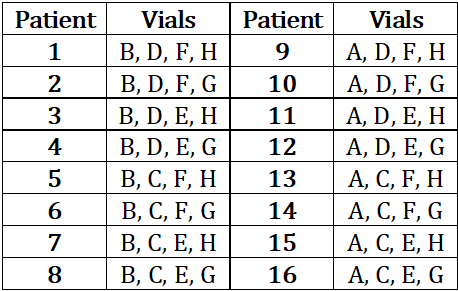
If a patient has the disease, then each vial containing his/her blood sample will test positive. If a vial tests positive, one of the patients whose blood samples were mixed in the vial has the disease. If a vial tests negative, then none of the patients whose blood samples were mixed in the vial has the disease.
Suppose vial C tests positive and vials A, E and H test negative. Which patient has the disease?
Passage / Data
Answer the next 4 questions based on the information given below.
Sixteen patients in a hospital must undergo a blood test for a disease. It is known that exactly one of them has the disease. The hospital has only eight testing kits and has decided to pool blood samples of patients into eight vials for the tests. The patients are numbered 1 through 16, and the vials are labelled A, B, C, D, E, F, G, and H. The following table shows the vials into which each patient’s blood sample is distributed.
If a patient has the disease, then each vial containing his/her blood sample will test positive. If a vial tests positive, one of the patients whose blood samples were mixed in the vial has the disease. If a vial tests negative, then none of the patients whose blood samples were mixed in the vial has the disease.
Suppose vial A tests positive and vials D and G test negative. Which of the following vials should we test next to identify the patient with the disease?
Passage / Data
Answer the next 4 questions based on the information given below.
Sixteen patients in a hospital must undergo a blood test for a disease. It is known that exactly one of them has the disease. The hospital has only eight testing kits and has decided to pool blood samples of patients into eight vials for the tests. The patients are numbered 1 through 16, and the vials are labelled A, B, C, D, E, F, G, and H. The following table shows the vials into which each patient’s blood sample is distributed.
If a patient has the disease, then each vial containing his/her blood sample will test positive. If a vial tests positive, one of the patients whose blood samples were mixed in the vial has the disease. If a vial tests negative, then none of the patients whose blood samples were mixed in the vial has the disease.
Which of the following combinations of test results is NOT possible?
Passage / Data
Answer the next 4 questions based on the information given below.
Sixteen patients in a hospital must undergo a blood test for a disease. It is known that exactly one of them has the disease. The hospital has only eight testing kits and has decided to pool blood samples of patients into eight vials for the tests. The patients are numbered 1 through 16, and the vials are labelled A, B, C, D, E, F, G, and H. The following table shows the vials into which each patient’s blood sample is distributed.
If a patient has the disease, then each vial containing his/her blood sample will test positive. If a vial tests positive, one of the patients whose blood samples were mixed in the vial has the disease. If a vial tests negative, then none of the patients whose blood samples were mixed in the vial has the disease.
Suppose one of the lab assistants accidentally mixed two patients' blood samples before they were distributed to the vials. Which of the following correctly represents the set of all possible numbers of positive test results out of the eight vials?
Passage / Data
Answer the following question based on the information given below.
Princess, Queen, Rani and Samragni were the four finalists in a dance competition. Ashman, Badal, Gagan and Dyu were the four music composers who individually assigned items to the dancers. Each dancer had to individually perform in two dance items assigned by the different composers. The first items performed by the four dancers were all assigned by different music composers. No dancer performed her second item before the performance of the first item by any other dancers. The dancers performed their second items in the same sequence of their performance of their first items.
The following additional facts are known.i) No composer who assigned item to Princess, assigned any item to Queen.
ii) No composer who assigned item to Rani, assigned any item to Samragni.
iii) The first performance was by Princess; this item was assigned by Badal.
iv) The last performance was by Rani; this item was assigned by Gagan.
v) The items assigned by Ashman were performed consecutively. The number of performances between items assigned by each of the remaining composers was the same.
Which of the following is true?
Passage / Data
Answer the following question based on the information given below.
Princess, Queen, Rani and Samragni were the four finalists in a dance competition. Ashman, Badal, Gagan and Dyu were the four music composers who individually assigned items to the dancers. Each dancer had to individually perform in two dance items assigned by the different composers. The first items performed by the four dancers were all assigned by different music composers. No dancer performed her second item before the performance of the first item by any other dancers. The dancers performed their second items in the same sequence of their performance of their first items.
The following additional facts are known.i) No composer who assigned item to Princess, assigned any item to Queen.
ii) No composer who assigned item to Rani, assigned any item to Samragni.
iii) The first performance was by Princess; this item was assigned by Badal.
iv) The last performance was by Rani; this item was assigned by Gagan.
v) The items assigned by Ashman were performed consecutively. The number of performances between items assigned by each of the remaining composers was the same.
Which of the following is FALSE?
Passage / Data
Answer the following question based on the information given below.
Princess, Queen, Rani and Samragni were the four finalists in a dance competition. Ashman, Badal, Gagan and Dyu were the four music composers who individually assigned items to the dancers. Each dancer had to individually perform in two dance items assigned by the different composers. The first items performed by the four dancers were all assigned by different music composers. No dancer performed her second item before the performance of the first item by any other dancers. The dancers performed their second items in the same sequence of their performance of their first items.
The following additional facts are known.i) No composer who assigned item to Princess, assigned any item to Queen.
ii) No composer who assigned item to Rani, assigned any item to Samragni.
iii) The first performance was by Princess; this item was assigned by Badal.
iv) The last performance was by Rani; this item was assigned by Gagan.
v) The items assigned by Ashman were performed consecutively. The number of performances between items assigned by each of the remaining composers was the same.
The sixth performance was composed by
Passage / Data
Answer the following question based on the information given below.
Princess, Queen, Rani and Samragni were the four finalists in a dance competition. Ashman, Badal, Gagan and Dyu were the four music composers who individually assigned items to the dancers. Each dancer had to individually perform in two dance items assigned by the different composers. The first items performed by the four dancers were all assigned by different music composers. No dancer performed her second item before the performance of the first item by any other dancers. The dancers performed their second items in the same sequence of their performance of their first items.
The following additional facts are known.i) No composer who assigned item to Princess, assigned any item to Queen.
ii) No composer who assigned item to Rani, assigned any item to Samragni.
iii) The first performance was by Princess; this item was assigned by Badal.
iv) The last performance was by Rani; this item was assigned by Gagan.
v) The items assigned by Ashman were performed consecutively. The number of performances between items assigned by each of the remaining composers was the same.
Which pair of performances were composed by the same composer?
Passage / Data
Answer the following questions based on the information given below.
The first year students in a business school are split into six sections. In 2019 the Business Statistics course was taught in these six sections by Annie, Beti, Chetan, Dave, Esha, and Fakir. All six sections had a common midterm (MT) and a common endterm (ET) worth 100 marks each. ET contained more questions than MT. Questions for MT and ET were prepared collectively by the six faculty members. Considering MT and ET together, each faculty member prepared the same number of questions.
Each of MT and ET had at least four questions that were worth 5 marks, at least three questions that were worth 10 marks, and at least two questions that were worth 15 marks. In both MT and ET, all the 5-mark questions preceded the 10-mark questions, and all the 15- mark questions followed the 10-mark questions.
The following additional facts are known.
- Annie prepared the fifth question for both MT and ET. For MT, this question carried 5 marks.
- Annie prepared one question for MT. Every other faculty member prepared more than one questions for MT.
- All questions prepared by a faculty member appeared consecutively in MT as well as ET
- Chetan prepared the third question in both MT and ET; and Esha prepared the eighth question in both.
- Fakir prepared the first question of MT and the last one in ET. Dave prepared the last question of MT and the first one in ET.
The second question in ET was prepared by:
Passage / Data
Answer the following questions based on the information given below.
The first year students in a business school are split into six sections. In 2019 the Business Statistics course was taught in these six sections by Annie, Beti, Chetan, Dave, Esha, and Fakir. All six sections had a common midterm (MT) and a common endterm (ET) worth 100 marks each. ET contained more questions than MT. Questions for MT and ET were prepared collectively by the six faculty members. Considering MT and ET together, each faculty member prepared the same number of questions.
Each of MT and ET had at least four questions that were worth 5 marks, at least three questions that were worth 10 marks, and at least two questions that were worth 15 marks. In both MT and ET, all the 5-mark questions preceded the 10-mark questions, and all the 15- mark questions followed the 10-mark questions.
The following additional facts are known.
- Annie prepared the fifth question for both MT and ET. For MT, this question carried 5 marks.
- Annie prepared one question for MT. Every other faculty member prepared more than one questions for MT.
- All questions prepared by a faculty member appeared consecutively in MT as well as ET
- Chetan prepared the third question in both MT and ET; and Esha prepared the eighth question in both.
- Fakir prepared the first question of MT and the last one in ET. Dave prepared the last question of MT and the first one in ET.
How many 5‐mark questions were there in MT and ET combined?
Passage / Data
Answer the following questions based on the information given below.
The first year students in a business school are split into six sections. In 2019 the Business Statistics course was taught in these six sections by Annie, Beti, Chetan, Dave, Esha, and Fakir. All six sections had a common midterm (MT) and a common endterm (ET) worth 100 marks each. ET contained more questions than MT. Questions for MT and ET were prepared collectively by the six faculty members. Considering MT and ET together, each faculty member prepared the same number of questions.
Each of MT and ET had at least four questions that were worth 5 marks, at least three questions that were worth 10 marks, and at least two questions that were worth 15 marks. In both MT and ET, all the 5-mark questions preceded the 10-mark questions, and all the 15- mark questions followed the 10-mark questions.
The following additional facts are known.
- Annie prepared the fifth question for both MT and ET. For MT, this question carried 5 marks.
- Annie prepared one question for MT. Every other faculty member prepared more than one questions for MT.
- All questions prepared by a faculty member appeared consecutively in MT as well as ET
- Chetan prepared the third question in both MT and ET; and Esha prepared the eighth question in both.
- Fakir prepared the first question of MT and the last one in ET. Dave prepared the last question of MT and the first one in ET.
Who prepared 15-mark questions for MT and ET?
Passage / Data
Answer the following questions based on the information given below.
The first year students in a business school are split into six sections. In 2019 the Business Statistics course was taught in these six sections by Annie, Beti, Chetan, Dave, Esha, and Fakir. All six sections had a common midterm (MT) and a common endterm (ET) worth 100 marks each. ET contained more questions than MT. Questions for MT and ET were prepared collectively by the six faculty members. Considering MT and ET together, each faculty member prepared the same number of questions.
Each of MT and ET had at least four questions that were worth 5 marks, at least three questions that were worth 10 marks, and at least two questions that were worth 15 marks. In both MT and ET, all the 5-mark questions preceded the 10-mark questions, and all the 15- mark questions followed the 10-mark questions.
The following additional facts are known.
- Annie prepared the fifth question for both MT and ET. For MT, this question carried 5 marks.
- Annie prepared one question for MT. Every other faculty member prepared more than one questions for MT.
- All questions prepared by a faculty member appeared consecutively in MT as well as ET
- Chetan prepared the third question in both MT and ET; and Esha prepared the eighth question in both.
- Fakir prepared the first question of MT and the last one in ET. Dave prepared the last question of MT and the first one in ET.
Which of the following questions did Beti prepare in ET?
Passage / Data
Answer the following questions based on the information given below.
Three doctors, Dr. Ben, Dr. Kane and Dr. Wayne visit a particular clinic Monday to Saturday to see patients. Dr. Ben sees each patient for 10 minutes and charges Rs. 100/-. Dr. Kane sees each patient for 15 minutes and charges Rs. 200/-, while Dr. Wayne sees each patient for 25 minutes and charges Rs. 300/-.
The clinic has three rooms numbered 1, 2 and 3 which are assigned to the three doctors as per the following table.
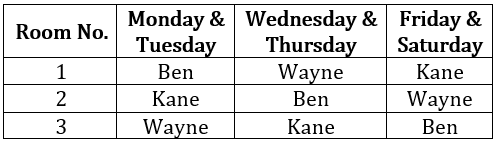
The clinic is open from 9 a.m. to 11.30 a.m. every Monday to Saturday.
On arrival each patient is handed a numbered token indicating their position in the queue, starting with token number 1 every day. As soon as any doctor becomes free, the next patient in the queue enters that emptied room for consultation. If at any time, more than one room is free then the waiting patient enters the room with the smallest number. For example, if the next two patients in the queue have token numbers 7 and 8 and if rooms numbered 1 and 3 are free, then patient with token number 7 enters room number 1 and patient with token number 8 enters room number 3.
What is the maximum number of patients that the clinic can cater to on any single day?
Passage / Data
Answer the following questions based on the information given below.
Three doctors, Dr. Ben, Dr. Kane and Dr. Wayne visit a particular clinic Monday to Saturday to see patients. Dr. Ben sees each patient for 10 minutes and charges Rs. 100/-. Dr. Kane sees each patient for 15 minutes and charges Rs. 200/-, while Dr. Wayne sees each patient for 25 minutes and charges Rs. 300/-.
The clinic has three rooms numbered 1, 2 and 3 which are assigned to the three doctors as per the following table.
The clinic is open from 9 a.m. to 11.30 a.m. every Monday to Saturday.
On arrival each patient is handed a numbered token indicating their position in the queue, starting with token number 1 every day. As soon as any doctor becomes free, the next patient in the queue enters that emptied room for consultation. If at any time, more than one room is free then the waiting patient enters the room with the smallest number. For example, if the next two patients in the queue have token numbers 7 and 8 and if rooms numbered 1 and 3 are free, then patient with token number 7 enters room number 1 and patient with token number 8 enters room number 3.
The queue is never empty on one particular Saturday. Which of the three doctors would earn the maximum amount in consultation charges on that day?
Passage / Data
Answer the following questions based on the information given below.
Three doctors, Dr. Ben, Dr. Kane and Dr. Wayne visit a particular clinic Monday to Saturday to see patients. Dr. Ben sees each patient for 10 minutes and charges Rs. 100/-. Dr. Kane sees each patient for 15 minutes and charges Rs. 200/-, while Dr. Wayne sees each patient for 25 minutes and charges Rs. 300/-.
The clinic has three rooms numbered 1, 2 and 3 which are assigned to the three doctors as per the following table.
The clinic is open from 9 a.m. to 11.30 a.m. every Monday to Saturday.
On arrival each patient is handed a numbered token indicating their position in the queue, starting with token number 1 every day. As soon as any doctor becomes free, the next patient in the queue enters that emptied room for consultation. If at any time, more than one room is free then the waiting patient enters the room with the smallest number. For example, if the next two patients in the queue have token numbers 7 and 8 and if rooms numbered 1 and 3 are free, then patient with token number 7 enters room number 1 and patient with token number 8 enters room number 3.
Mr. Singh visited the clinic on Monday, Wednesday, and Friday of a particular week, arriving at 8:50 a.m. on each of the three days. His token number was 13 on all three days. On which day was he at the clinic for the maximum duration?
Passage / Data
Answer the following questions based on the information given below.
Three doctors, Dr. Ben, Dr. Kane and Dr. Wayne visit a particular clinic Monday to Saturday to see patients. Dr. Ben sees each patient for 10 minutes and charges Rs. 100/-. Dr. Kane sees each patient for 15 minutes and charges Rs. 200/-, while Dr. Wayne sees each patient for 25 minutes and charges Rs. 300/-.
The clinic has three rooms numbered 1, 2 and 3 which are assigned to the three doctors as per the following table.
The clinic is open from 9 a.m. to 11.30 a.m. every Monday to Saturday.
On arrival each patient is handed a numbered token indicating their position in the queue, starting with token number 1 every day. As soon as any doctor becomes free, the next patient in the queue enters that emptied room for consultation. If at any time, more than one room is free then the waiting patient enters the room with the smallest number. For example, if the next two patients in the queue have token numbers 7 and 8 and if rooms numbered 1 and 3 are free, then patient with token number 7 enters room number 1 and patient with token number 8 enters room number 3.
On a slow Thursday, only two patients are waiting at 9 a.m. After that two patients keep arriving at exact 15 minute intervals starting at 9:15 a.m. -- i.e. at 9:15 a.m., 9:30 a.m., 9:45 a.m. etc. Then the total duration in minutes when all three doctors are simultaneously free is
Passage / Data
Answer the following question based on the information given below.
Twenty four people are part of three committees which are to look at research, teaching, and administration respectively. No two committees have any member in common. No two committees are of the same size. Each committee has three types of people: bureaucrats, educationalists, and politicians, with at least one from each of the three types in each committee. The following facts are also known about the committees:
- The numbers of bureaucrats in the research and teaching committees are equal, while the number of bureaucrats in the research committee is 75% of the number of bureaucrats in the administration committee.
- The number of educationalists in the teaching committee is less than the number of educationalists in the research committee. The number of educationalists in the research committee is the average of the numbers of educationalists in the other two committees.
- 60% of the politicians are in the administration committee, and 20% are in the teachingcommittee.
Based on the given information, which of the following statements MUST be FALSE?
Passage / Data
Answer the following question based on the information given below.
Twenty four people are part of three committees which are to look at research, teaching, and administration respectively. No two committees have any member in common. No two committees are of the same size. Each committee has three types of people: bureaucrats, educationalists, and politicians, with at least one from each of the three types in each committee. The following facts are also known about the committees:
- The numbers of bureaucrats in the research and teaching committees are equal, while the number of bureaucrats in the research committee is 75% of the number of bureaucrats in the administration committee.
- The number of educationalists in the teaching committee is less than the number of educationalists in the research committee. The number of educationalists in the research committee is the average of the numbers of educationalists in the other two committees.
- 60% of the politicians are in the administration committee, and 20% are in the teachingcommittee.
What is the number of bureaucrats in the administration committee?
Passage / Data
Answer the following question based on the information given below.
Twenty four people are part of three committees which are to look at research, teaching, and administration respectively. No two committees have any member in common. No two committees are of the same size. Each committee has three types of people: bureaucrats, educationalists, and politicians, with at least one from each of the three types in each committee. The following facts are also known about the committees:
- The numbers of bureaucrats in the research and teaching committees are equal, while the number of bureaucrats in the research committee is 75% of the number of bureaucrats in the administration committee.
- The number of educationalists in the teaching committee is less than the number of educationalists in the research committee. The number of educationalists in the research committee is the average of the numbers of educationalists in the other two committees.
- 60% of the politicians are in the administration committee, and 20% are in the teachingcommittee.
What is the number of educationalists in the research committee?
Passage / Data
Answer the following question based on the information given below.
Twenty four people are part of three committees which are to look at research, teaching, and administration respectively. No two committees have any member in common. No two committees are of the same size. Each committee has three types of people: bureaucrats, educationalists, and politicians, with at least one from each of the three types in each committee. The following facts are also known about the committees:
- The numbers of bureaucrats in the research and teaching committees are equal, while the number of bureaucrats in the research committee is 75% of the number of bureaucrats in the administration committee.
- The number of educationalists in the teaching committee is less than the number of educationalists in the research committee. The number of educationalists in the research committee is the average of the numbers of educationalists in the other two committees.
- 60% of the politicians are in the administration committee, and 20% are in the teachingcommittee.
Which of the following CANNOT be determined uniquely based on the given information?
Passage / Data
Answer the following question based on the information given below.
Adriana, Bandita, Chitra, and Daisy are four female students, and Amit, Barun, Chetan, and Deb are four male students. Each of them studies in one of three institutes - X, Y, and Z. Each student majors in one subject among Marketing, Operations, and Finance, and minors in a different one among these three subjects. The following facts are known about the eight students:
- Three students are from X, three are from Y, and the remaining two students, both female, are from Z.
- Both the male students from Y minor in Finance, while the female student from Y majors in Operations.
- Only one male student majors in Operations, while three female students minor in Marketing.
- One female and two male students major in Finance.
- Adriana and Deb are from the same institute. Daisy and Amit are from the same institute.
- Barun is from Y and majors in Operations. Chetan is from X and majors in Finance.
- Daisy minors in Operations.
Who are the students from the institute Z?
Passage / Data
Answer the following question based on the information given below.
Adriana, Bandita, Chitra, and Daisy are four female students, and Amit, Barun, Chetan, and Deb are four male students. Each of them studies in one of three institutes - X, Y, and Z. Each student majors in one subject among Marketing, Operations, and Finance, and minors in a different one among these three subjects. The following facts are known about the eight students:
- Three students are from X, three are from Y, and the remaining two students, both female, are from Z.
- Both the male students from Y minor in Finance, while the female student from Y majors in Operations.
- Only one male student majors in Operations, while three female students minor in Marketing.
- One female and two male students major in Finance.
- Adriana and Deb are from the same institute. Daisy and Amit are from the same institute.
- Barun is from Y and majors in Operations. Chetan is from X and majors in Finance.
- Daisy minors in Operations.
Which subject does Deb minor in?
Passage / Data
Answer the following question based on the information given below.
Adriana, Bandita, Chitra, and Daisy are four female students, and Amit, Barun, Chetan, and Deb are four male students. Each of them studies in one of three institutes - X, Y, and Z. Each student majors in one subject among Marketing, Operations, and Finance, and minors in a different one among these three subjects. The following facts are known about the eight students:
- Three students are from X, three are from Y, and the remaining two students, both female, are from Z.
- Both the male students from Y minor in Finance, while the female student from Y majors in Operations.
- Only one male student majors in Operations, while three female students minor in Marketing.
- One female and two male students major in Finance.
- Adriana and Deb are from the same institute. Daisy and Amit are from the same institute.
- Barun is from Y and majors in Operations. Chetan is from X and majors in Finance.
- Daisy minors in Operations.
Which subject does Amit major in?
Passage / Data
Answer the following question based on the information given below.
Adriana, Bandita, Chitra, and Daisy are four female students, and Amit, Barun, Chetan, and Deb are four male students. Each of them studies in one of three institutes - X, Y, and Z. Each student majors in one subject among Marketing, Operations, and Finance, and minors in a different one among these three subjects. The following facts are known about the eight students:
- Three students are from X, three are from Y, and the remaining two students, both female, are from Z.
- Both the male students from Y minor in Finance, while the female student from Y majors in Operations.
- Only one male student majors in Operations, while three female students minor in Marketing.
- One female and two male students major in Finance.
- Adriana and Deb are from the same institute. Daisy and Amit are from the same institute.
- Barun is from Y and majors in Operations. Chetan is from X and majors in Finance.
- Daisy minors in Operations.
If Chitra majors in Finance, which subject does Bandita major in?
Passage / Data
Answer the following question based on the information given below.
Fuel contamination levels at each of 20 petrol pumps P1, P2, …, P20 were recorded as either high, medium, or low.
- Contamination levels at three pumps among P1 – P5 were recorded as high.
- P6 was the only pump among P1 – P10 where the contamination level was recorded as low.
- P7 and P8 were the only two consecutively numbered pumps where the same levels of contamination were recorded.
- High contamination levels were not recorded at any of the pumps P16 – P20.
- The number of pumps where high contamination levels were recorded was twice the number of pumps where low contamination levels were recorded.
Which of the following MUST be true?
Passage / Data
Answer the following question based on the information given below.
Fuel contamination levels at each of 20 petrol pumps P1, P2, …, P20 were recorded as either high, medium, or low.
- Contamination levels at three pumps among P1 – P5 were recorded as high.
- P6 was the only pump among P1 – P10 where the contamination level was recorded as low.
- P7 and P8 were the only two consecutively numbered pumps where the same levels of contamination were recorded.
- High contamination levels were not recorded at any of the pumps P16 – P20.
- The number of pumps where high contamination levels were recorded was twice the number of pumps where low contamination levels were recorded.
What best can be said about the number of pumps at which the contamination levels were recorded as medium?
Passage / Data
Answer the following question based on the information given below.
Fuel contamination levels at each of 20 petrol pumps P1, P2, …, P20 were recorded as either high, medium, or low.
- Contamination levels at three pumps among P1 – P5 were recorded as high.
- P6 was the only pump among P1 – P10 where the contamination level was recorded as low.
- P7 and P8 were the only two consecutively numbered pumps where the same levels of contamination were recorded.
- High contamination levels were not recorded at any of the pumps P16 – P20.
- The number of pumps where high contamination levels were recorded was twice the number of pumps where low contamination levels were recorded.
If the contamination level at P11 was recorded as low, then which of the following MUST be true?
Passage / Data
Answer the following question based on the information given below.
Fuel contamination levels at each of 20 petrol pumps P1, P2, …, P20 were recorded as either high, medium, or low.
- Contamination levels at three pumps among P1 – P5 were recorded as high.
- P6 was the only pump among P1 – P10 where the contamination level was recorded as low.
- P7 and P8 were the only two consecutively numbered pumps where the same levels of contamination were recorded.
- High contamination levels were not recorded at any of the pumps P16 – P20.
- The number of pumps where high contamination levels were recorded was twice the number of pumps where low contamination levels were recorded.
If contamination level at P15 was recorded as medium, then which of the following MUST be FALSE?
Passage / Data
Answer the following question based on the information given below.
Seven candidates, Akil, Balaram, Chitra, Divya, Erina, Fatima, and Ganeshan, were invited to interview for a position. Candidates were required to reach the venue before 8 am. Immediately upon arrival, they were sent to one of three interview rooms: 101, 102, and 103. The following venue log shows the arrival times for these candidates. Some of the names have not been recorded in the log and have been marked as ‘?’.

Additionally here are some statements from the candidates: Balaram: I was the third person to enter Room 101. Chitra: I was the last person to enter the room I was allotted to. Erina: I was the only person in the room I was allotted to. Fatima: Three people including Akil were already in the ro om that I was allotted to when entered it. Ganeshan : I was one among the two candidates allotted to Room 102.
What best can be said about the room to which Divya was allotted?
Passage / Data
Answer the following question based on the information given below.
Seven candidates, Akil, Balaram, Chitra, Divya, Erina, Fatima, and Ganeshan, were invited to interview for a position. Candidates were required to reach the venue before 8 am. Immediately upon arrival, they were sent to one of three interview rooms: 101, 102, and 103. The following venue log shows the arrival times for these candidates. Some of the names have not been recorded in the log and have been marked as ‘?’.
Additionally here are some statements from the candidates: Balaram: I was the third person to enter Room 101. Chitra: I was the last person to enter the room I was allotted to. Erina: I was the only person in the room I was allotted to. Fatima: Three people including Akil were already in the ro om that I was allotted to when entered it. Ganeshan : I was one among the two candidates allotted to Room 102.
Who else was in Room 102 when Ganeshan entered?
Passage / Data
Answer the following question based on the information given below.
Seven candidates, Akil, Balaram, Chitra, Divya, Erina, Fatima, and Ganeshan, were invited to interview for a position. Candidates were required to reach the venue before 8 am. Immediately upon arrival, they were sent to one of three interview rooms: 101, 102, and 103. The following venue log shows the arrival times for these candidates. Some of the names have not been recorded in the log and have been marked as ‘?’.
Additionally here are some statements from the candidates: Balaram: I was the third person to enter Room 101. Chitra: I was the last person to enter the room I was allotted to. Erina: I was the only person in the room I was allotted to. Fatima: Three people including Akil were already in the ro om that I was allotted to when entered it. Ganeshan : I was one among the two candidates allotted to Room 102.
When did Erina reach the venue?
Passage / Data
Answer the following question based on the information given below.
Seven candidates, Akil, Balaram, Chitra, Divya, Erina, Fatima, and Ganeshan, were invited to interview for a position. Candidates were required to reach the venue before 8 am. Immediately upon arrival, they were sent to one of three interview rooms: 101, 102, and 103. The following venue log shows the arrival times for these candidates. Some of the names have not been recorded in the log and have been marked as ‘?’.
Additionally here are some statements from the candidates: Balaram: I was the third person to enter Room 101. Chitra: I was the last person to enter the room I was allotted to. Erina: I was the only person in the room I was allotted to. Fatima: Three people including Akil were already in the ro om that I was allotted to when entered it. Ganeshan : I was one among the two candidates allotted to Room 102.
If Ganeshan entered the venue before Divya, when did Balaram enter the venue?
Passage / Data
Answer the following question based on the information given below.
Healthy Bites is a fast food joint serving three items: burgers, fries and ice cream. It has two employees Anish and Bani who prepare the items ordered by the clients. Preparation time is 10 minutes for a burger and 2 minutes for an order of ice cream. An employee can prepare only one of these items at a time. The fries are prepared in an automatic fryer which can prepare up to 3 portions of fries at a time, and takes 5 minutes irrespective of the number of portions. The fryer does not need an employee to constantly attend to it, and we can ignore the time taken by an employee to start and stop the fryer; thus an employee can be engaged in preparing other items while the frying is on. However fries cannot be prepared in anticipation of future orders.
Healthy Bites wishes to serve the order as early as possible. The individual items in any order are served as and when ready; however, the order is considered to be completely served only when all the items of that order are served.
The table below gives the orders of three clients and the times at which they placed their orders:

Assume that only one client’s order can be processed at any given point of time. So, Anish or Bani cannot start preparing a new order while a pervious order is being prepared. At what time is the order placed by Client 1 completely served?
Passage / Data
Answer the following question based on the information given below.
Healthy Bites is a fast food joint serving three items: burgers, fries and ice cream. It has two employees Anish and Bani who prepare the items ordered by the clients. Preparation time is 10 minutes for a burger and 2 minutes for an order of ice cream. An employee can prepare only one of these items at a time. The fries are prepared in an automatic fryer which can prepare up to 3 portions of fries at a time, and takes 5 minutes irrespective of the number of portions. The fryer does not need an employee to constantly attend to it, and we can ignore the time taken by an employee to start and stop the fryer; thus an employee can be engaged in preparing other items while the frying is on. However fries cannot be prepared in anticipation of future orders.
Healthy Bites wishes to serve the order as early as possible. The individual items in any order are served as and when ready; however, the order is considered to be completely served only when all the items of that order are served.
The table below gives the orders of three clients and the times at which they placed their orders:
Assume that only one client’s order can be processed at any given point of time. So, Anish or Bani cannot start preparing a new order while a pervious order is being prepared. At what time is the order placed by Client 3 completely served?
Passage / Data
Answer the following question based on the information given below.
Healthy Bites is a fast food joint serving three items: burgers, fries and ice cream. It has two employees Anish and Bani who prepare the items ordered by the clients. Preparation time is 10 minutes for a burger and 2 minutes for an order of ice cream. An employee can prepare only one of these items at a time. The fries are prepared in an automatic fryer which can prepare up to 3 portions of fries at a time, and takes 5 minutes irrespective of the number of portions. The fryer does not need an employee to constantly attend to it, and we can ignore the time taken by an employee to start and stop the fryer; thus an employee can be engaged in preparing other items while the frying is on. However fries cannot be prepared in anticipation of future orders.
Healthy Bites wishes to serve the order as early as possible. The individual items in any order are served as and when ready; however, the order is considered to be completely served only when all the items of that order are served.
The table below gives the orders of three clients and the times at which they placed their orders:
Suppose the employees are allowed to process multiple order at a time, but the preference would be to finish orders of clients who placed their orders earlier. At what time is the order placed by Client 2 completely served?
Passage / Data
Answer the following question based on the information given below.
Healthy Bites is a fast food joint serving three items: burgers, fries and ice cream. It has two employees Anish and Bani who prepare the items ordered by the clients. Preparation time is 10 minutes for a burger and 2 minutes for an order of ice cream. An employee can prepare only one of these items at a time. The fries are prepared in an automatic fryer which can prepare up to 3 portions of fries at a time, and takes 5 minutes irrespective of the number of portions. The fryer does not need an employee to constantly attend to it, and we can ignore the time taken by an employee to start and stop the fryer; thus an employee can be engaged in preparing other items while the frying is on. However fries cannot be prepared in anticipation of future orders.
Healthy Bites wishes to serve the order as early as possible. The individual items in any order are served as and when ready; however, the order is considered to be completely served only when all the items of that order are served.
The table below gives the orders of three clients and the times at which they placed their orders:
Suppose the employees are allowed to process multiple order at a time, but the preference would be to finish orders of clients who placed their orders earlier. Also assume that the fourth client came in only at 10:35. Between 10:00 and 10:30, for how many minutes is exactly one of the employees idle?
Passage / Data
Answer the following question based on the information given below.
There are 21 employees working in a division, out of whom 10 are special-skilled employees (SE) and the remaining are regular-skilled employees (RE). During the next five months, the division has to complete five projects every month. Out of the 25 projects, 5 projects are “challenging”’ while the remaining ones are “standard”. Each of the challenging projects has to be completed in different months. Every month, five teams – T1, T2, T3, T4 and T5, work on one project each. T1, T2, T3, T4 and T5 are allotted the challenging project in the first, second, third, fourth and fifth month, respectively. The team assigned the challenging project has one more employee than the rest.
In the first month, T1 has one more SE than T2, T2 has one more SE than T3, T3 has one more SE than T4, and T4 has one more SE than T5. Between two successive months, the composition of the teams changes as follows:
a. The team allotted the challenging project, gets two SE from the team which was allotted the challenging project in the previous month. In exchange, one RE is shifted from the former team to the latter team.
b. After the above exchange, if T1 has any SE and T5 has any RE, then one SE is shifted from T1 to T5, and one RE is shifted fromT5 to T1. Also, if T2 has any SE and T4 has any RE, then one SE is shifted from T2 to T4, and one RE is shifted from T4 to T2.
Each standard project has a total of 100 credit points, while each challenging project has 200 credit points. The credit points are equally shared between the employees included in that team.
The number of times in which the composition of team T2 and the number of times in which composition of team T4 remained unchanged in two successive months are:
Passage / Data
Answer the following question based on the information given below.
There are 21 employees working in a division, out of whom 10 are special-skilled employees (SE) and the remaining are regular-skilled employees (RE). During the next five months, the division has to complete five projects every month. Out of the 25 projects, 5 projects are “challenging”’ while the remaining ones are “standard”. Each of the challenging projects has to be completed in different months. Every month, five teams – T1, T2, T3, T4 and T5, work on one project each. T1, T2, T3, T4 and T5 are allotted the challenging project in the first, second, third, fourth and fifth month, respectively. The team assigned the challenging project has one more employee than the rest.
In the first month, T1 has one more SE than T2, T2 has one more SE than T3, T3 has one more SE than T4, and T4 has one more SE than T5. Between two successive months, the composition of the teams changes as follows:
a. The team allotted the challenging project, gets two SE from the team which was allotted the challenging project in the previous month. In exchange, one RE is shifted from the former team to the latter team.
b. After the above exchange, if T1 has any SE and T5 has any RE, then one SE is shifted from T1 to T5, and one RE is shifted fromT5 to T1. Also, if T2 has any SE and T4 has any RE, then one SE is shifted from T2 to T4, and one RE is shifted from T4 to T2.
Each standard project has a total of 100 credit points, while each challenging project has 200 credit points. The credit points are equally shared between the employees included in that team.
The number of SE in T1 and T5 for the projects in the third month are, respectively:
Passage / Data
Answer the following question based on the information given below.
There are 21 employees working in a division, out of whom 10 are special-skilled employees (SE) and the remaining are regular-skilled employees (RE). During the next five months, the division has to complete five projects every month. Out of the 25 projects, 5 projects are “challenging”’ while the remaining ones are “standard”. Each of the challenging projects has to be completed in different months. Every month, five teams – T1, T2, T3, T4 and T5, work on one project each. T1, T2, T3, T4 and T5 are allotted the challenging project in the first, second, third, fourth and fifth month, respectively. The team assigned the challenging project has one more employee than the rest.
In the first month, T1 has one more SE than T2, T2 has one more SE than T3, T3 has one more SE than T4, and T4 has one more SE than T5. Between two successive months, the composition of the teams changes as follows:
a. The team allotted the challenging project, gets two SE from the team which was allotted the challenging project in the previous month. In exchange, one RE is shifted from the former team to the latter team.
b. After the above exchange, if T1 has any SE and T5 has any RE, then one SE is shifted from T1 to T5, and one RE is shifted fromT5 to T1. Also, if T2 has any SE and T4 has any RE, then one SE is shifted from T2 to T4, and one RE is shifted from T4 to T2.
Each standard project has a total of 100 credit points, while each challenging project has 200 credit points. The credit points are equally shared between the employees included in that team.
Which of the following CANNOT be the total credit points earned by any employee from the projects?
Passage / Data
Answer the following question based on the information given below.
There are 21 employees working in a division, out of whom 10 are special-skilled employees (SE) and the remaining are regular-skilled employees (RE). During the next five months, the division has to complete five projects every month. Out of the 25 projects, 5 projects are “challenging”’ while the remaining ones are “standard”. Each of the challenging projects has to be completed in different months. Every month, five teams – T1, T2, T3, T4 and T5, work on one project each. T1, T2, T3, T4 and T5 are allotted the challenging project in the first, second, third, fourth and fifth month, respectively. The team assigned the challenging project has one more employee than the rest.
In the first month, T1 has one more SE than T2, T2 has one more SE than T3, T3 has one more SE than T4, and T4 has one more SE than T5. Between two successive months, the composition of the teams changes as follows:
a. The team allotted the challenging project, gets two SE from the team which was allotted the challenging project in the previous month. In exchange, one RE is shifted from the former team to the latter team.
b. After the above exchange, if T1 has any SE and T5 has any RE, then one SE is shifted from T1 to T5, and one RE is shifted fromT5 to T1. Also, if T2 has any SE and T4 has any RE, then one SE is shifted from T2 to T4, and one RE is shifted from T4 to T2.
Each standard project has a total of 100 credit points, while each challenging project has 200 credit points. The credit points are equally shared between the employees included in that team.
One of the employees named Aneek scored 185 points. Which of the following CANNOT be true?
Passage / Data
Directions for next 4 questions.
Funky Pizzaria was required to supply pizzas to three different parties. The total number of pizzas it had to deliver was 800, 70% of which were to be delivered to party 3 and the rest equally divided between Party 1 and Party 2.
Pizzas could be of Thin Crust (T) or Deep Dish (D) variety and come in either Normal Cheese (NC) or Extra Cheese (EC) versions. Hence, there are four types of pizzas: T-NC, T-EC, D-NC and D-EC. Partial information about proportions of T and NC pizzas ordered by the three parties is given below:
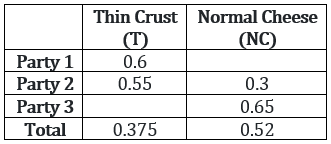
How many Thin Crust pizzas were to be delivered to Party 3?
Passage / Data
Directions for next 4 questions.
Funky Pizzaria was required to supply pizzas to three different parties. The total number of pizzas it had to deliver was 800, 70% of which were to be delivered to party 3 and the rest equally divided between Party 1 and Party 2.
Pizzas could be of Thin Crust (T) or Deep Dish (D) variety and come in either Normal Cheese (NC) or Extra Cheese (EC) versions. Hence, there are four types of pizzas: T-NC, T-EC, D-NC and D-EC. Partial information about proportions of T and NC pizzas ordered by the three parties is given below:
How many Normal Cheese pizzas were required to be delivered to Party 1?
Passage / Data
Directions for next 4 questions.
Funky Pizzaria was required to supply pizzas to three different parties. The total number of pizzas it had to deliver was 800, 70% of which were to be delivered to party 3 and the rest equally divided between Party 1 and Party 2.
Pizzas could be of Thin Crust (T) or Deep Dish (D) variety and come in either Normal Cheese (NC) or Extra Cheese (EC) versions. Hence, there are four types of pizzas: T-NC, T-EC, D-NC and D-EC. Partial information about proportions of T and NC pizzas ordered by the three parties is given below:
For Party 2, if 50% of the Normal Cheese pizzas were of Thin Crust variety, what was the difference between the numbers of T-EC and D-EC pizzas to be delivered to party 2?
Passage / Data
Directions for next 4 questions.
Funky Pizzaria was required to supply pizzas to three different parties. The total number of pizzas it had to deliver was 800, 70% of which were to be delivered to party 3 and the rest equally divided between Party 1 and Party 2.
Pizzas could be of Thin Crust (T) or Deep Dish (D) variety and come in either Normal Cheese (NC) or Extra Cheese (EC) versions. Hence, there are four types of pizzas: T-NC, T-EC, D-NC and D-EC. Partial information about proportions of T and NC pizzas ordered by the three parties is given below:
Suppose that a T-NC pizza cost as much as a D-NC pizza, but 3/5th of the price of a D-EC pizza. A D-EC pizza costs Rs. 50 more than a T-EC pizza, and the latter costs Rs. 500.
If 25% of the Normal Cheese pizzas delivered to Party 1 were of Deep Dish variety, what was the total bill for Party 1?
Passage / Data
Answer the following question based on the information given below.
There were seven elective courses - E1 to E7 – running in a specific term in a college. Each of the 300 students enrolled had chosen just one elective from among these seven. However, before the start of the term, E7 was withdrawn as the instructor concerned had left the college. The students who had opted for E7 were allowed to join any of the remaining electives. Also, the students who had chosen other electives were given one chance to change their choice. The table below captures the movement of the students from one elective to another during this process. Movement from one elective to the same elective simply means no movement. Some numbers in the table got accidentally erased; however, it is known that these were either 0 or 1.
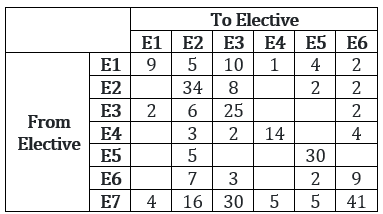
Further, the following are known:
- Before the change process there were 6 more students in E1 than in E4, but after the reshuffle, the number of students in E4 was 3 more than that in E1.
- The number of students in E2 increased by 30 after the change process.
- Before the change process, E4 and 2 more students than E6, while E2 had 10 more students than E3.
How many elective courses among E1 to E6 had a decrease in their enrollments after the change process?
Passage / Data
Answer the following question based on the information given below.
There were seven elective courses - E1 to E7 – running in a specific term in a college. Each of the 300 students enrolled had chosen just one elective from among these seven. However, before the start of the term, E7 was withdrawn as the instructor concerned had left the college. The students who had opted for E7 were allowed to join any of the remaining electives. Also, the students who had chosen other electives were given one chance to change their choice. The table below captures the movement of the students from one elective to another during this process. Movement from one elective to the same elective simply means no movement. Some numbers in the table got accidentally erased; however, it is known that these were either 0 or 1.
Further, the following are known:
- Before the change process there were 6 more students in E1 than in E4, but after the reshuffle, the number of students in E4 was 3 more than that in E1.
- The number of students in E2 increased by 30 after the change process.
- Before the change process, E4 and 2 more students than E6, while E2 had 10 more students than E3.
After the change process, which of the following is the correct sequence of number of students in the six electives E1 to E6?
Passage / Data
Answer the following question based on the information given below.
There were seven elective courses - E1 to E7 – running in a specific term in a college. Each of the 300 students enrolled had chosen just one elective from among these seven. However, before the start of the term, E7 was withdrawn as the instructor concerned had left the college. The students who had opted for E7 were allowed to join any of the remaining electives. Also, the students who had chosen other electives were given one chance to change their choice. The table below captures the movement of the students from one elective to another during this process. Movement from one elective to the same elective simply means no movement. Some numbers in the table got accidentally erased; however, it is known that these were either 0 or 1.
Further, the following are known:
- Before the change process there were 6 more students in E1 than in E4, but after the reshuffle, the number of students in E4 was 3 more than that in E1.
- The number of students in E2 increased by 30 after the change process.
- Before the change process, E4 and 2 more students than E6, while E2 had 10 more students than E3.
After the change process, which course among E1 to E6 had the largest change in its enrollment as a percentage of its original enrollment?
Passage / Data
Answer the following question based on the information given below.
There were seven elective courses - E1 to E7 – running in a specific term in a college. Each of the 300 students enrolled had chosen just one elective from among these seven. However, before the start of the term, E7 was withdrawn as the instructor concerned had left the college. The students who had opted for E7 were allowed to join any of the remaining electives. Also, the students who had chosen other electives were given one chance to change their choice. The table below captures the movement of the students from one elective to another during this process. Movement from one elective to the same elective simply means no movement. Some numbers in the table got accidentally erased; however, it is known that these were either 0 or 1.
Further, the following are known:
- Before the change process there were 6 more students in E1 than in E4, but after the reshuffle, the number of students in E4 was 3 more than that in E1.
- The number of students in E2 increased by 30 after the change process.
- Before the change process, E4 and 2 more students than E6, while E2 had 10 more students than E3.
Later, the college imposed a condition that if after the change of electives, the enrollment in any elective (other than E7) dropped to less than 20 students, all the students who had left that course will be required to re-enroll for that elective.
Which of the following is a correct sequence of electives in decreasing order of their final enrollments?
Passage / Data
Answer the following question based on the information given below.
At a management school, the oldest 10 dorms, numbered 1 to 10, need to be repaired urgently. The following diagram represents the estimated repair costs (in Rs. Crores) for the 10 dorms. For any dorm, the estimated repair cost (in Rs. Crores) in an integer. Repairs with estimated cost Rs. 1 or 2 Crores are considered light repairs, repairs with estimated cost Rs. 3 or 4 are considered moderate repairs and repairs with estimated cost Rs. 5 of 6 Crores are considered extensive repairs.
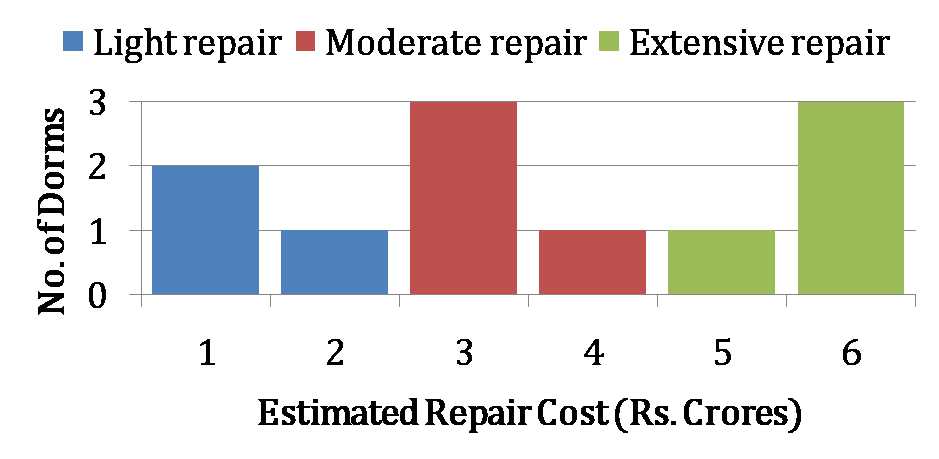
Further, the following are known:
- Odd – numbered dorms do not need light repair; even-numbered dorms do not need moderate repair and dorms, whose numbers are divisible by 3, do not need extensive repair.
- Dorms 4 to 9 all need different repair costs, with Dorm 7 needing the maximum and Dorm 8 needing the minimum.
Which of the following is NOT necessarily true?
Passage / Data
Answer the following question based on the information given below.
At a management school, the oldest 10 dorms, numbered 1 to 10, need to be repaired urgently. The following diagram represents the estimated repair costs (in Rs. Crores) for the 10 dorms. For any dorm, the estimated repair cost (in Rs. Crores) in an integer. Repairs with estimated cost Rs. 1 or 2 Crores are considered light repairs, repairs with estimated cost Rs. 3 or 4 are considered moderate repairs and repairs with estimated cost Rs. 5 of 6 Crores are considered extensive repairs.
Further, the following are known:
- Odd – numbered dorms do not need light repair; even-numbered dorms do not need moderate repair and dorms, whose numbers are divisible by 3, do not need extensive repair.
- Dorms 4 to 9 all need different repair costs, with Dorm 7 needing the maximum and Dorm 8 needing the minimum.
What is the total cost of repairing the odd-numbered dorms (in Rs. Crores)?
Passage / Data
Answer the following question based on the information given below.
At a management school, the oldest 10 dorms, numbered 1 to 10, need to be repaired urgently. The following diagram represents the estimated repair costs (in Rs. Crores) for the 10 dorms. For any dorm, the estimated repair cost (in Rs. Crores) in an integer. Repairs with estimated cost Rs. 1 or 2 Crores are considered light repairs, repairs with estimated cost Rs. 3 or 4 are considered moderate repairs and repairs with estimated cost Rs. 5 of 6 Crores are considered extensive repairs.
Further, the following are known:
- Odd – numbered dorms do not need light repair; even-numbered dorms do not need moderate repair and dorms, whose numbers are divisible by 3, do not need extensive repair.
- Dorms 4 to 9 all need different repair costs, with Dorm 7 needing the maximum and Dorm 8 needing the minimum.
Suppose further that:
- 4 of the 10 dorms needing repair are women’s dorms and need a total of Rs. 20 Crores for repair.
- Only one of Dorms 1 to 5 is a women’s dorm.
What is the cost for repairing Dorm 9 (in Rs. Crores)?
Passage / Data
Answer the following question based on the information given below.
At a management school, the oldest 10 dorms, numbered 1 to 10, need to be repaired urgently. The following diagram represents the estimated repair costs (in Rs. Crores) for the 10 dorms. For any dorm, the estimated repair cost (in Rs. Crores) in an integer. Repairs with estimated cost Rs. 1 or 2 Crores are considered light repairs, repairs with estimated cost Rs. 3 or 4 are considered moderate repairs and repairs with estimated cost Rs. 5 of 6 Crores are considered extensive repairs.
Further, the following are known:
- Odd – numbered dorms do not need light repair; even-numbered dorms do not need moderate repair and dorms, whose numbers are divisible by 3, do not need extensive repair.
- Dorms 4 to 9 all need different repair costs, with Dorm 7 needing the maximum and Dorm 8 needing the minimum.
Suppose further that:
- 4 of the 10 dorms needing repair are women’s dorms and need a total of Rs. 20 Crores for repair.
- Only one of Dorms 1 to 5 is a women’s dorm.
Which of the following is a women’s dorm?
Passage / Data
Answer the following question based on the information given below.
A, B, C, D, E, and F are a group of friends. There are two housewives, one professor, one engineer, one accountant and one lawyer in the group. There are only two married couples in the group. The lawyer is married to D, who is a housewife. No woman in the group is either an engineer or an accountant. C, the accountant, is married to F, who is a professor. A is married to a housewife. E is not a housewife.
Which of the following is one of the married couples?
Passage / Data
Answer the following question based on the information given below.
A, B, C, D, E, and F are a group of friends. There are two housewives, one professor, one engineer, one accountant and one lawyer in the group. There are only two married couples in the group. The lawyer is married to D, who is a housewife. No woman in the group is either an engineer or an accountant. C, the accountant, is married to F, who is a professor. A is married to a housewife. E is not a housewife.
What is E's profession?
Passage / Data
Answer the following question based on the information given below.
A, B, C, D, E, and F are a group of friends. There are two housewives, one professor, one engineer, one accountant and one lawyer in the group. There are only two married couples in the group. The lawyer is married to D, who is a housewife. No woman in the group is either an engineer or an accountant. C, the accountant, is married to F, who is a professor. A is married to a housewife. E is not a housewife.
How many members of the group are males?
Passage / Data
Answer the following question based on the information given below.
Five friends meet every morning at Sree Sagar restaurant for an idli-vada breakfast. Each consumes a different number of idlis and vadas. The number of idlis consumed are 1, 4, 5, 6, and 8, while the number of vadas consumed are 0, 1, 2, 4, and 6. Below are some more facts about who eats what and how much?
i. The number of vadas eaten by Ignesh is three times the number of vadas consumed by the person who eats four idlis.
ii. Three persons, including the one who eats four vadas, eat without chutney.
iii. Sandeep does not take any chutney.
iv. The one who eats one idli a day does not eat any vadas or chutney. Further, he is not Mukesh.
v. Daljit eats idli with chutney and also eats vada.
vi. Mukesh, who does not take chutney, eats half as many vadas as the person who eats twice as many idlis as he does.
vii. Bimal eats two more idlis than Ignesh, but Ignesh eats two more vadas than Bimal.
Which one of the following statements is true?
Passage / Data
Answer the following question based on the information given below.
Five friends meet every morning at Sree Sagar restaurant for an idli-vada breakfast. Each consumes a different number of idlis and vadas. The number of idlis consumed are 1, 4, 5, 6, and 8, while the number of vadas consumed are 0, 1, 2, 4, and 6. Below are some more facts about who eats what and how much?
i. The number of vadas eaten by Ignesh is three times the number of vadas consumed by the person who eats four idlis.
ii. Three persons, including the one who eats four vadas, eat without chutney.
iii. Sandeep does not take any chutney.
iv. The one who eats one idli a day does not eat any vadas or chutney. Further, he is not Mukesh.
v. Daljit eats idli with chutney and also eats vada.
vi. Mukesh, who does not take chutney, eats half as many vadas as the person who eats twice as many idlis as he does.
vii. Bimal eats two more idlis than Ignesh, but Ignesh eats two more vadas than Bimal.
Which of the following statements is true?
Passage / Data
Answer the following question based on the information given below.
Five friends meet every morning at Sree Sagar restaurant for an idli-vada breakfast. Each consumes a different number of idlis and vadas. The number of idlis consumed are 1, 4, 5, 6, and 8, while the number of vadas consumed are 0, 1, 2, 4, and 6. Below are some more facts about who eats what and how much?
i. The number of vadas eaten by Ignesh is three times the number of vadas consumed by the person who eats four idlis.
ii. Three persons, including the one who eats four vadas, eat without chutney.
iii. Sandeep does not take any chutney.
iv. The one who eats one idli a day does not eat any vadas or chutney. Further, he is not Mukesh.
v. Daljit eats idli with chutney and also eats vada.
vi. Mukesh, who does not take chutney, eats half as many vadas as the person who eats twice as many idlis as he does.
vii. Bimal eats two more idlis than Ignesh, but Ignesh eats two more vadas than Bimal.
Which of the following statements is true?
Passage / Data
Answer the following question based on the information given below.
The table below gives information about four different crops, their different quality categories and the regions where they are cultivated. Based on the information given in the table, answer the questions given below:
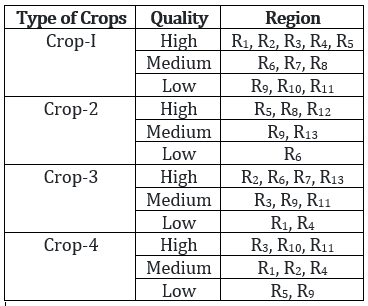
How many regions produce medium quality of Crop-1 or Crop-2 and also produce low quality of Crop-3 or Crop-4?
Passage / Data
Answer the following question based on the information given below.
The table below gives information about four different crops, their different quality categories and the regions where they are cultivated. Based on the information given in the table, answer the questions given below:
Which of the following statements is true?
Passage / Data
Answer the following question based on the information given below.
The table below gives information about four different crops, their different quality categories and the regions where they are cultivated. Based on the information given in the table, answer the questions given below:
How many low quality Crop-1 producing regions are either high quality Crop-4 producing regions or medium quality Crop-3 producing regions?
Five persons with names P, M, U, T and X live separately in any one of the following a palace, a hut, a fort, a house or a hotel. Each one likes two different colours from among the following blue, black, red, yellow and green. U likes red and blue. T likes black. The person living in a palace does not like black or blue. P likes blue and red. M likes yellow. X lives in a hotel. M lives in a
There are ten animals-two each of lion, panther, bison, bear, and deer in a zoo. The enclosures in the zoo are named X, Y, Z, P and Q and each enclosure is allotted to one of the following attendants Jack, Mohan, Shalini, Suman and Rita. Two animals of different species are housed in each enclosure. A lion and a deer cannot be together. A panther cannot be with either a deer or a bison. Suman attends to animals from among bison, deer, bear and panther only. Mohan attends to a lion and a panther. Jack does not attend to deer, lion or bison. X, Y and Z are allotted to Mohan, Jack and Rita respectively. X and Q enclosures have one animal of the same species. Z and P have the same pair of animals. The animals attended by Shalini are
Passage / Data
Directions: Answer the questions based on the following information.
A, B, C, D, E and F are a group of friends from a club. There are two housewives, one lecturer, one architect, one accountant and one lawyer in the group. There are two married couples in the group. The lawyer is married to D who is a housewife. No lady in the group is either an architect or an accountant. C, the accountant, is married to F who is a lecturer. A is married to D and E is not a housewife.
What is the profession of E?
Passage / Data
Directions: Answer the questions based on the following information.
A, B, C, D, E and F are a group of friends from a club. There are two housewives, one lecturer, one architect, one accountant and one lawyer in the group. There are two married couples in the group. The lawyer is married to D who is a housewife. No lady in the group is either an architect or an accountant. C, the accountant, is married to F who is a lecturer. A is married to D and E is not a housewife.
How many members of the group are male?
Passage / Data
Direction : Answer the questions based on the following information.
Seven university cricket players are to be honoured at a special luncheon. The players will be seated on the dais along one side of a single rectangular table.
I. A and G have to leave the luncheon early and must be seated at the extreme right end of the table, which is closest to the exit.
II. B will receive the Man of the Match Award and must be in the centre chair.
III. C and D who are bitter rivals for the position of wicketkeeper, dislike one another and should be seated as far apart as possible.
IV. E and F are best friends and want to sit together.
Which of the following may not be seated at either end of the table?
Passage / Data
Direction: Answer the questions based on the following information.
Amar, Akbar and Anthony are three friends. Only three colours are available for their shirts, viz. red, green and blue. Amar does not wear red shirt. Akbar does not wear green shirt. Anthony does not wear blue shirt.
If Akbar and Anthony wear the same colour of shirts, then which of the following is not true?
Passage / Data
Direction: Answer the questions based on the following information.
Amar, Akbar and Anthony are three friends. Only three colours are available for their shirts, viz. red, green and blue. Amar does not wear red shirt. Akbar does not wear green shirt. Anthony does not wear blue shirt.
If two of them wear the same colour, then how many of the following must be false?
I. Amar wears blue and Akbar does not wear green
II. Amar does not wear blue and Akbar wears blue
III. Amar does not wear blue and Akbar does not wear blue
IV. Amar wears green, Akbar does not wear red, Anthony does not wear green
Passage / Data
Read the text and the numbered statements carefully and answer the questions given at the end.
Four people of different nationalities live on the same side of a street in four houses each of different color. Each person has a different favorite drink. The following additional information is also known:
- The Englishman lives in the red house.
- The Italian drinks tea.
- The Norwegian lives in the first house on the left.
- In the second house from the right they drink milk.
- The Norwegian lives adjacent to the blue house.
- The Spaniard drinks fruit juice.
- Tea is drunk in the blue house.
- The white house is to the right of the red house.
The color of the Norwegian’s house is
Passage / Data
Read the text and the numbered statements carefully and answer the questions given at the end.
Four people of different nationalities live on the same side of a street in four houses each of different color. Each person has a different favorite drink. The following additional information is also known:
- The Englishman lives in the red house.
- The Italian drinks tea.
- The Norwegian lives in the first house on the left.
- In the second house from the right they drink milk.
- The Norwegian lives adjacent to the blue house.
- The Spaniard drinks fruit juice.
- Tea is drunk in the blue house.
- The white house is to the right of the red house.
Milk is drunk by
Passage / Data
Read the text and the numbered statements carefully and answer the questions given at the end.
Four people of different nationalities live on the same side of a street in four houses each of different color. Each person has a different favorite drink. The following additional information is also known:
- The Englishman lives in the red house.
- The Italian drinks tea.
- The Norwegian lives in the first house on the left.
- In the second house from the right they drink milk.
- The Norwegian lives adjacent to the blue house.
- The Spaniard drinks fruit juice.
- Tea is drunk in the blue house.
- The white house is to the right of the red house.
The Norwegian drinks
Passage / Data
Read the text and the numbered statements carefully and answer the questions given at the end.
Four people of different nationalities live on the same side of a street in four houses each of different color. Each person has a different favorite drink. The following additional information is also known:
- The Englishman lives in the red house.
- The Italian drinks tea.
- The Norwegian lives in the first house on the left.
- In the second house from the right they drink milk.
- The Norwegian lives adjacent to the blue house.
- The Spaniard drinks fruit juice.
- Tea is drunk in the blue house.
- The white house is to the right of the red house.
Which of the following is not true?